
Abstract:
Mozilla Firefox 156 was officially released today, focusing on in-depth optimization of system resource utilization, multi-task response speed, and underlying graphics architecture. The new version significantly reduces memory and CPU usage in multi-tab scenarios, and further improves modern graphics backend support for platforms such as Linux, marking a key step in the browser's balance between performance and energy efficiency.
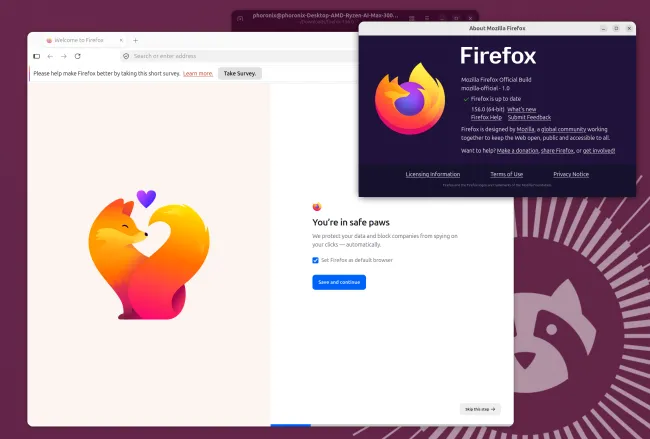
At the core performance level, Firefox 156 has systematically reconstructed the internal process management and cache recycling mechanism. For long-running or high-load scenarios with dozens of web pages open at the same time, the new version introduces more intelligent sleep and memory compaction strategies, which effectively alleviates the CPU overhead caused by memory fragmentation and unnecessary wake-up of background processes. Multiple basic benchmark tests have shown that the new version's cold start speed and complex web page rendering latency have been significantly improved, and it also helps reduce energy consumption and extend battery life on portable mobile devices.
For Linux users, Firefox 156’s performance under the Wayland Display Service Agreement has ushered in a substantial upgrade. The new version further improves Fractional Scaling support for high-score screens, eliminating interface blur and input delay issues that may occur in specific desktop environments. At the same time, the video hardware decoding function based on the Vulkan backend has gradually expanded its coverage after testing and improvement. Together with the underlying VA-API interface, it can significantly offload the soft decoding pressure on the CPU when playing 4K and 8K high-bitrate videos, providing a smoother and more stable playback experience.
In addition, Firefox 156 has also made simultaneous iterations in terms of web standards compliance and developer ecology. The new version introduces a number of the latest CSS features and WebAssembly interface extensions, and makes more comprehensive software and hardware compatible adaptations to the WebGPU specification, enabling higher execution efficiency for browser-based complex 3D applications and local lightweight model inference. The privacy and security protection module has also been updated with rules on a routine basis, patching several underlying vulnerabilities and enhancing the granularity of interception of cross-site tracking scripts.
Currently, the installation packages and source code images of Firefox 156 for each platform have been officially uploaded to Mozilla's official server. Users including Windows, macOS, and major Linux distributions can successively obtain upgrades through the in-app update channel or official sources:
https://ftp.mozilla.org/pub/firefox/releases/156.0/
Comments