
Abstract:
Smart watches can already monitor heart rate, but most products still rely on LED light sources and photoelectric sensors, which not only require batteries and electronic components, but measurement accuracy may also be affected by skin color, tattoos, and wearing position. Researchers at the Norwegian University of Science and Technology (NTNU) have now developed a completely different solution: a flexible silicone patch that does not contain batteries, wires, electronic components, or traditional sensors. As long as it is attached to the surface of the skin, it can produce subtle color changes with the heartbeat, and then read the pulse signal through an ordinary smartphone camera.
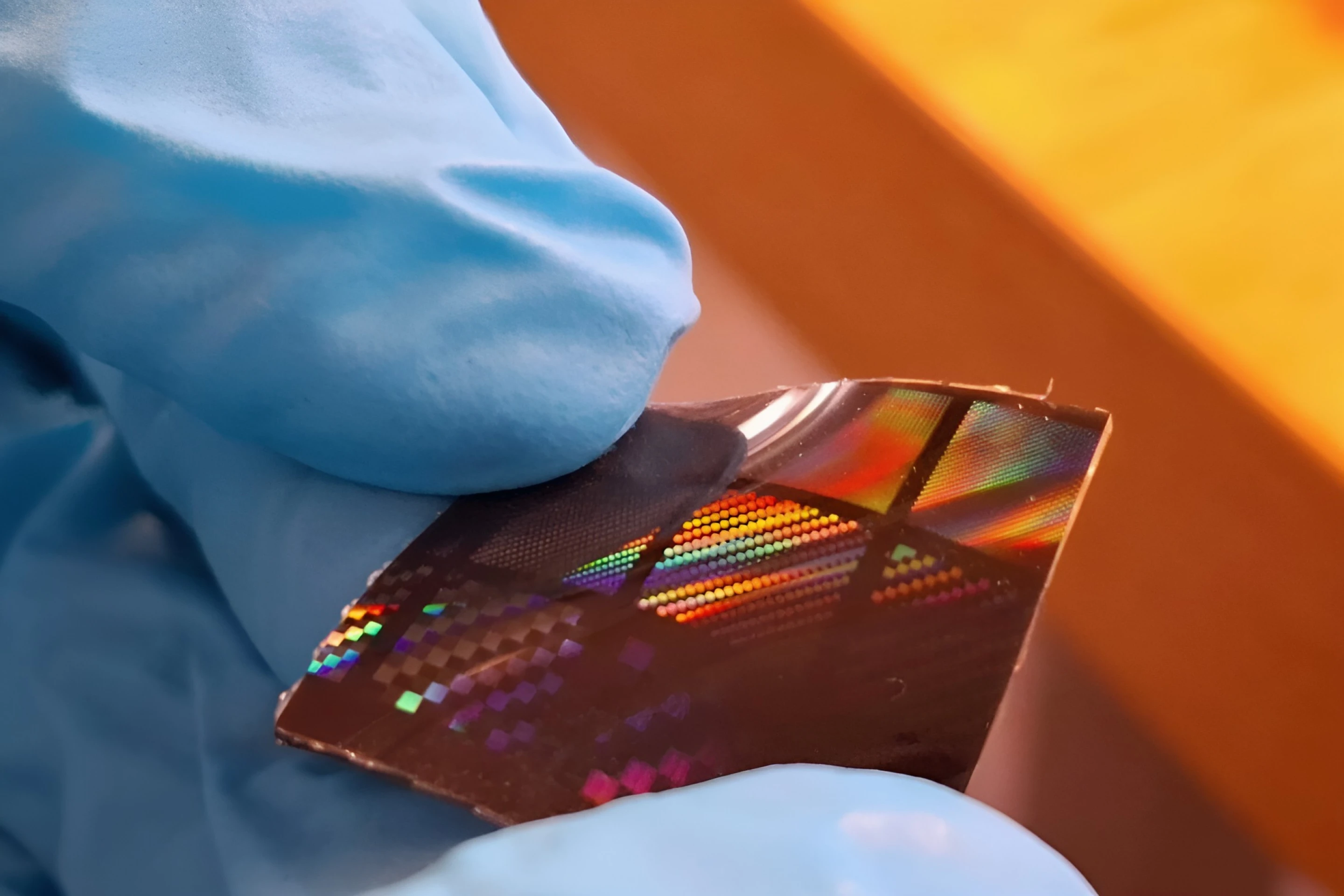
The device is called OptoPatch. Not only can it record heart rate, it can also capture details in arterial pulse waveforms, providing potential clues to assess blood vessel elasticity, the researchers said.
This research will be published in the journal "Advanced Materials" in 2026, and the paper is titled "Circuit-Free Cardiovascular Monitoring via Smartphone-Readable Skin-Interfaced Nanophotonic Films".
The most unique thing about OptoPatch is that it does not require active light emitting or electronic detection devices. It uses an optical phenomenon generated by nanostructures to directly convert the tiny mechanical movements generated when human blood vessels pulse into color changes that can be recognized by cameras.
Normally, each contraction of the heart pushes blood into the arteries, creating a pressure wave that travels along the blood vessels. The artery walls expand and contract slightly, and this movement is also transmitted to the skin tissue covering the blood vessels.
If the patch is placed close to the surface of the skin, such as the radial artery in the wrist, the blood vessel pulsation will cause the patch to stretch and rebound extremely slightly. Researchers took advantage of this phenomenon to turn pulse movements that were originally imperceptible to the naked eye into signals that can be read through color changes.
The body of the patch is made of polydimethylsiloxane (PDMS), a soft, elastic silicone rubber. Both sides of the material are processed with different micro-nano structures, each of which assumes different functions.
The upper surface of the patch is arranged with regular micro-grooves with a spacing of only hundreds to thousands of nanometers. These structures constitute a diffraction grating. When white light hits a surface, different wavelengths of light are reflected at different angles, creating a rainbow-like color effect.
This phenomenon is similar to the principle of colored reflections appearing on the back of CD discs. The densely arranged micro-grooves on the surface of the optical disc change the direction of reflection and diffraction of light, and OptoPatch makes similar structures on the surface of stretchable silicone.
When the patch is slightly stretched by the pulse, the spacing and arrangement direction between the grooves will change, thereby changing the angle, color and brightness of the reflected light. Each heartbeat produces corresponding optical changes.
It may be difficult for ordinary people to accurately identify these subtle changes with the naked eye, but smartphone cameras can continuously record the color of the patch surface. By analyzing the intensity changes of the red, green, and blue color channels in the video, the researchers were able to reconstruct the corresponding arterial pulse waveform.
The other side of the patch uses a bionic design. Inspired by octopus suckers, the researchers created a large number of micro-adsorption structures on the bottom of the silicone so that they can be firmly attached to the skin surface without having to rely on traditional adhesives.
To verify the effect of the technology, the research team recruited 13 healthy volunteers, attached OptoPatch to the radial artery on their wrists, and recorded using ordinary smartphones, including Samsung Galaxy A55 and iPhone 14. The mobile phone captures the color changes of the patch at 60 frames per second.
At the same time, the researchers also used a clinical continuous blood pressure monitoring system to record reference pulse waveforms to compare the results of the two measurement methods.
Experiments show that the pulse waveform reconstructed by OptoPatch is highly consistent with the clinical reference signal, with an average correlation coefficient of 0.94. The researchers also compared it with traditional reflection photoplethysmography (PPG), camera-based PPG, and piezoelectric pulse sensors and found that the waveforms obtained by OptoPatch were closer to clinical reference pressure signals.
More importantly, it records more than just heart rate.
Every time an arterial pulse wave propagates in a blood vessel, it is also affected by factors such as blood vessel elasticity, peripheral vascular resistance, and pressure wave reflection. The researchers found that OptoPatch was able to capture some of the subtle features inside a single pulse wave, including the timing of the reflected pressure wave.
This information can be useful in studying blood vessel stiffness. Generally speaking, as we age, the elasticity of blood vessels gradually decreases and the walls of the arteries become stiffer. Smoking, metabolic abnormalities, and other health factors may also accelerate this process.
The research team successfully identified reflected wave characteristics in 12 of 13 volunteers, indicating that this patch is expected to provide information beyond the basal heart rate measurement range. In addition, the researchers found that the patch recorded some abnormal heartbeat events that were consistent with clinical reference devices.
This technology is fundamentally different from the PPG principle currently used in smart watches.
Smart watches usually emit light to the skin through green LEDs, and then use photoelectric sensors to detect changes in reflected light caused by changes in blood flow. Because the measurement process relies on light passing through the skin and being absorbed by the tissue, skin color, tattoos, sensor location, and movement status can all affect the results.
Among them, melanin absorbs part of the light, so the measurement performance of traditional optical heart rate sensors may be different in people with different skin colors.
OptoPatch does not need to measure the changes in light passing through the skin. What it really detects is the color change that occurs on the surface of the patch itself. Human skin is only responsible for transmitting the mechanical movement generated by blood vessel pulsation to the silicone material. Therefore, this measurement method can avoid the direct influence of skin color on the optical signal.
The researchers believe this property may be particularly valuable in areas with limited medical resources. In remote areas or environments lacking professional medical equipment, medical staff only need a patch and an ordinary smartphone to obtain more detailed pulse waveform information without having to rely on expensive special equipment.
NTNU researcher Torjus Lines Steffensen said that this technology actually transfers a large number of complex functions in traditional measurement systems to smartphones. The patch itself does not require power supply or electronic components. All signal reading and subsequent analysis can be completed by the mobile phone.
However, OptoPatch is still in the experimental research stage, and there is still a lot of work to be done before it can become a real medical monitoring product.
First of all, the current experiment only involves 13 healthy volunteers, and all tests were completed with the subjects sitting and remaining still. It's unclear whether the patch can maintain the same measurement accuracy during walking, running or other body movements.
Secondly, different people’s skin thickness, subcutaneous tissue structure, and degree of contact between the patch and the skin may affect the measurement results. In the future, tests need to be conducted on more people with different ages and physical characteristics.
In addition, although the researchers successfully photographed the color changes using ordinary smartphones, signal analysis currently still needs to be completed separately through computer software. Achieving daily use will also require the development of a dedicated mobile application that can directly process the video, reconstruct the pulse waveform and display the results.
More importantly, the research team has only demonstrated that the patch can capture waveform characteristics related to blood vessel stiffness, and has not completed verification for clinical diagnosis. It also cannot directly measure blood pressure or blood oxygen saturation, nor can it replace an electrocardiogram (ECG) in monitoring the heart's electrical activity.
Therefore, OptoPatch cannot be understood as a medical device that can already diagnose cardiovascular diseases. It is currently demonstrating a new passive pulse monitoring technology. Whether it can be truly used for vascular health assessment in the future requires larger-scale clinical research.
Nevertheless, this research still provides an interesting direction: future wearable health devices may not necessarily require batteries, chips and complex sensors. By designing special functional materials, the tiny mechanical movements generated by the human body itself can also be directly converted into readable optical signals.
If follow-up research can solve the problems of dynamic measurement, long-term wearing and clinical verification, OptoPatch is expected to become a new health monitoring tool with lower cost, no need for power supply, and can be used with ordinary mobile phones.
Comments