
Abstract:
In the past, ground personnel had to wait four to five minutes for an 8K ultra-high-definition panoramic photo of the moon to be sent back from the lunar orbit. Today, the same photo can be sent in about 12 seconds. What brought about this change was the recently completed Earth-Moon two-way high-speed laser communication test. This test established a stable and high-speed laser link between the Earth and the Moon at a distance of 400,000 kilometers, which is equivalent to setting up an "information highway" between the Earth and the Moon.
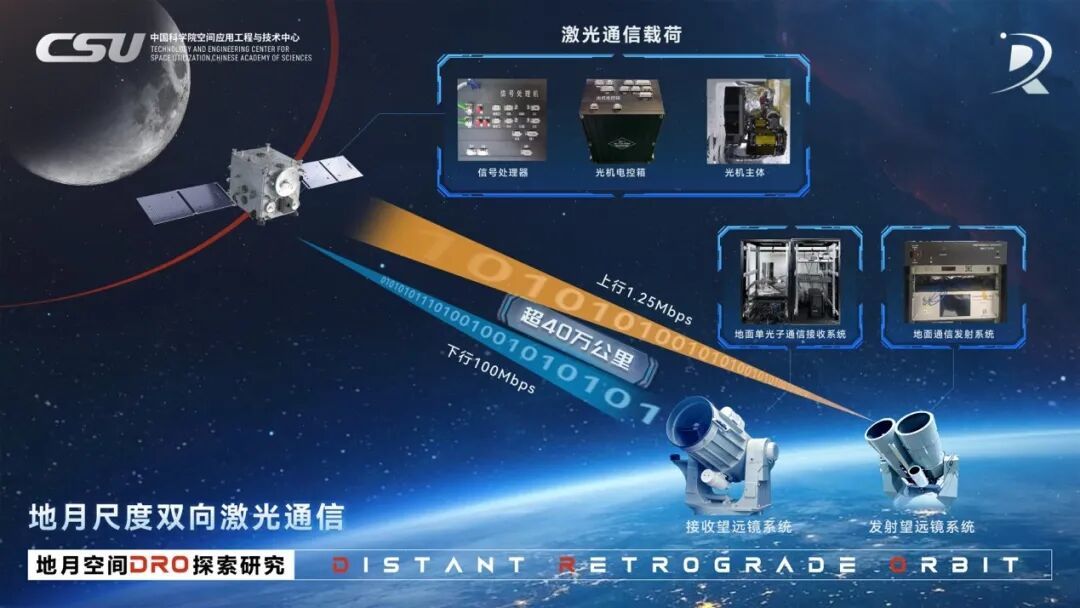
Schematic diagram of two-way laser communication on the Earth-Moon scale. Image source: Space Application Engineering and Technology Center, Chinese Academy of Sciences
What are the advantages of cis-lunar laser communications? What technical difficulties must be overcome to achieve two-way laser communication between the Earth and the Moon? What changes will follow? Focusing on these issues, on September 1, reporters from Science and Technology Daily interviewed relevant experts.
First question: What are the advantages of Earth-Moon laser communication?
Traditional radio frequency communication relies on radio waves, while laser communication uses light wave transmission, which is closer to optical fiber broadband in principle. The biggest advantages of laser communication are large bandwidth and fast speed. When the equipment installed on the satellite is similar in size, weight, and power consumption, the rate of laser communication can be 10 to 100 times faster than traditional microwave communication.
"Radio frequency is like an ordinary highway with limited lanes and easy saturation of traffic; laser is like a multi-lane highway, which can transmit a much larger amount of data in the same time." Yang Lei, a researcher at the Center for Space Application Engineering and Technology of the Chinese Academy of Sciences, explained that at the distance between the earth and the moon, traditional radio frequency communication is very difficult to transmit high-definition video or massive scientific data, while laser communication can easily do the job.
Another benefit of laser communication is that it is not easy to leak secrets. The laser beam is particularly concentrated and does not "broadcast" around like radio waves. The energy does not travel everywhere, making it difficult for others to intercept the signal halfway. "Laser is like a flashlight, shining wherever it shines. Microwave is more like a loudspeaker broadcast, with a large range, but everyone can hear it." Yang Lei said vividly.
Second question: What problems need to be overcome in 400,000 kilometers of two-way laser communication?
400,000 kilometers is equivalent to 10 times around the Earth's equator, and it takes more than 1 second for light to travel from the moon to the Earth. To achieve two-way laser communication over such a long distance, we have to overcome three hurdles: weak signal, difficulty in aiming, and slow transmission.
Although the laser beam is concentrated in a direction, it will still spread out a lot after traveling 400,000 kilometers. When it reaches the ground telescope, it may only have a little bit of what it was when it was launched, and it will become very weak. The ground receiving end must use a highly sensitive detector to "recognize" the weak photons from the background noise. "To this end, we built a superconducting nanowire single-photon detector array. It is like an ultra-sensitive 'eye' that can capture photons. It has very little noise and responds very quickly. Coupled with a self-developed signal processing algorithm, even if the signal is so weak that it is almost 'drowned' by the noise, it can be 'fished out' from a lot of interference." Yang Lei said.
At the same time, the laser beam is very narrow, the earth and the moon are constantly moving, and the satellite platform itself also vibrates slightly. Ground stations and satellites must always be precisely aligned; if they are even slightly off, the link may be broken. Yang Lei made an analogy: "This is equivalent to pointing a laser beam from Beijing at a small moving point on the moon and keeping it locked."

Image source: Visual China
In order to solve this problem, the research team came up with several ways: first, to accurately calculate the orbit of the satellite and predict the position in advance, so that the telescopes on both sides know where to point and will not miss the target; second, the ground station combines several laser beams into one and sends them out. , and then correct the direction in real time according to changes in temperature and elevation angle to ensure a stable landing on the satellite; third, strong optical isolation is made at both the transmitting and receiving ends to prevent the strong laser emitted from blinding the detector, so that the simultaneous receiving and receiving of light signals will not interfere with each other.
The signal has been received, and the transmission speed must keep up. The difficulty is that these photons do not come in a regular queue, but are sparse and intermittent. To put them together into complete information, the time must be very accurate, accurate to the picosecond level. What is the concept of picosecond? One trillionth of a second, which is countless times shorter than the time it takes you to blink your eyes. The team has specially developed picosecond-level time recognition and large-bandwidth communication processing technology, which is equivalent to assigning a super-accurate "time stamp" to each photon, so that they can be put together seamlessly without any chaos.
Question 3: How will this technology help future lunar exploration and deep space missions?
"In the future, we will build an international lunar scientific research station and carry out various scientific experiments (tests) on it. These scientific experiments (tests) will generate massive amounts of data. How the data can be transmitted back to the earth has always been a communication bottleneck that restricts the progress of scientific research. This technological breakthrough is of great significance in breaking the bottleneck." said Wang Qiang, deputy director of the Space Application Engineering and Technology Center of the Chinese Academy of Sciences.
More importantly, the distance between the earth and the moon is just the starting point. Yang Lei said that the technologies such as high-precision tracking, weak signal detection and high-speed single photon signal processing verified this time can be further extended to Mars, asteroids and even further deep space missions, and will effectively support my country's deep space exploration to achieve more original scientific results.
Comments