
Abstract:
Raspberry Pi officially released the Smart Display Module, a $30 adapter board that can install the separately sold Compute Module 5 (CM5) into commercial monitors or projectors that are compatible with the Intel SDM standard. After the device is embedded into the screen, it can be deployed more concisely and with almost no external cables, supports 4K video playback, and is compatible with existing content management systems that support Raspberry Pi 5 or CM5.
This product is currently on sale through the Raspberry Pi global authorized dealer network. It is a relatively niche product, but the price is relatively affordable for users with relevant needs.
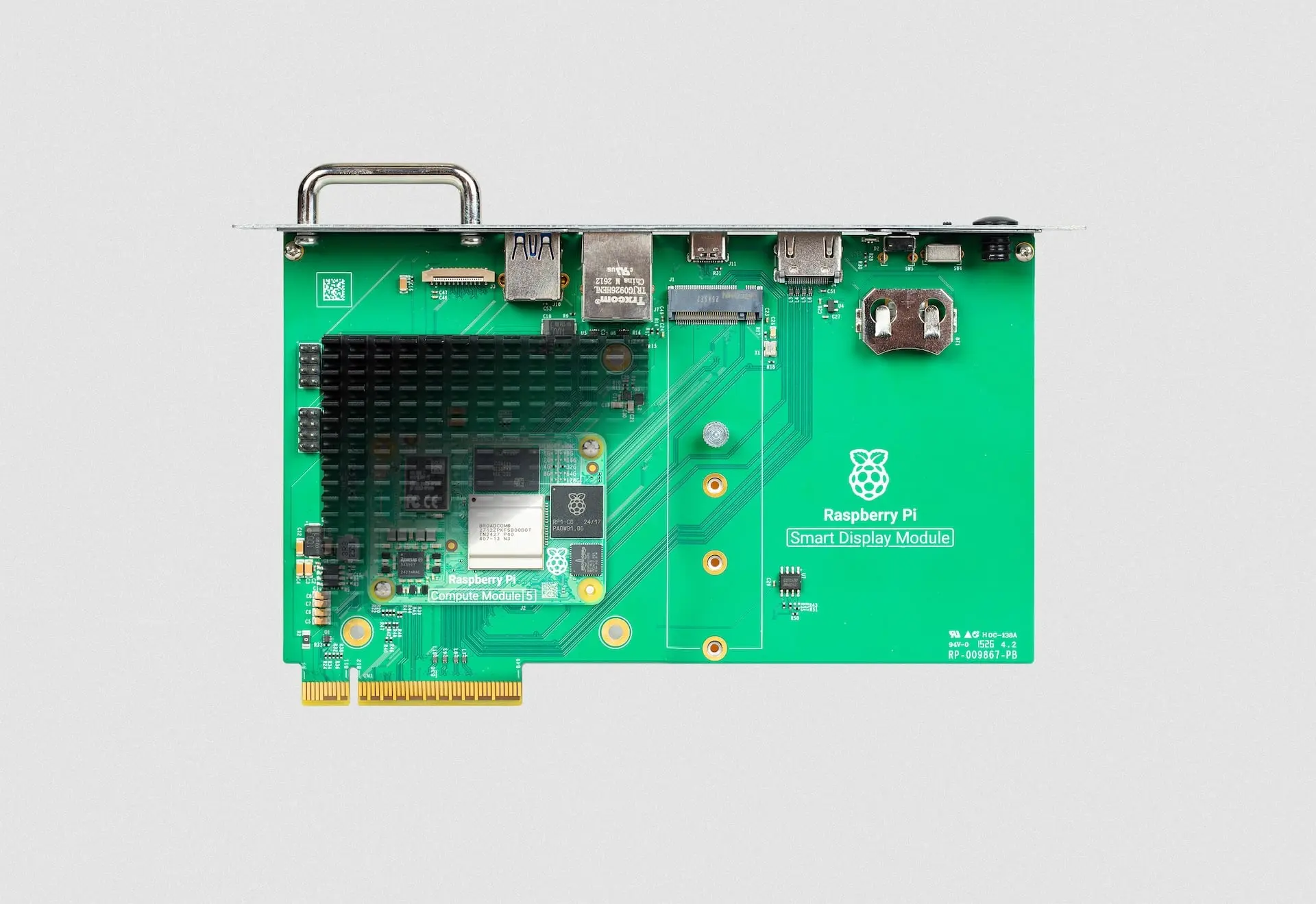
The smart display module complies with Intel SDM specifications and supports the U.FL antenna interface on CM5, which can be connected to the antenna in the Raspberry Pi antenna kit. The board also has a startup mode switch, an external power button and an LED indicator, and provides an installation location for the Raspberry Pi antenna kit. Interfaces include HDMI 2.0, USB 3.0 Type-A, USB 2.0 Type-C for programming CM5, Gigabit Ethernet RJ45, M.2 M-key PCIe slot, 22-pin MIPI DSI/CSI-2 interface, CR2032 real-time clock battery socket and CM5 slot. The M.2 slot supports 2230, 2242, 2260 and 2280 specifications and can be used for high-speed storage or used with compatible accelerators for AI computing, such as Hailo processors.
The module's Intel SDM edge connector provides HDMI 2.0, USB 3.0, two sets of I²C, universal SPI and UART interfaces. The entire board adopts a fanless and silent design, can support 7×24 hours of operation, and integrates the necessary connections for power, video, audio, data and control.
This product was jointly developed by Raspberry Pi and Sharp Display Solutions Europe. Its target applications include flight information display systems, indoor navigation and enterprise digital signage, among other scenarios that require high reliability. Early tests show that this installation method can eliminate the need for external cables, power adapters and mounting brackets. Raspberry Pi recommends that administrators and system integrators confirm local inventory availability before placing orders and verify that the display device meets relevant specifications.
The Raspberry Pi first demonstrated the module in January this year, and in February at the European Integrated Systems Show in Barcelona. At that time, it was said that the product would be launched soon. The final product was officially launched at the end of September. Although the waiting time is longer than the "coming soon" statement, it is now available for purchase by users who need this solution.
Comments