
Abstract:
After wireless headphones have dominated the market for many years, wired headphones are ushering in a new renaissance trend. After Bose and other brands re-launched wired products, Razer has officially joined the ranks and released the new Hammerhead V3 Chroma wired gaming headset, hoping to provide mobile gamers and PC users with a low-latency, high-compatibility audio experience.

Unlike traditional 3.5mm headphones, Hammerhead V3 Chroma uses a USB-C interface to connect, targeting smartphones, handheld devices and computer devices that now widely use USB-C interfaces. In order to improve the horizontal holding experience, Razer specially adopts a 90-degree bending USB-C plug design, so that the connecting cable can extend along the edge of the device, reducing interference with the holding of both hands when the mobile phone is played in horizontal screen.
The new product continues Razer’s distinctive gaming style. The outside of the headset is equipped with a luminous Razer Chroma RGB lighting system that supports approximately 16.8 million color displays. Even on wired headsets, Razer still has not given up its iconic RGB elements, allowing the product to maintain strong e-sports attributes in appearance.
In terms of audio, Hammerhead V3 Chroma uses a dual-unit design, including an 11mm dynamic driver and an independent high-frequency unit, which are respectively responsible for low-frequency and high-frequency sound performance. Razer says this architecture can deliver richer sound levels and improved detail reproduction in games, music and movies.
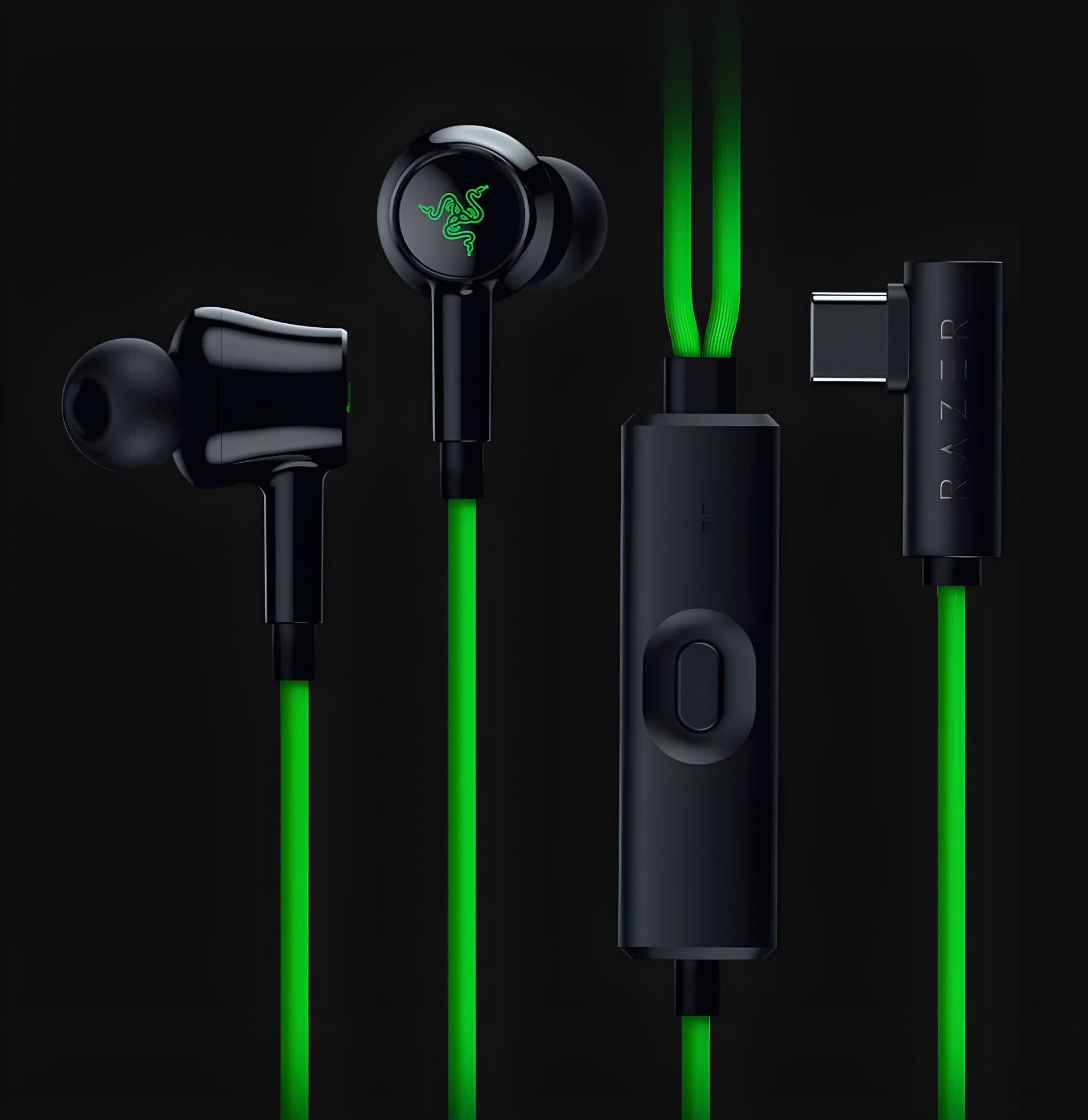
It is worth noting that this wired headset also has an active noise reduction function. With feed-forward noise reduction technology, users can reduce external noise interference when commuting, in public places or in multi-person environments. The headset wire control part integrates volume adjustment, playback control and noise reduction switching functions. Users can complete common settings adjustments without operating the device.
To meet the needs of different usage scenarios, Razer has built-in four sound effect presets for games, music, movies, and calls, and also supports user-defined equalizer settings. After connecting to a PC, users can also enable the THX 7.1 surround sound function through the Razer Synapse 4 software for a more immersive spatial audio experience.
In terms of voice function, the headset has a built-in omnidirectional microphone, which can be used for game voice, video calls and daily communication. The product also has IPX4 splash resistance, which can handle sweat and light rain environments, but it is not fully waterproof.
Compared with wireless headphones, one of the biggest advantages of Hammerhead V3 Chroma is that it does not require charging. Power supply and audio transmission are completed through USB-C cables, which avoids problems such as Bluetooth connection delays, battery aging, and battery life anxiety. At the same time, wired connections can also bypass Bluetooth audio compression, theoretically retaining more sound details.
However, wired design also means that users need to readjust to the limitations brought by cables. The cable may get caught on clothing during movement, and the range of motion may also be affected by the connection distance of the device. The 90-degree interface improves the holding experience rather than solving the binding problem of the cable itself.
Razer positions the Hammerhead V3 Chroma as a professional audio device for mobile gamers, taking into account both PC and handheld users. The product is currently on sale in global markets, priced at US$79.99 in the United States. As more and more manufacturers refocus on the wired audio market, wired headphones, which were once thought to be disappearing, are returning to consumers' horizons in the form of USB-C and e-sports designs.
Comments