
Abstract:
When humans see the world, they do not simply present the signals received by their eyes directly. Visual information is processed by multiple areas of the brain with different functions, and these areas must continuously exchange information to ultimately form a relatively unified perception result. A new study by researchers from the Cold Spring Harbor Laboratory, the University of Cambridge and University College London found that the brain may gradually form a consistent interpretation of the same information in different visual areas through a neural mechanism similar to "reaching consensus".

This study published in "Nature Neuroscience" used mice as experimental subjects, focusing on the primary visual cortex V1 and the lateral medial visual area LM. Both areas belong to the visual cortex of the brain, but the information they are responsible for processing is different, and there are bidirectional neural connections between the two, so it is not simply a one-way transmission of information from one area to the other.
The researchers found that when the neural activity patterns in the two areas, V1 and LM, were consistent with each other, the activity lasted longer; whereas when the two areas produced conflicting activity patterns, the differences quickly faded away in less than a second. This means that different areas of the brain may not process information independently, but may interact with each other to gradually weaken inconsistent information while retaining mutually recognized patterns of neural activity.
The research team calls this mechanism "consensus building." This mechanism may help the brain integrate data from different neural areas and different information channels to form a coherent overall perception.
Researchers use optical illusions as an example to explain this problem. When a person sees a blurry object in a dim environment, he may instantly recognize it as a face; an orange may be briefly seen as an apple under certain lights and angles. The visual system is not faced with a set of always clear and completely consistent information, but requires constant coordination between different interpretations. To study this coordination process, the researchers trained mice to discriminate between two visual patterns tilted at opposite angles and then rewarded the mice for only one of the patterns. During the experiment, the researchers briefly turned off neural activity in V1 or LM while recording changes in the other visual area after losing input from the partner area.
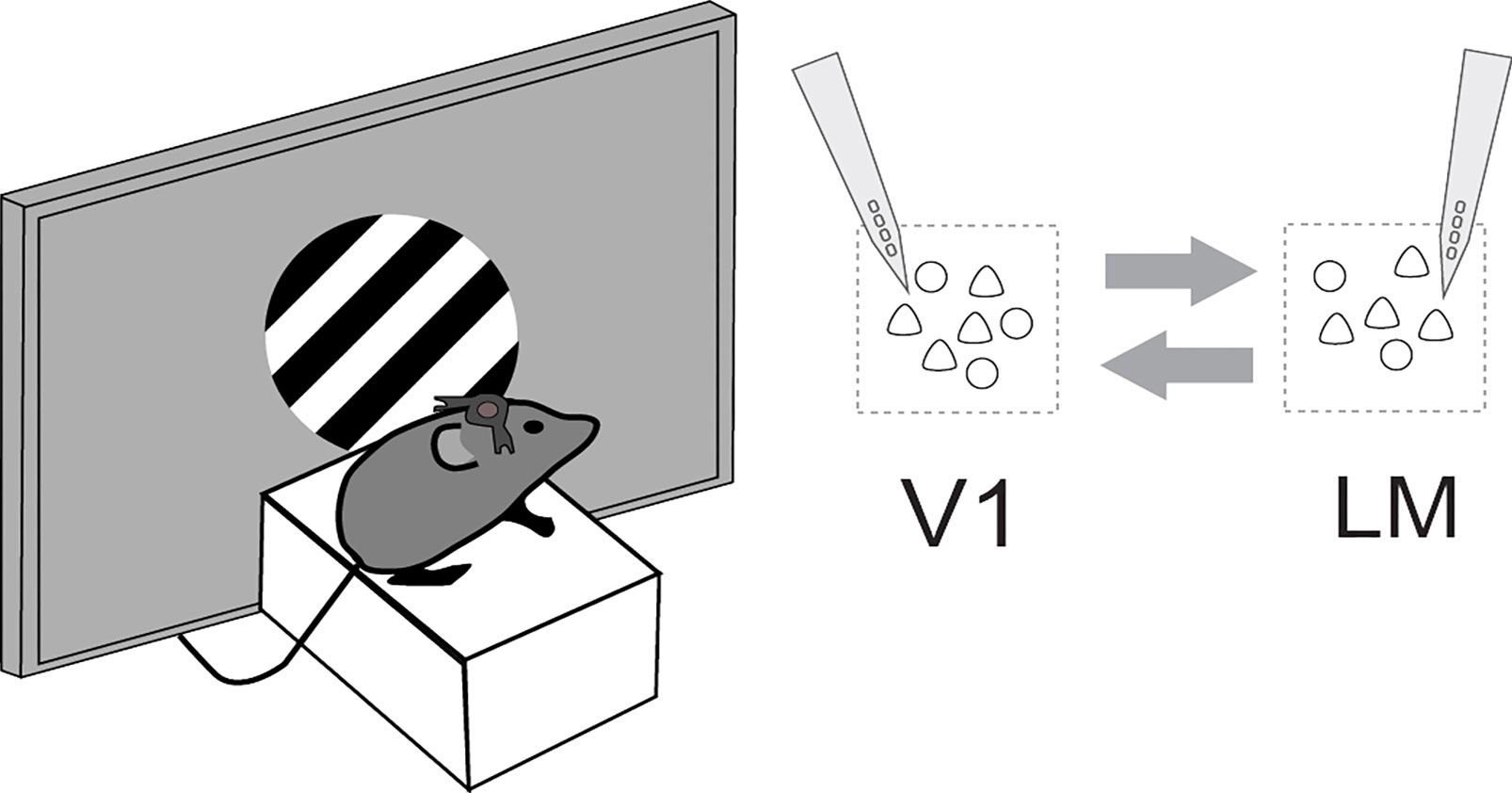
With these experimental data, the researchers further established an artificial neural network model representing the neural circuit between V1 and LM. The model is able to simulate activity in two brain regions under different visual stimuli and test how the connection between the two regions affects the duration of neural activity when specific neurons are interfered with.
The researchers ultimately discovered that the bidirectional connection between V1 and LM can dynamically change the neural activity state of the two regions. When the two parties have similar activity patterns, the relevant signals will be sustained; when the activity patterns of the two parties are inconsistent, the conflict signals will quickly weaken.
To build a more accurate model, the researchers analyzed neural activity data from 7 mice, including 194 V1 neurons and 228 LM neurons. The research team used these data to build brain region circuit models and predict activity changes under different stimulation and neural intervention conditions.
Researchers believe that this mechanism may explain a long-standing neuroscience problem: different areas in the brain are highly specialized and each receive and process different types of information, but what people ultimately obtain is a unified and coherent worldview.
In other words, the brain does not simply splice the results of multiple brain regions together, but may allow different regions to gradually "negotiate" a common explanation through continuous two-way feedback between brain regions. Rather than saying that one brain region ultimately has the absolute decision-making power, it is better to say that multiple brain regions continue to influence each other and eventually form a relatively stable common state.
However, this study has only observed two visual brain areas so far, and the experimental subjects were mice. Therefore, the researchers cannot directly prove that the human brain uses the same mechanism. The experiment also tested the mice's discrimination of different oblique visual patterns, rather than the complex visual illusions in daily life of humans.
The research team next hopes to further determine whether "consensus building" exists in a wider range of cerebral cortex areas. If this mechanism not only applies to V1 and LM, but also works generally between other brain areas, then it may become an important theoretical framework to explain how the brain integrates complex information.
Researchers are particularly concerned about information conflicts between different senses. For example, when a person sees an object moving in a direction that is inconsistent with the information provided by a sound it hears, how does the brain decide which piece of information to ultimately believe? Whether visual, auditory and other sensory systems are also coordinated through similar neural mechanisms remains to be further studied.
If this consensus-building mechanism turns out to be widespread in the cerebral cortex, it may also help scientists understand some situations in which neural systems fail to form a unified explanation. When different brain regions fail to effectively coordinate information, abnormalities in perception and cognition can result.
This research may also provide new ideas for artificial intelligence. Modern AI systems often consist of multiple specialized modules working together, and different models or modules sometimes produce different or even contradictory results for the same input. Researchers believe that the brain's mechanism of retaining mutually consistent information and quickly weakening conflicting information may inspire artificial intelligence systems to design more effective information coordination methods in the future.
The core finding of this study is not that the brain has a single area responsible for "judgment", but that different brain areas continue to interact with each other through two-way connections, gradually reducing differences in the time dimension and strengthening common activity patterns, allowing the highly specialized nervous system to eventually form a relatively unified perception result.
Comments