
Abstract:
Scientists have discovered a never-before-seen silver crystal structure that is much more chemically active than common silver. When a research team from Hokkaido University in Japan decomposed silver iodide under the action of electron beams, they observed that silver atoms were arranged in an extremely rare simple cubic manner and quickly reacted with oxygen to form silver oxide. Relevant results have been published in Nano Letters.
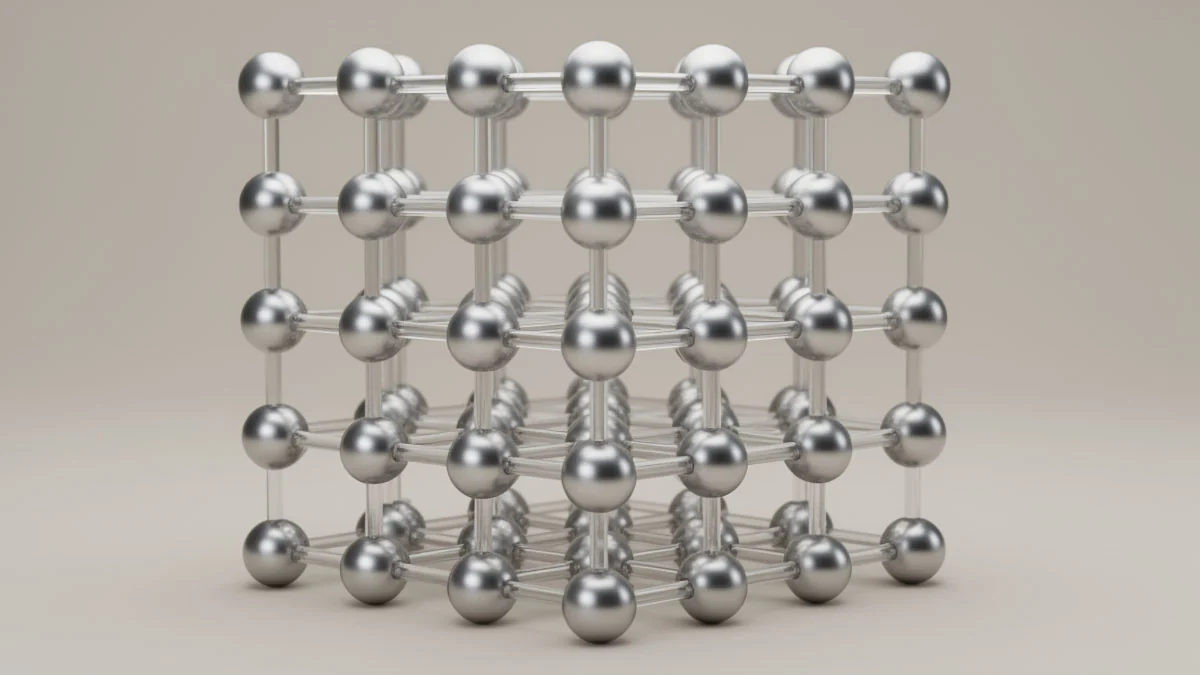
Ordinary silver usually crystallizes in a face-centered cubic structure: atoms are distributed in the eight corners of repeating cubic units and in the center of each face, forming a tight packing. Common metals such as gold, copper, and aluminum also have similar structures. The silver atoms discovered this time only occupy the corners of each repeating cubic unit, forming a simple cubic structure, and the atomic arrangement is significantly sparser.
This structure is extremely rare among pure elements. The research team said that the only pure element previously known to exist in a simple cubic structure was the radioactive element polonium; this structure was confirmed in 1966. Masaya Sakakibara, the first author of the study, said that it was surprising that such a low-density structure could be formed in a pure metal crystal. They expected that electron beam irradiation would decompose silver iodide and produce silver nanoparticles, but they did not expect that these particles would adopt a simple cubic structure.
The research team used transmission electron microscopy to conduct experiments. The device uses electrons with wavelengths shorter than visible light to resolve structures at the scale of individual atoms. While the electron beam causes the silver iodide to decompose, it also allows the researchers to observe in real time how the silver atoms reorganize and form crystals.
Nanoscale conditions are key to this discovery. When a material is only a few nanometers in size, it can briefly form crystal structures that are not stable in larger samples. Such unconventional arrangements can result in physical and chemical properties that are significantly different from conventional forms.
The researchers compared the stability of the two silver structures in a high vacuum environment. Regular face-centered cubic silver remains stable, while simple cubic silver crystals gradually become oxidized to form silver oxide. This rapid transformation directly proves that the new structure has unusually high chemical activity. Masaru Sakakibara also pointed out that simple cubic silver begins to transform into silver oxide within about 100 seconds after it is formed.
The research team believes that this technology is expected to become a method for discovering other unknown crystal structures and help people study the resulting new properties. Co-author Yuki Kimura, head of the Low Temperature Nanomaterials Science Laboratory at Hokkaido University, said that in the future the team will continue to explore the physical and chemical properties of simple cubic silver in depth and extend this method to other elements and compounds.
Comments