
Abstract:
Room temperature superconductivity has always been one of the most important research goals in condensed matter physics. If superconductivity can be achieved at ordinary ambient temperatures, it could usher in major changes in areas such as power transmission, magnetic levitation transportation, energy storage, and quantum computing. A research team from Utrecht University in the Netherlands, Leiden University in the Netherlands, and the University of Munich in Germany recently made an important progress:
They found that in some high-temperature superconducting materials, the electron pairing phenomenon necessary to form superconductivity can be maintained until room temperature. This means that the key factor that prevents materials from achieving room-temperature superconductivity may not be the inability of electrons to form pairs, but the inability of these electron pairs to move in a coordinated manner.
Superconductivity is a special physical state. When a material becomes superconducting, current can flow through it without resistance, so energy is not lost due to resistance like ordinary conductors. In 1911, scientists first discovered the phenomenon of superconductivity. However, traditional superconducting materials usually need to be cooled to extremely low temperatures to work. Many materials even require the use of liquid helium to lower the temperature to about minus 260 degrees Celsius. This expensive and complex cooling requirement severely limits the large-scale application of superconducting technology.
In the mid-1980s, scientists discovered a number of materials that could superconduct at significantly higher temperatures, some of which had a superconducting critical temperature of about minus 173 degrees Celsius. Although this temperature is still far lower than room temperature, it breaks the temperature limit of traditional superconducting materials and also raises new theoretical issues: The theories that explain traditional low-temperature superconductivity cannot fully explain why these high-temperature superconducting materials can work.
This research focuses on two indispensable conditions in the formation of superconductivity.
The first condition is electron pairing. Normally, electrons interact with each other, and in certain materials and environments, two electrons can form an associated state called a Cooper pair. This pairing is an important basis for the formation of superconductivity.
The second condition is phase coherence. Even if the electrons have formed a pair, it does not mean that the material will necessarily enter a superconducting state. The electron pairs must also form a coordinated quantum state, like partners in a dance team. Not only do each member of the pair need to work together, but all members must also maintain the same rhythm. Only when a large number of electron pairs can move together in a coordinated manner can a material exhibit true superconducting properties.
In traditional low-temperature superconducting materials, electron pairing and phase coherence usually occur together when the temperature is reduced near the critical point. But the researchers found that the two processes in high-temperature superconducting materials can be separated from each other. Electrons are able to form pairs well in advance, well above the critical temperature of superconducting, and remain in this state even at room temperature.
The research team believes that this shows that the interaction that maintains electron pairing is strong enough that even if the temperature rises to room temperature, the electron pair will not disintegrate immediately. What really limits the formation of superconductivity may be the second condition, which is whether these electron pairs can establish phase coherence.
Ingmar Swart, one of the leaders of the research and a scientist at Utrecht University, said that this discovery is of great significance because the research team has proven that one of the two key conditions required to form room temperature superconductivity can be achieved at room temperature. If electron pairing simply cannot be maintained at room temperature, then efforts to find room-temperature superconducting materials will be fundamentally limited from the outset. Now that this obstacle has been further removed, researchers can more intensively study how exactly phase coherence forms and what prevents it from emerging at higher temperatures.
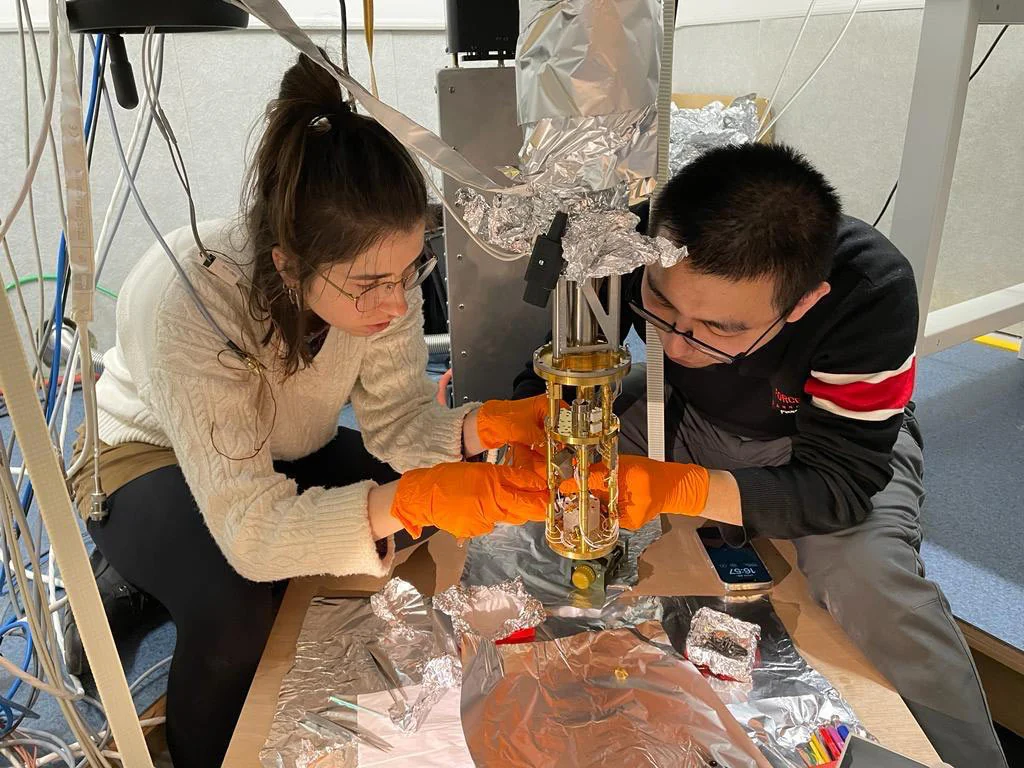
The progress of this research is closely related to the new measurement equipment developed by the researchers themselves. Traditional measurement methods often have difficulty in clearly distinguishing whether the current is carried by a single electron or by electrons that have formed a pair. The new device designed by the research team can distinguish between these two currents, allowing them to directly study the temperature range in which electron pairing occurs within the material, and how this relates to the superconducting state.
The material used in the research is a copper oxide high-temperature superconductor, specifically a bismuth strontium calcium copper oxide material. By measuring its electron energy characteristics, the researchers found a correspondence between a phenomenon previously known as the pseudogap (Pseudogap) and the energy required for electron pairing. This provides new experimental basis for understanding the electron pairing mechanism in high-temperature superconductivity.
The relevant research paper is titled "Equivalence of pseudogap and pairing energy in a cuprate high-temperature superconductor" and was published in the journal Science on November 5, 2026. The main authors of the paper include Jiasen Niu and Maialen Ortego Larrazabal, and the research was completed in collaboration with scientists from Utrecht University, Leiden University, Munich University and other institutions.
However, this discovery does not mean that scientists have created room temperature superconducting materials. The researchers have not demonstrated that any material can achieve zero resistance at room temperature, nor have they demonstrated superconducting circuits that can operate at room temperature. The real breakthrough came when they discovered that the necessary condition for pairing electrons can exist at room temperature, further narrowing the scope of the problem that needs to be solved in the search for room-temperature superconductors.
Next, the research team will focus on studying phase coherence, trying to figure out why electron pairs can form at room temperature but cannot coordinate their motion at the same temperature. If they could find a way to control this process, they might be able to design new materials that can superconduct at higher temperatures.
From the perspective of research significance, the most important value of this achievement is not to immediately bring a new superconducting material, but to help scientists more accurately understand the physical mechanism of high-temperature superconductivity. Over the past few decades, room-temperature superconductivity research has been limited by incomplete theoretical explanations. Now, electron pairing and phase coherence can be studied separately, providing a clearer direction for the next stage of material design and experimental exploration.
Comments