
Abstract:
A research team from the Shenyang Institute of Automation, Chinese Academy of Sciences, recently developed a wireless, light-controlled miniature "robotic manta ray" whose propulsion fins are driven by real skeletal muscles taken from the legs of bullfrogs. This research uses biological tissue directly as an actuator, which is a cutting-edge exploration in the field of biosyncretic robots. The relevant results have been published in "Advanced Functional Materials".
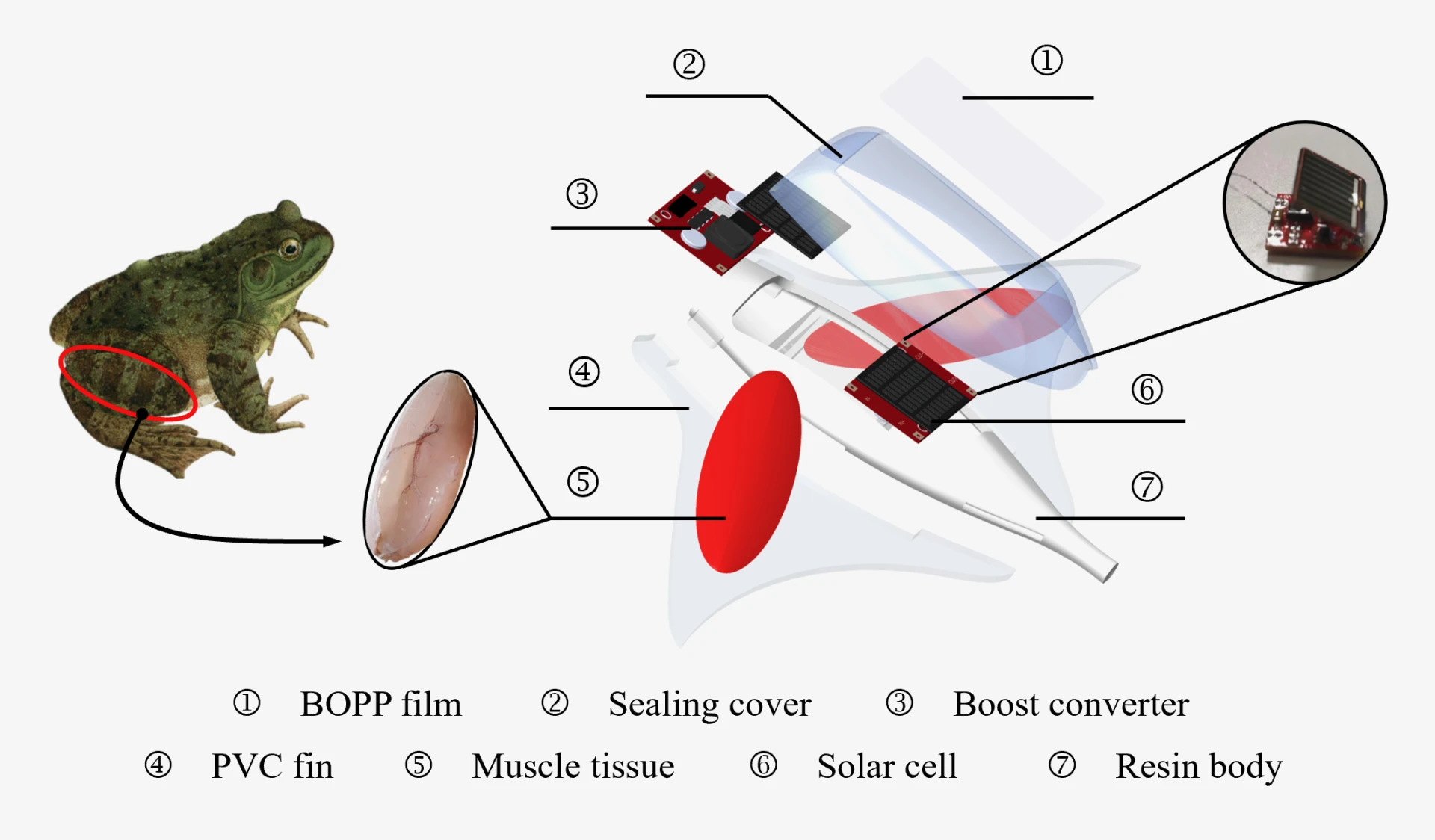
The research team extracted the gracilis muscle from the leg of a common bullfrog as an actuator. Under optimized electrical stimulation conditions (1 Hz, 5 V, 10 ms per pulse), the muscle can produce a stable contraction force of approximately 6.5 N with a contraction amplitude of approximately 25%; under stronger stimulation, peak forces can reach 9.4 N. The tissue remained electrically responsive for 11 days and was able to reliably drive the robot for approximately seven days.
Different from previous protocols that used laboratory culture or reconstructed muscle tissue, this study directly used naturally isolated intact skeletal muscle. The researchers pointed out that natural muscle fibers have a highly ordered arrangement structure, so the contraction performance is significantly better than that of cell culture-reconstructed muscle bundles. However, insufficient output force has always been a key bottleneck limiting the speed and mobility of existing skeletal muscle-driven robots.
In order to get rid of the constraints of traditional wired electrical stimulation systems, the team integrated micro-gallium arsenide (GaAs) photovoltaic modules on the back of the robotic manta ray and irradiated it with an 808-nanometer near-infrared laser. The photovoltaic unit converts light signals into electrical signals and transmits them to the nerves on the surface of the muscles to trigger contractions; the photovoltaic areas on the left and right sides can be independently addressed, and the differentiated contraction of the muscles on both sides is achieved by controlling the timing and position of the light, thereby completing cableless controls such as forwarding, turning, circular and U-shaped turns.
In terms of motion performance, the average straight-line speed of the robot manta ray is 0.54 body lengths per second (about 2.7 cm/s), and can reach up to 2 body lengths per second in a short period of time. The research team said this is the highest relative forward speed of a skeletal muscle-driven biohybrid robot reported so far. Its minimum turning radius is only one-eighth of its body length, its maximum angular speed reaches 21 degrees per second, and it takes about 17 seconds to complete a full circle. In addition to cruising on the surface and swimming underwater with a load (up to 5 grams), the robot can even move in slow curves on rigid surfaces.
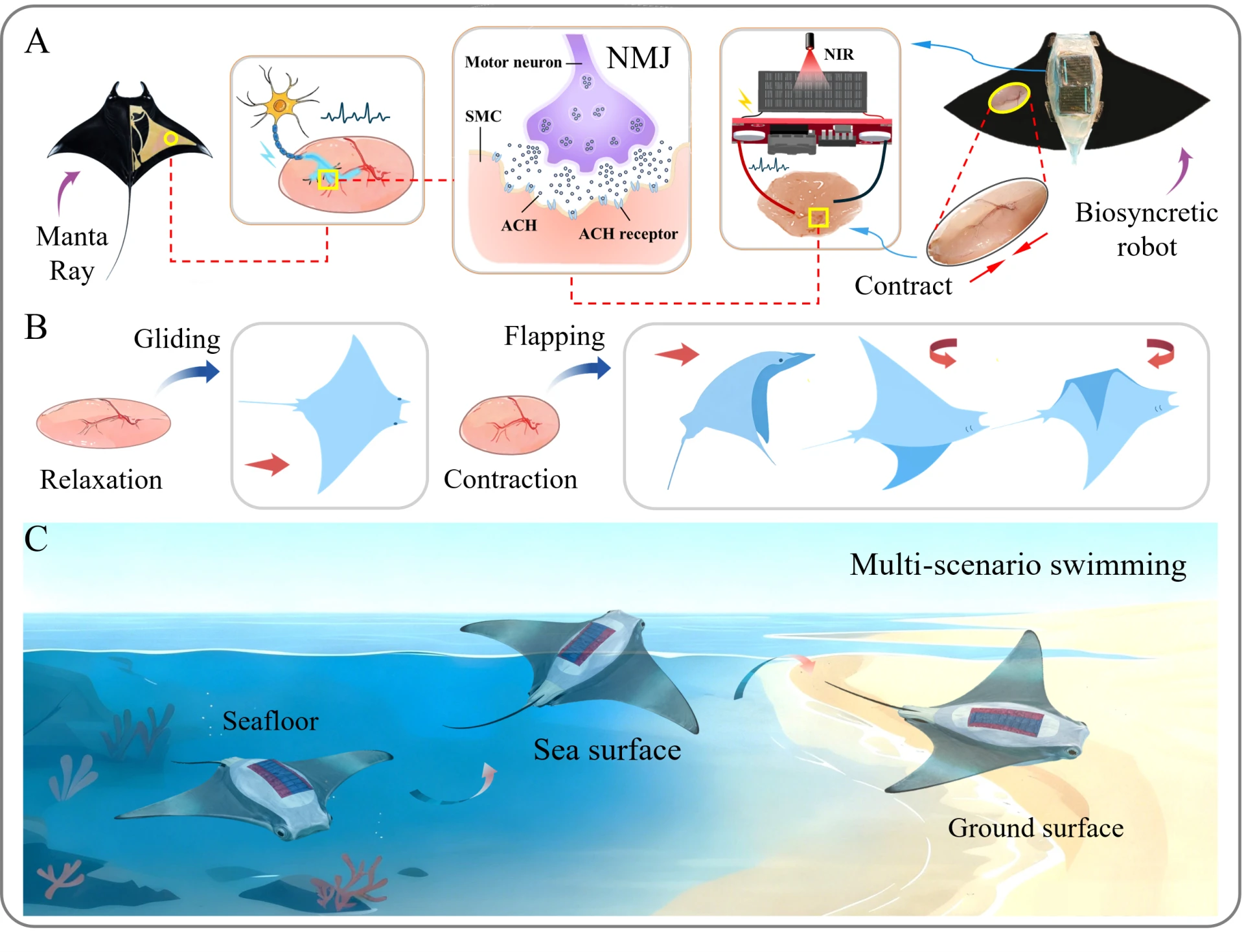
The researchers stated that this is the first time that natural isolated skeletal muscle has been coupled with a wireless photoelectric nerve stimulation system, verifying the feasibility of natural muscle tissue as a high-performance biological actuator. This technical route is not limited to the manta ray configuration: natural muscle actuators are expected to adapt to other robot structures, and the "optical-electrical" wireless control scheme provides a way to control biological actuators without the need for permanent external wires.
At the application level, the team believes that this type of small, fin-propelled robot is suitable for shallow water environment monitoring and low-disturbance observation of aquatic life, and can avoid the interference caused by traditional underwater robot propellers and rigid mechanisms. In addition, the electrical stimulation framework developed to maintain effective contraction of isolated muscles can also provide experimental reference for in vitro muscle rehabilitation research and dynamic tissue engineering culture systems after nerve injury.
The current main limitation is the lifespan of biological tissue and dependence on external energy: integrated muscles can work reliably for about 7 days and electrical response can last up to 11 days; wireless stimulation still requires continuous power supply and control by an external near-infrared light source. In the next step, the team plans to optimize in vitro culture strategies to extend muscle lifespan, develop neuro-like flexible film electrodes to achieve more uniform electrical signal distribution, and try to combine photovoltaic systems with onboard energy storage so that the robot can store the collected light energy and call it when needed, rather than relying entirely on real-time illumination.
Comments