
Abstract:
TCL CSOT recently announced that its T8 factory in Guangzhou, China, has officially started moving in production equipment. With the arrival of the first core production equipment, the project officially moved from the factory construction stage to the equipment installation and commissioning stage. Zhang Feng, senior vice president of TCL CSOT, said that the arrival of the first piece of core equipment marks that the T8 project has entered an important stage of equipment installation and joint debugging, laying the foundation for subsequent mass production.
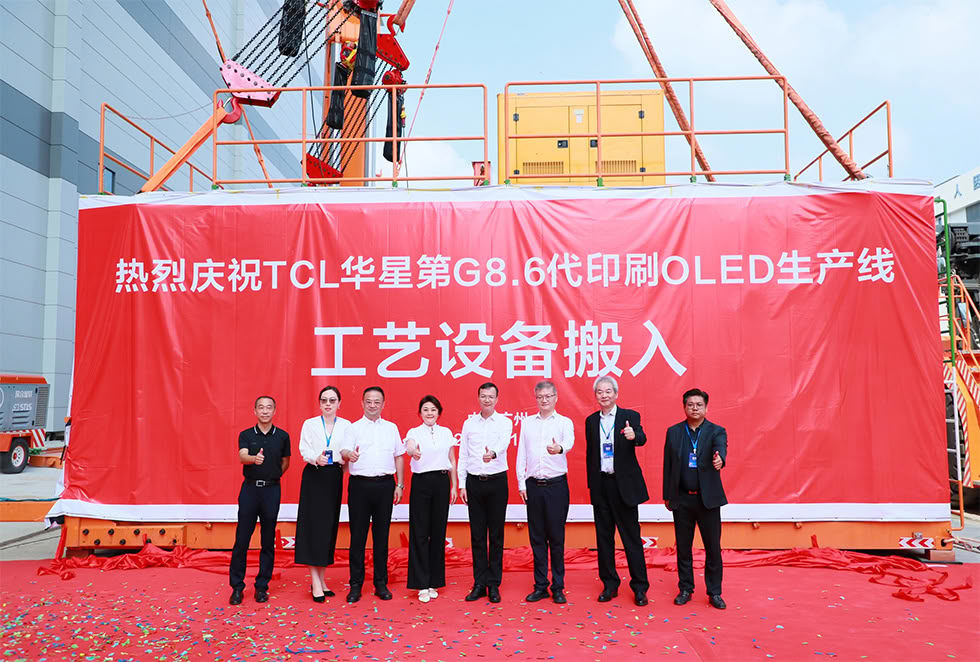
It is understood that the T8 project is an 8.6-generation printing OLED production line with a total investment of approximately 29.5 billion yuan (approximately US$4.42 billion). The project officially started construction in September 2025, and it took only 226 days to complete the main structure construction of the main factory, showing a relatively fast construction progress. According to the plan, the production line is expected to achieve mass production in the fourth quarter of 2027.
After the factory is completed, it can process approximately 22,500 glass substrates per month. Each substrate is 2,290 mm x 2,620 mm in size. It is mainly used to produce medium and large OLED display panels. In the initial stage of production, the production capacity will focus on product markets such as tablet computers, notebook computers and monitors. At the same time, TCL CSOT is also exploring the possibility of applying printed OLED technology to the fields of flexible displays and folding screen panels.
TCL Huaxing Optoelectronics stated that the company has continuously invested 13 years in the research and development of printed OLED technology and gradually promoted the technology from the laboratory research stage to commercial production. The company believes that compared with traditional OLED manufacturing processes, printing and printing technology is expected to further reduce production costs and improve material utilization efficiency, thereby enhancing the market competitiveness of OLED products.
TCL CSOT Printing OLED Center General Manager Cao Weiran said that from the initial drop of ink and experimental prototype, to the Wuhan T12 5.5-generation line becoming the world's first mass-produced printed OLED production line, and now the Guangzhou 8.6-generation production line has entered the equipment move-in stage, the company has spent 13 years promoting printed OLED technology to complete the leap from laboratory to industrialization. The arrival of the T8 project equipment also means that the official mass production has entered the final sprint stage.
Currently, mainstream OLED panel manufacturing usually uses vacuum thermal evaporation technology to deposit organic light-emitting materials, while printed OLED uses digitally controlled printing equipment to spray organic materials directly onto designated areas of the substrate. This production method can theoretically reduce material waste and lower manufacturing costs. However, whether the T8 production line can reach a level of competition with existing mature OLED production processes in terms of capacity scale, yield level and cost control in the future will still become the focus of the industry.
As the T8 project gradually completes equipment installation and debugging, the large-scale commercial application of printed OLED technology has also entered a new stage of development. The industry generally believes that if this technology can successfully achieve large-scale production, it will likely have an important impact on the future market structure of medium and large-sized OLED panels.
Comments