
Abstract:
Thorsten Schlok, chief economist of Apollo Global Management, recently issued a sharply worded report, bluntly stating that the true scope of the so-called "artificial intelligence revolution" is far less widespread than advertised. Data shows that the impact of artificial intelligence on the macro economy is still very limited, which may mean that we are in for a very interesting period in terms of financial trends and the direction of the global economy.
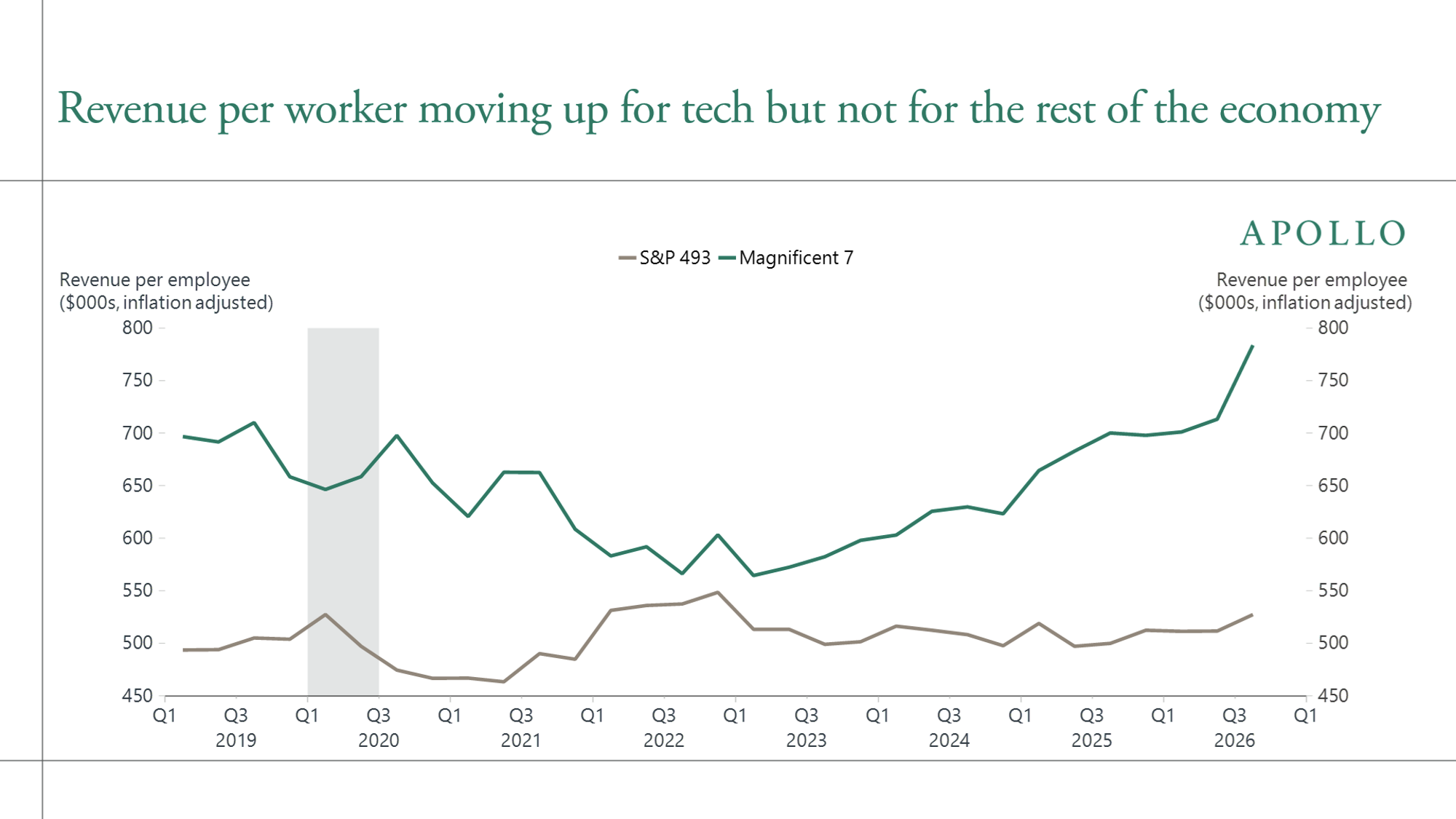
According to Slock's analysis in the "Daily Spark" column, despite the huge investments and huge noise surrounding the latest advances in large language model research, artificial intelligence has so far not brought any financial returns in the corporate world outside the U.S. technology industry. A handful of technology-related companies did make substantial gains, but the vast majority of companies in the S&P 500 saw little to no results from their investments in generative artificial intelligence or large language models.
Sloak noted that inflation-adjusted per-capita revenue was rising only for the "Big Seven," the group with the highest tech weight in the S&P 500 and including Nvidia, Tesla, Amazon, Microsoft, Google parent Alphabet, Apple and Meta. Profit margins for this group are also rising. He calls the rest of the companies in the index the "S&P 493," and these companies' per capita revenue and profit margins are both flat.
Furthermore, the Apollo economist sees no sign of AI driving productivity growth. Simply put, generative AI and large language models have no impact on corporate profits outside of the tech industry. Without any tangible results, mainstream S&P 500 companies have begun to scale back the huge expenditures required for artificial intelligence, viewing word consumption as a cost that drags down profit margins, rather than as a potential source of future growth.
Venture capital-backed companies continue to increase spending on artificial intelligence tokens, while mainstream companies do not need the latest models and are unwilling to pay for them. Slock said that if artificial intelligence remains limited to a small part of the overall economy, its macroeconomic effects will be very limited.
Artificial intelligence models may become increasingly commoditized, and tokens may eventually become “cheap” enough to drive revenue growth and profit margin expansion. But Slock believes that this ambitious goal may be more difficult to achieve than it sounds. He described artificial intelligence as a powerful "calculator" but also emphasized that businesses rely on good judgment rather than number crunching.
Slok wrote in the article: "Artificial intelligence does not understand responsibility, trust, culture, unwritten rules, moral trade-offs, or fairness, and all of these factors shape reputational risks and ultimately drive revenue growth and profit margin improvements." In his view, the final direction of the artificial intelligence narrative will be determined by the "S&P 493" rather than by the financial prosperity of the seven technology giants.
The Apollo company where Slock works manages approximately US$1 trillion in assets, so his judgment on the economy carries considerable weight. His views echo other cautionary reports, with Gartner recently estimating that more than $3.5 trillion in investments in artificial intelligence infrastructure could be impaired by the end of 2030. But not everyone shares such a pessimistic view. Goldman Sachs economist Jan Hatzius believes that investments in artificial intelligence will eventually translate into higher productivity and economy-wide profit returns.
Comments