
Abstract:
While global technology stocks are teetering on the verge of collapse, Chinese technology stocks have taken the lead in collapsing - exorbitant valuations collapsed under the dual pressure of concerns about AI demand and restrictions on China's exports. This plunge caused the mainland's Science and Technology Innovation 50 Index, which gathered leaders in artificial intelligence and semiconductors, to fall by 40% in less than four months, and the market value of approximately US$480 billion was wiped out. It's an ominous sign for already unstable global markets and a setback for China's efforts to channel savings into the stock market to finance the AI boom.
It also slapped the brakes on a two-year rally that began when promises of economic stimulus sent stock prices soaring and stalled Beijing's efforts to break a long-term "boom and bust" cycle and create a "slow bull" market. China's blue-chip CSI 300 index has fallen about 20% from its June high.
"The stock market later evolved into a crazy speculative bull market," said Dong Baozhen, a fund manager in Beijing. "Now we see the bubble is bursting."
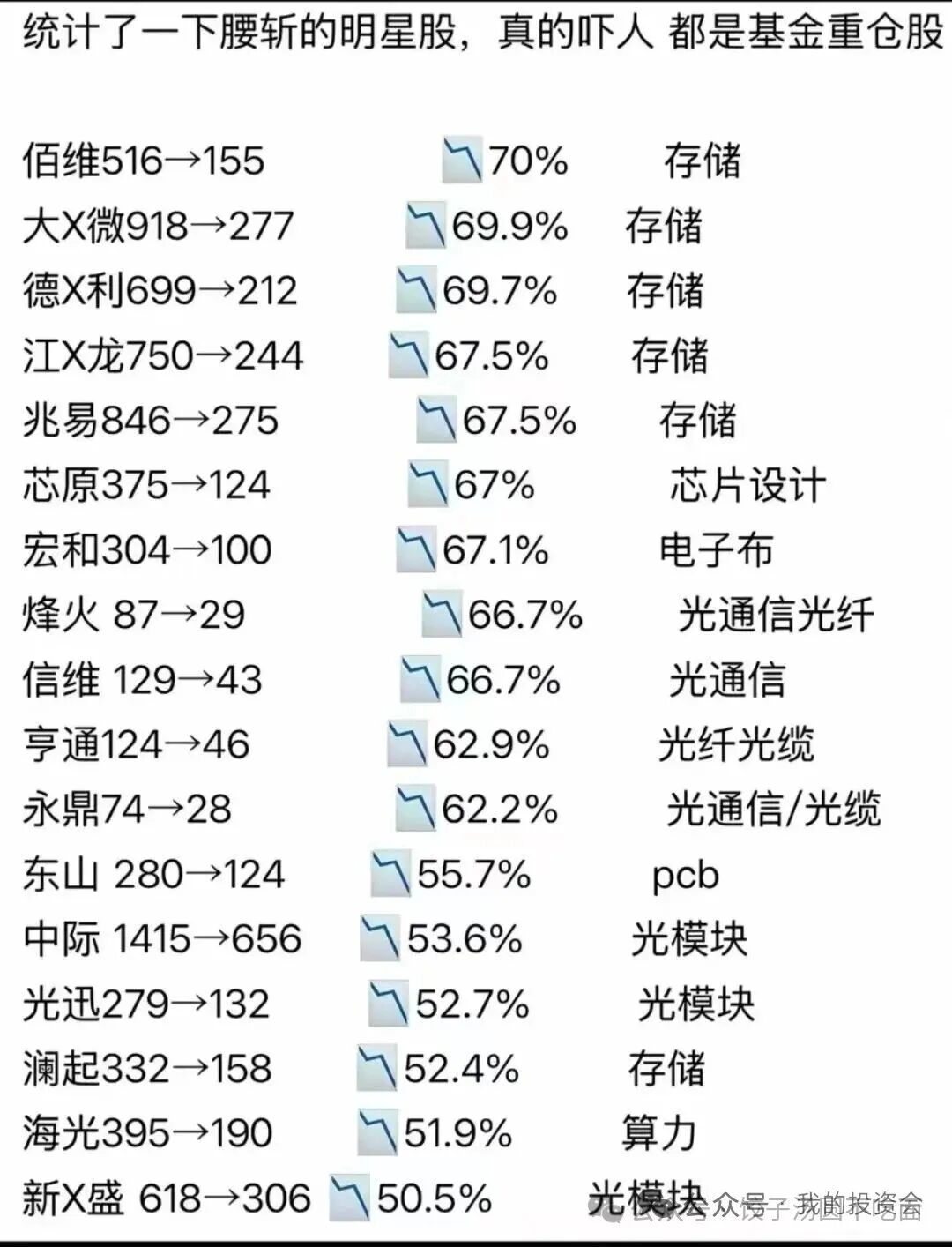
The background of this reversal is that the growth rate of the Chinese market was much higher than that of other markets in the West and Asia. In contrast, U.S. AI stocks were only "slightly pricked" - the Nasdaq index retreated 6% from the all-time high set three weeks ago. There was no obvious trigger for the sell-off in China, but traders said high prices, tax bills and the threat that the United States or other countries could ban Chinese equipment from data centers all played a role. According to data from Goldman Sachs, AI stocks account for 42% of China’s market capitalization and 57% of the trading volume of mainland A shares and Hong Kong H shares. In a market dominated by retail investors, few are immune.
The darling of retail investors fell sharply. Robot manufacturer Yushu Technology was oversubscribed by retail investors 8,000 times when it went public, but its share price has halved since it started trading in August; chip manufacturer Changxin Memory has lost more than a quarter of its market value in the past month. Chip companies Muxi Integrated Circuit and Moore Thread, whose shares soared 700% and 400% respectively on their first day of listing last year, have also halved since July.
Chen Wensheng, a small business owner and investor from Hainan, said he entered the market during the rally because he felt official support for companies like Yushu Technology - whose shareholders include state-backed funds. But now he and his friends are taking losses. Frustration that a Beijing-backed investment thesis ended so badly has pushed many investors into defensive assets and could slow down the pace of equity raises for technology companies. Shares of optical device makers Zhongji InnoLight and Xinyi Sheng are down about 60% from their highs in June and July, in part because Washington is pushing to ban these former stars from supplying U.S. data centers.
The current price-to-earnings ratio of the Science and Technology Innovation 50 Index is still about 100 times. Although it has fallen from a high of nearly 250 times, investors compare it with the Nasdaq 100 Index's valuation of 30 times and worry that the sell-off may worsen before it gets better. "What is happening now will stop many companies trying to go public," said Hong Hao, managing partner and chief investment officer of Hong Kong Hao Capital.
The mania and its aftermath contrast with a push by regulators to boost returns, curb volatility and crack down on leverage and high-frequency trading. State-backed investors had sold on the rise to suppress gains. The China Securities Regulatory Commission did not immediately respond to questions faxed by Reuters last week. China Securities Regulatory Commission Chairman Wu Qing met with market participants earlier this month to listen to suggestions for improving capital markets, according to the regulator's website. Some in the investment community believe the boom has damaged market structure.
"Excessive emphasis on 'tech content' - that is, the weight of technology companies in the market capitalization of major indexes - will lead to deviations and even distortions in capital behavior," said Leo Wang, a partner at Beijing Qianchuang Capital. "This has created serious bubbles in some sectors and caused serious bleeding in other sectors."
Others see value in the sell-off, saying it is neither a surprise nor a detriment to long-term-focused reforms that have made progress in improving returns, especially earnings, in recent years. HSBC research shows that although Asian funds have been generally sellers over the past three months, they remain overweight China. The updated recommendation list released by Goldman Sachs earlier this month included dozens of Chinese AI stocks such as Zhongji InnoLight and Changxin Storage. William Bratton, a securities strategist at BNP Paribas, also said that the market provides buying opportunities for cautious investors. However, in the Mainland, many people are still paying attention to other sectors, or waiting for lower valuations before making a move.
"Just like all other Chinese manufacturers, (chip manufacturers and AI suppliers) will eventually fall into a price war," said Wang Zhuo, a partner and fund manager at Shanghai Zhuo Zhu Investment Management. "There are no exceptions. All bubbles will eventually burst."
Comments