
Abstract:
Since its publication in 1999, "The Gruffalo" has been a classic on children's bookshelves. Axel Scheffler, the illustrator of the book, said in an interview that he is seriously considering suing some AI companies on the grounds that these companies have reproduced his works without authorization and are suspected of copyright infringement.
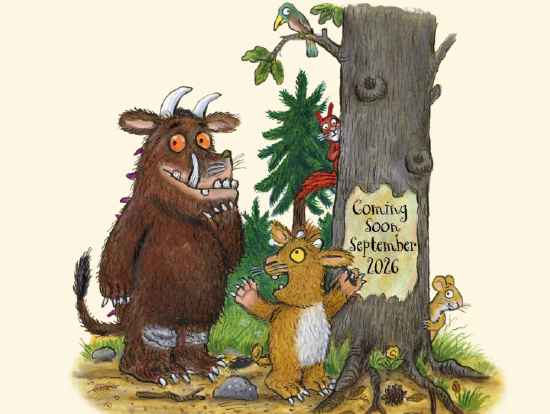
The illustrations created by Axel Scheffler have captivated countless children over the years. The Gruffalo, written by Julia Donaldson, a London-born children's literature writer, tells the story of a little mouse who outsmarts a monster.
"I have contacted a German lawyer," Scheffler said. "Illustrators have already sued AI companies, and I am seriously evaluating the lawsuit. I just hope they stop this behavior." The artist, who lives in South London, has not yet disclosed the name of the company he is planning to sue.
The previous defense of AI companies was that using copyrighted materials to train models does not necessarily constitute copyright infringement.
Scheffler himself does not use a smartphone. He said that he originally planned to ignore AI until someone showed him that his most famous characters have been recreated by AI in various scenes, including Silicon Valley, Oktoberfest and other scenes. "I was very shocked. The pictures were clearly my mice and my Gruffalo. The AI imitated my painting style as much as possible, but the rest of the picture was generated. This was obviously copyright theft," he said.
Scheffler is considering launching a lawsuit in Germany because he believes EU regulations are more friendly to creators. Nick Buckland, an intellectual property lawyer at London law firm Lewis Silkin, agrees that Germany is a feasible way for creators to protect their rights. "There have been two cases in Germany: the music copyright collective management organization won the case, proving that the AI company copied and presented the lyrics verbatim." He told the BBC.
But he also pointed out that it is difficult to prove copyright infringement. While having an instantly recognizable character like the Gruffalo would give Scheffler an advantage in his case, he would still have to prove that his copyright had been infringed. "Generative AI does not directly copy, but does training." Buckland explained, "This is also the core logic of AI manufacturers claiming that they have no infringement. For example, if the user wants a picture of a puppy, the AI will scan millions of dog pictures in the training library, and then generate a picture and return it to the user."
OpenAI, the company behind ChatGPT, has been sued by Penguin Random House Germany and author and illustrator Ingo Siegner. The plaintiff accused OpenAI of stealing the children's picture book character "Der kleine Drache Kokosnuss". The Munich Regional Court will rule on the case in spring 2027.
An OpenAI spokesperson responded: "We are carrying out fruitful communication with copyright holders around the world, while protecting intellectual property rights and properly handling copyright complaints, while supporting creative activities, including fan creation." The California company said that its model training materials come from multiple sources, and copyright holders can directly submit infringement dispute complaints.
For Scheffler, the significance of this matter is not only for "The Gruffalo", which has sold more than 18 million copies worldwide, but also for all creators. He said the purpose of the lawsuit is not to seek compensation, but to provide protection for current and future creators.
Other artists are also worried that AI will impact their livelihoods. Ivy Deng, who is studying for a master's degree in painting at the Royal College of Art, said: "From a regulatory perspective, I feel that my works are not fully protected under fair use rules. But I have confidence in the art industry and art supporters. They can distinguish between the thinking and effort of hand-made creation and the instantaneous AI-generated images. There is an essential difference between the two."
Professor James Coupe, head of the AI project at the Royal College of Art, believes that Scheffler’s actions make this discussion more valuable. "People often simplify the debate into accepting AI or resisting AI, but this ignores the more critical question: who is shaping this technology and whose interests the technology serves. Art has important value here. It does not mean that artists must become technology developers, but that artistic practice can question the presuppositions, values and power paradigms imposed on us by technology."
The British government announced in June last year that it plans to invest 2 billion pounds in the development of AI by 2030 to unleash the potential of technological change. Buckland believes that the government needs to find a balance between protecting the creative industry and developing the AI industry: "Obviously, if you want to maximize the return on AI investment, it is easy to relax regulatory restrictions. The government is in a difficult choice and needs to find a middle path."
A spokesman for the British Department of Culture, Media and Sport said that the government does not believe that supporting the creative industry and supporting the development of AI is an either-or option: "We have extensively engaged creators, AI companies, industry associations, trade unions, academics and AI users. Copyright laws should not only consolidate the UK's position as a creative highland, but also release the huge potential of AI innovation to boost the economy and benefit the people."
Even so, Scheffler and his publisher are still debating whether to formally file a lawsuit in his native Germany. According to this illustrator, the value of the work itself is the core of the discussion. "AI can never replace hand-drawn images, there will always be something missing. I encourage everyone to stick to hand-drawing and preserve this tradition; when AI becomes popular, hand-made creations may be valued more."
Comments