
Abstract:
On September 1st, Mecamander officially landed on the Hong Kong stock capital market with the aura of “the first stock of embodied smart eyes, brains and hands”. But just a few days after the company went public, its founder Shao Tianlan “turned the tables” on the embodied intelligence industry. In a recent post on Moments, Shao Tianlan said bluntly,
Currently, many "game-based" embodied intelligence companies make extensive use of "data mining centers" and related transactions with localities, investors, and suppliers to create false and unsustainable income.
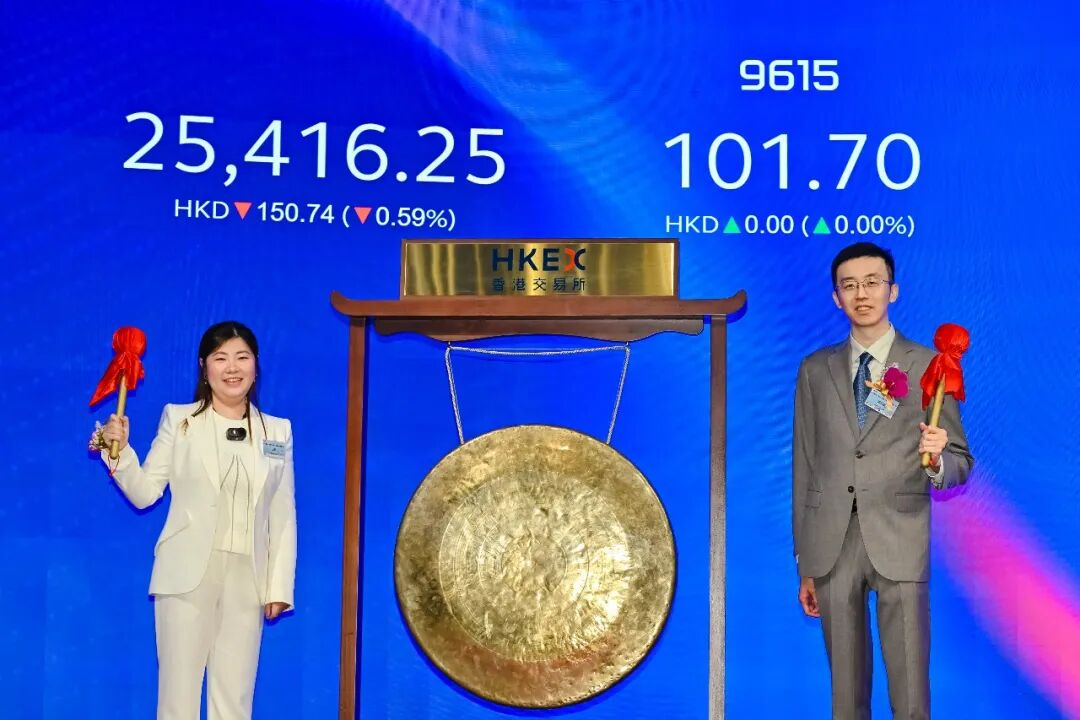
In his view, the above-mentioned approach is to achieve a rapid listing, which will not only harm investors, but also plunge the company into a whirlpool of continuous fraud and blood loss. In the comment area, Shao Tianlan also specifically named another star robotics company - Galaxy General.
Facing the "bombardment" from its peers, Galaxy General issued a statement on September 10 saying that
it will not participate in the war of words. The company will adhere to its original aspirations, develop with embodied intelligence technology as its core, and implement real applications as its long-term goal.
Radar Finance learned that Mecamand, led by Shao Tianlan, was established in 2016. As a leading company in the market segment of AI+3D vision-guided general intelligent robot components, it suffered a "break" after listing on the Hong Kong Stock Exchange on September 1 this year. Since then, its stock price has fallen for several days.
At the performance level, because it is in the early stage of commercialization, Mecamander's profit margins have been squeezed out by a large amount of R&D expenditures and sales expenses, and the company has not yet achieved profitability. From 2023 to 2025, the company's cumulative losses have exceeded 1 billion yuan.
The founder of Mecamander "bombed" his peers, Galaxy GM said it would not engage in war of words
Recently, screenshots of Shao Tianlan’s Moments, the founder of Mecamander, have been widely circulated on the Internet, and have caused quite a stir in the currently hot field of embodied intelligence.
The screenshot shows that Shao Tianlan questioned and criticized the current business models and listing intentions of some embodied intelligence companies in the article.
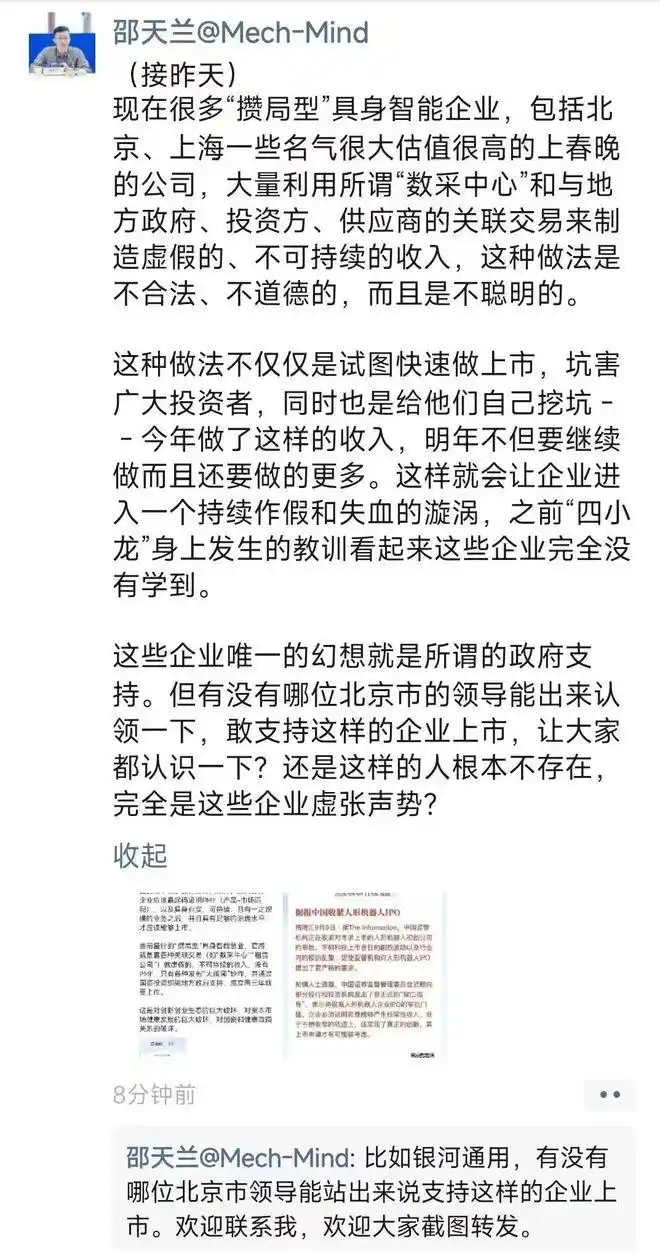
Shao Tianlan said, "Nowadays, many 'game-building' embodied intelligence companies, including some well-known and highly valued Spring Festival Gala companies in Beijing and Shanghai, make extensive use of related transactions between so-called 'data mining centers' and local governments, investors, and suppliers to create false and unsustainable income. This practice is illegal, unethical, and unsmart."
Shao Tianlan believes that the above-mentioned approach is aimed at achieving a rapid listing, but it has harmed the majority of investors. At the same time, the company itself will fall into a "whirlpool of continuous fraud and blood loss" - "If we have made such revenue this year, we will not only continue to do it but also do more next year."
In the comment area of this circle of friends, Shao Tianlan also specifically mentioned another robot counterpart, Galaxy General, and said, "You are welcome to contact me, and everyone is welcome to take screenshots and forward them."
Tianyancha shows that the full name of Galaxy General, which was "named" by Shao Tianlan this time, is Beijing Galaxy General Robot Co., Ltd. The company was registered and established in May 2023, and its business scope covers the manufacturing and sales of consumer service robots; the research and development and sales of intelligent robots; the manufacturing and sales of industrial robots, etc.
Radar Finance noticed that Shao Tianlan and Galaxy General founder Wang He are Tsinghua University alumni. The former graduated from the School of Software, Tsinghua University, and the latter graduated from the Department of Electronic Engineering, Tsinghua University.
Faced with the "bombardment" from alumni and the recent discussions on the embodied intelligence industry in the market, Galaxy General responded by publishing an article titled "Embodied Intelligence is a long-distance race, we are only racing against time" through the public account "Galaxy General Galbot" on September 10.
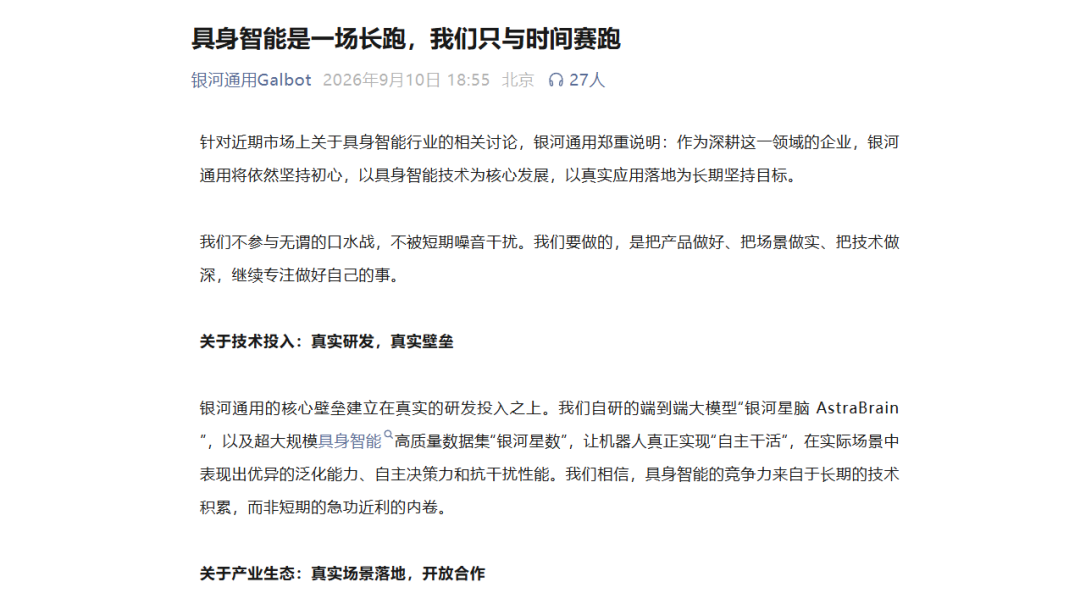
Galaxy General said, "We will not participate in meaningless wars of words and will not be disturbed by short-term noise. What we have to do is to make products better, make the scenarios more realistic, deepen the technology, and continue to focus on doing our own thing."
At the same time, Galaxy General also emphasized that as an enterprise deeply involved in this field, the company will still adhere to its original aspirations, develop with embodied intelligence technology as its core, and implement real applications as its long-term goal.
Tsinghua University academic tycoon leads a team to create the “first team of embodied intelligent eyes, brains and hands”
Shao Tianlan, who posted a post on WeChat Moments "bombarding" the current status of the industry, is also one of the entrants into the embodied intelligence industry.
Public information shows that in 2012, Shao Tianlan graduated from the School of Software, Tsinghua University, and then went to the Technical University of Munich in Germany to study robotics.
After graduating from graduate school in 2015, Shao Tianlan worked as an engineer at KBee AG, a well-known German robot company, mainly responsible for robot research and development.
With the arrival of 2016, known as the "First Year of Artificial Intelligence," Shao Tianlan resolutely chose to return to China to start a business, adhering to the original intention of making robots smarter.
In September of the same year, Mecamander Robotics was officially established. Based on his previous education and work experience, Shao Tianlan led Mekamande to enter the AI+3D vision-guided general intelligent robot component market segment.
In 2017, Mechmander launched the first-generation Mech-Eye industrial-grade 3D camera, Mech-Vision machine vision software and Mech-Viz robot programming software for the global market.
In 2019, Mecamander began commercializing intelligent robot solutions. According to CIC Consulting, it is one of the first companies in China to provide universal 3D vision solutions for industrial robots.
In 2021, Mechmander began mass production of Mech-Eye 3D cameras and large-scale launch of Mech-Vision software, and later expanded into intelligent path planning and multi-modal artificial intelligence solutions through the launch of Mech-Viz and Mech-GPT.
As of the end of the first quarter of this year, Mech-Eye has sold more than 24,000 Mech-Eye cameras to more than 1,600 customers in the logistics, automotive, consumer electronics and new energy industries.
In addition, Mecamander's intelligent detection and measurement products will be officially commercialized in 2023 and have since been adopted by many battery and auto parts manufacturers for online quality control.
In 2025, after several years of internal research and development and early pilot testing, Mechmander officially launched Mech-Hand, which has been commercially deployed in logistics, automotive and precision assembly scenarios.
Mecamander’s current achievements cannot be achieved without the help of capital. Radar Finance learned from the official website that since its establishment, Mecamander has received multiple rounds of support from well-known investment institutions such as IDG Capital, Meituan, Sequoia China, Source Code Capital, Intel Capital, Qiming Venture Partners, etc., with a cumulative financing amount of more than 2 billion yuan.
On September 1 this year, Mecamander was listed on the Hong Kong Stock Exchange with an issue price of HK$101.7 per share, and successfully won the title of "the first stock of embodied smart eyes, brains and hands".
However, on the first day of listing, Mecamander's share price suffered a "break", closing down 1.87% at HK$99.8 per share.
In the next three days, Mecamander's stock price continued to fall, with single-day declines of 1.55%, 15.67%, and 5.25% respectively.
Since September 7, Mecamander’s share price has begun to recover. As of the close of trading on September 11, Mecamander was quoted at HK$95 per share, but still lower than the issue price of HK$101.7 per share, with a total market value of approximately HK$11.876 billion.
Commercialization is still in the early stages, with losses exceeding 1 billion yuan in three years
While the capital market has received a "cold look", Mecamander is also facing the pressure of continued losses at the performance level.
The prospectus shows that from 2023 to 2025, Mecamander recorded net losses of 401 million yuan, 283 million yuan, and 360 million yuan respectively, with a cumulative loss of more than 1 billion yuan in three years.
As for the company's continued losses, Mecamander attributed it to the fact that the company is still in the early stages of commercialization, as well as significant R&D investment and early investment in the expansion and upgrading of the sales network.
In Mecamander’s view, R&D is the driving force for company innovation, enabling it to create advanced 3D vision and AI technologies. With its interdisciplinary R&D capabilities, the company integrates technical expertise in various fields such as optics, robotics and AI algorithms, and continues to expand the technical boundaries of 3D vision and artificial intelligence.
To this end, Mecamander has always maintained a high level of investment in research and development.
The prospectus shows that from 2023 to 2025, the company's research and development expenses will be 119 million yuan, 109 million yuan, and 113 million yuan respectively, accounting for 65.6%, 40.6%, and 29% of the total revenue in the same period respectively.
In the same period, Mecamander's sales expenses were 186 million yuan, 162 million yuan, and 168 million yuan respectively, accounting for 102.7%, 60.4%, and 43.3% of the total revenue for the period respectively.
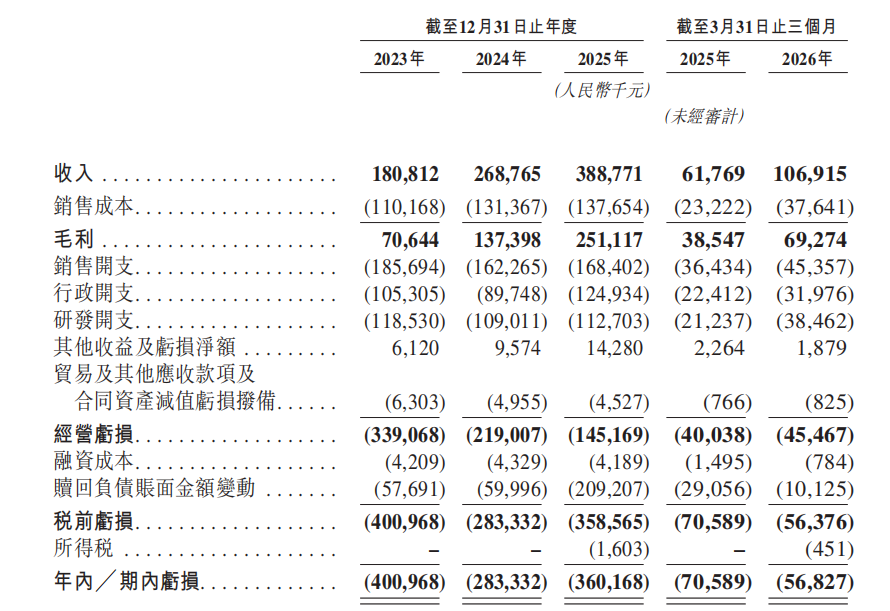
However, thanks to the dual drive of the company's business application scenario expansion and global market promotion acceleration, Mecamander's revenue continues to grow: from 181 million yuan in 2023 to 389 million yuan in 2025, with a compound annual growth rate of 46.6%.
In the first quarter of this year, Mecamander achieved revenue of 107 million yuan, a year-on-year increase of 73.1%; it recorded a net loss of 57 million yuan, a year-on-year decrease of 19.5%.
Mecamander said that the company's revenue growth was mainly due to the increase in revenue from intelligent robot guidance products. In the first quarter of this year, a total of 2,412 units of this product were sold, an increase of 1,091 units year-on-year, contributing revenue of 99 million yuan, an increase of nearly 70% year-on-year.
From a regional perspective, in the first quarter of this year, Mecamander's revenue from mainland China was 60 million yuan, a year-on-year increase of 78.65%. Mainly driven by rising customer demand, product sales in mainland China increased from 1,050 units in the same period last year to 1,882 units.
In the same period, as Mecamander continued to expand overseas markets, the company's overseas revenue in the first quarter also increased by 66.5% year-on-year to 47 million yuan. As of the Latest Practicable Date, the Company has provided services to more than 900 overseas customers in nearly 50 countries and regions.
In addition, Mecamander's profitability has also improved. The company's gross profit increased from 39 million yuan in the same period last year to 69 million yuan in the first quarter of this year, and its gross profit margin increased by 2.4 percentage points year-on-year to 64.8%.
It is worth mentioning that with the wider deployment of intelligent robots in manufacturing, logistics and service industries, and the increasing demand for high-precision, flexible and scene-adaptive sensing functions, the potential of the global AI+3D vision-guided general intelligent robot component market is increasing.
According to Mecamander's prospectus, the global market size of AI+3D vision-guided general intelligent robot components is expected to grow from 1.8 billion yuan in 2025 to 10.6 billion yuan in 2030, with a compound annual growth rate of 43.2%; and is expected to further expand to 102.5 billion yuan in 2035.
From the perspective of installation volume, the global installation volume of AI+3D vision-guided general intelligent robot components has reached 30,100 units in 2025, and is expected to grow to 239,900 units in 2030, and further increase to 2,684,100 units in 2035.
The industry’s penetration rate in the general intelligent robot market is expected to increase from 5.1% in 2025 to 22.2% in 2035.
As the market scale continues to expand, industry competition will also intensify. As of the end of 2025, there are more than 20 players in this segment, and the top five players account for approximately 45.4% of the market in terms of revenue in 2025.
Currently, Mecamander is in a leading position: in 2025, Mecamander achieved revenue of 389 million yuan, ranking first in the industry, with a market share of approximately 22.1%. At the same time, the company's shipment volume also ranks first in the industry.
However, Mecamander also admitted in the prospectus that "the industry in which we operate is highly competitive and is affected by accelerated iterations of technology, shortened product life cycles, cyclical fluctuations in the market structure, continued low prices, and intensified competition at home and abroad."
Comments