
Abstract:
In recent years, humanoid robots represented by embodied intelligence have been highly sought after by the industrial and technological circles around the world. Not only have major high-tech giants come to an end, but also many emerging companies have begun to join this track. In the context of the rapid development and increasingly mature technology related to humanoid robots, it is natural for military industry companies to think about whether they can use this as a basis to develop military humanoid robots for modern and future battlefield operations.
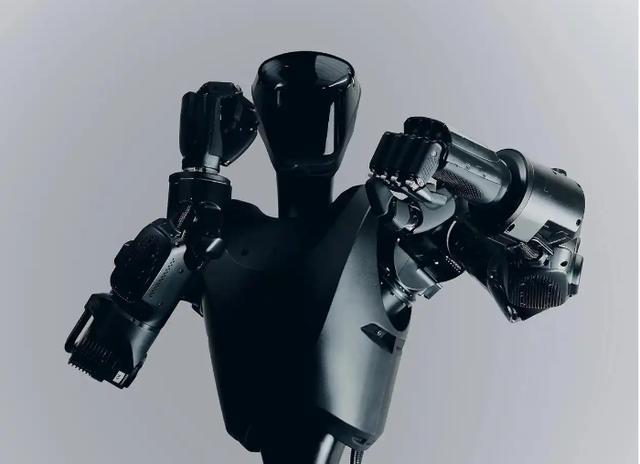
The American Phantom Mk1 humanoid robot has landed on the battlefield in Ukraine. It can independently conduct reconnaissance and fight with guns. It plans to mass-produce 50,000 units in 2027.
Now, we have seen that Basic Future Industries of the United States has begun sending the "Phantom" Mk1 military humanoid robot it developed to the Ukrainian battlefield to undergo actual combat testing. At the World Robot Conference held not long ago, the "Fuxi" special humanoid robot developed by China Ordnance Industry Co., Ltd. wielded a baton and a shield in a dynamic demonstration, quite like a "Terminator". In addition, this type of robot can also install non-lethal weapons on its arms, making it my country's first public humanoid robot that can be armed.
Unique advantages of military humanoid robots
In fact, many readers may have this question: At present, a large number of various types of unmanned equipment have been put into the battlefield, including drones, unmanned vehicles, unmanned boats and unmanned submarines. In addition, quadruped robots commonly known as “robot dogs” have also been used in small batches in Ukraine. In this case, does it still make sense to develop military humanoid robots specifically for combat?
To understand this, we must first understand the unique advantages of the human body structure from a biological perspective. In fact, humans are far inferior to other animals in many aspects. For example, because humans run on two legs, their speed is much slower than that of many four-legged animals. Cheetahs can run at a top speed of 120 kilometers per hour, and the current world 100-meter record held by sprinter Usain Bolt is only 9.58 seconds. In addition, humans do not have sharp teeth and claws like many animals, and their ability to attack with bare hands is very limited.
However, the biggest advantage of humans walking upright is that they free up their forelimbs and arms. In particular, the structure and flexibility of human hands are the best among all animals, and they can hold and use various tools and weapons. In addition, except that humans cannot fly on their own power like birds, they can achieve the abilities of various other animals, such as running, jumping, rolling, crawling, overcoming obstacles, climbing, swimming, etc. Therefore, if we talk about a single item, humans may not be as good as other animals. But in terms of comprehensive mobility, humans are undoubtedly the most outstanding species on earth.
Therefore, humanoid robots designed based on the human body structure naturally have more comprehensive mobility capabilities than the drones, unmanned vehicles, unmanned boats, unmanned submarines and quadruped robots mentioned above. For example, according to the current design level of the world's mainstream humanoid robots, it can already achieve high-speed running and jumping, large-scale trench crossing, climbing over low walls and other difficult actions. In the future, with the development of technology, humanoid robots should be able to further perform more difficult actions such as climbing, crawling, and rolling.
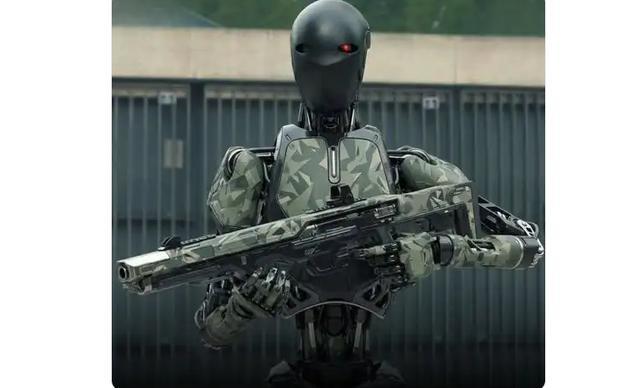
It is highly probable that humanoid robots armed with guns will appear on future battlefields.
In addition, if a humanoid robot is combined with an individual aircraft, it can increase its flight capabilities. Combining humanoid robots with unmanned vehicle walking systems such as wheels and tracks can achieve faster traveling speeds on flat roads than bipedal running. Going one step further, combining humanoid robots with propellers and water-jet propulsion devices, and further enhancing waterproof capabilities, it is not just a dream for humanoid robots to travel on the water or even dive.
In short, through modular design, humanoid robots can achieve equivalent or even better mobility and battlefield adaptability than drones, unmanned vehicles, unmanned boats, unmanned submarines and quadruped robots. This is a capability that currently cannot be achieved by any specially designed unmanned equipment.
From a practical perspective on the battlefield, humanoid robots are also the unmanned equipment with the best general capabilities and versatility. Because almost all the weapons currently equipped by the armies of various countries, ranging from small weapons to large tanks, tanks, fighter planes and warships, are designed to adapt to human operation. Therefore, humanoid robots can directly operate and use weapons and equipment designed according to the human body without special design and equipment. For example, unmanned vehicles, robot dogs and other unmanned equipment need to install special stable platforms to achieve weapon aiming and shooting, but humanoid robots do not need them at all. Humanoid robots have arms and shoulder designs similar to those of the human body, and can directly use small weapons such as pistols, rifles, machine guns, and even rocket launchers. Similarly, humanoid robots can also replace combatants, serving as drivers, commanders, and gunners in tanks and vehicles, as pilots in fighter cockpits, and as various operators in various positions such as warships. In this way, the militaries of various countries do not need to specialize in the development of various large-scale unmanned equipment. They only need to have humanoid robots directly on duty, and they can achieve the unmanned, automated and intelligentization of their own troops to a large extent.
What challenges do military humanoid robots face?
Of course, if military humanoid robots are to be truly practical and achieve or even surpass the combat effectiveness of human warriors, judging from the current level of technological development, they will still face many huge challenges.
First of all, energy is the first "stumbling block" currently blocking the development of military humanoid robots. Judging from the current mainstream humanoid robots developed by various countries, except for the early "Atlas" developed by Boston Dynamics in the United States, which uses hydraulic power, most mainstream models now use battery-powered electric drive. Therefore, the capacity of the battery determines to a large extent how long the humanoid robot can work.
Judging from the current development situation, mainstream humanoid robots usually use large-capacity lithium batteries as the main energy source, which can usually reach levels of 72V/30Ah. In the future, humanoid robots can further use solid-liquid hybrid batteries or even more advanced solid-state batteries to greatly increase the power density ratio, allowing the battery to store more electrical energy with basically the same volume and weight.
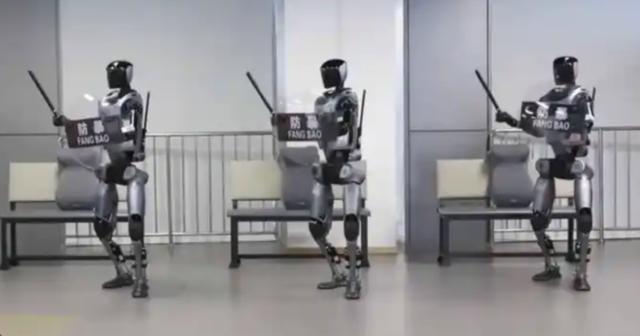
"Fuxi" special explosion-proof robot.
However, from a real battlefield perspective, the limitations and inherent flaws of battery power supply for humanoid robots are still too obvious. For example, when a military humanoid robot is operating at full load and full power, its battery life can usually only last 4 to 6 hours, or even shorter, which is far from meeting the needs of high-intensity warfare. In addition, just like the current problems encountered by new energy vehicles, when a military humanoid robot only has half of its power left, should it replace the battery or continue fighting? How can a large number of batteries, which are both bulky and heavy, be safely transported from the rear to the front? How to recharge the replaced empty battery, etc. If only a small number of military humanoid robots were put into use, these problems might be overcome. When military humanoid robots are equipped with a large number of troops, these problems will become more obvious. Therefore, military humanoid robots urgently need to achieve a qualitative leap in technology in energy/power systems.
Secondly,
The second "stumbling block" faced by military humanoid robots is protection issues
. On the one hand, modern and future battlefield environments are extremely complex. Military humanoid robots must have very high levels of waterproof, dustproof, shockproof, anti-fall, and anti-electromagnetic pulse/interference performance, and achieve very high reliability before they can be put into combat. Otherwise, military humanoid robots will often collapse or malfunction due to environmental problems on the battlefield, which will cause even greater trouble.On the other hand,
military humanoid robots must also have a high level of bulletproof performance
. Military humanoid robots have very obvious target characteristics and can easily become targets of concentrated fire from the enemy. Moreover, the cost of hundreds of thousands of dollars or even millions of dollars also means that military humanoid robots are not disposable consumables. Therefore, using high-level protection to improve battlefield survivability is an important aspect that must be considered in the design of military humanoid robots. Moreover, for the battery part, military humanoid robots must also carry out key protection. Once the current lithium battery is penetrated by a bullet and causes a short circuit between the positive and negative areas, it will cause an extremely violent explosion and fire. Even solid-state batteries that will become practical in the future are not completely safe. They will still catch fire if they are broken down and short-circuited, but the degree of damage is weaker than that of liquid batteries.Furthermore, the intelligence, autonomy and human control of military humanoid robots are also a big problem. At present, the world's mainstream humanoid robots use a large number of actual scene training and simulation modeling scene training to adapt to specific environments and complete specific tasks. Modern and future battlefield scenarios are extremely complex, and it is simply impossible to use large-scale model training to adapt military humanoid robots to all scenarios encountered. Therefore, the current control of military humanoid robots either uses remote controls or control consoles similar to drones and unmanned vehicles; or combatants wear motion capture systems to remotely control military humanoid robots through "action mapping" (interested readers can refer to the American movie "Armor", which demonstrates this technology well).
Moreover, even if future military humanoid robots have a considerable degree of artificial intelligence systems, whether they will be given the power to fire autonomously is still open to question. If an intelligent military humanoid robot malfunctions and kills us regardless of the enemy, it will also be a huge disaster for our own side.
Despite the many difficulties and challenges, the author believes that it will still be a high probability event that a large number of military humanoid robots will appear on the battlefield in the future, but it has just begun. For example, the American "Phantom" Mk1 military humanoid robot mentioned at the beginning of this article has begun attempts to operate various weapons. In the videos and pictures released by Basic Future Industries, there are scenes of the "Phantom" Mk1 robot holding a Glock pistol and aiming, and there are also scenes of personnel holding shotguns teaching the robot's tactical movements. The company even released a test video of a "Phantom" Mk1 robot holding a mortar shell, sending it into the mortar muzzle and firing it. Although these videos and pictures show that the "Phantom" Mk1 robot is still very "childish", who can say that what is hidden behind it will not be the terrifying figure of a T800 "Terminator" titanium alloy skeleton.
Comments