
Abstract:
As hairy crab consumption enters the peak season, crab cards continue to be popular as a mainstream delivery voucher, but there are "traps" hidden behind the face value. Many consumers are confused about the actual value of the face value and are full of doubts about this set of pricing rules.
A reporter from the Beijing Business Daily found that the current crab card industry has a common phenomenon of "decoupling between model and actual selling price". Some crab cards have the same original price as the model, but are actually sold at as low as 20% off. Moreover, hairy crab cards with the same specifications marked by different brands have different models. Merchants also admitted that the model numbers are only internal specification codes and there is no unified pricing standard. The second-hand circulation market further enlarges the discount space. The second-hand price of mainstream brand crab cards is only 50-30% off the discounted price of JD.com’s self-operated products. Some practitioners pointed out that the current crab card industry hides many types of consumer traps, from the disguised weight gain of crab tying ropes, difficulty in delaying reservations until the expiration date, to the sideways promotion of the origin to mislead consumers. The nature of crab cards has become "paper crabs", and the selling price is decoupled from the crab itself, which not only overdraws consumer trust, but also affects the healthy development of the industry.
The original price is heavily discounted, and each model has its own pricing system
"When the autumn wind blows, crabs' legs itch; when chrysanthemums bloom, you hear crabs coming." As the weather gets cooler, hairy crabs have become a frequent visitor to the dinner table recently. In addition to purchasing crabs directly, crab cards are also one of the main forms of selling hairy crabs. However, many consumers have raised questions: There are various models of crab cards on the market. Even if the models are the same, the selling prices are significantly different. What is the relationship between the model labeling of the crab cards and the actual pricing?
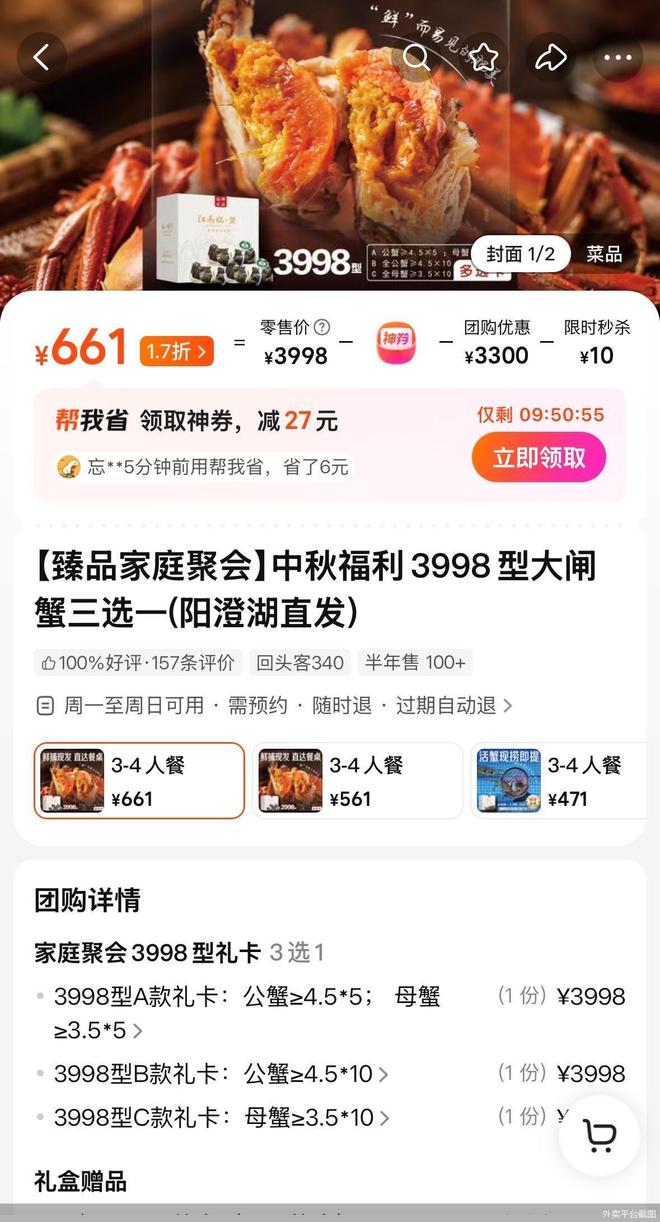
Beijing Business Daily reporter saw through the takeout platform that some merchants selling hairy crabs also provide crab cards, and the models correspond to the selling prices. For example, the original price of type 888 hairy crabs is 888 yuan, and the original price of type 3998 crab cards is 3,998 yuan, giving consumers the illusion that the model is the face value. The discounts of this type of crab card are astonishingly large. For example, the 888-type hairy crab is discounted to 179 yuan after adding the 700 yuan group purchase discount. The 3998 type crab card is 661 yuan after subtracting the group purchase discount and limited-time flash sale, which is equivalent to a 2.1% discount and a 1.7% discount respectively.
In this regard, a reporter from the Beijing Business Daily contacted the above-mentioned merchant, and the other party said that the 888 model was only an auspicious number for the setting, and the price setting of the original price of "888 yuan" and the current price of 179 yuan was indicated as a company setting, and the rest was not clear.
The rule of "model corresponds to face value" is not universal in the industry, and the above-mentioned "word game" is more likely to become a consumer trap. Once consumers want to horizontally compare crab card models and product specifications of different brands, problems arise: many merchants' crab card models and crab specifications are not related.
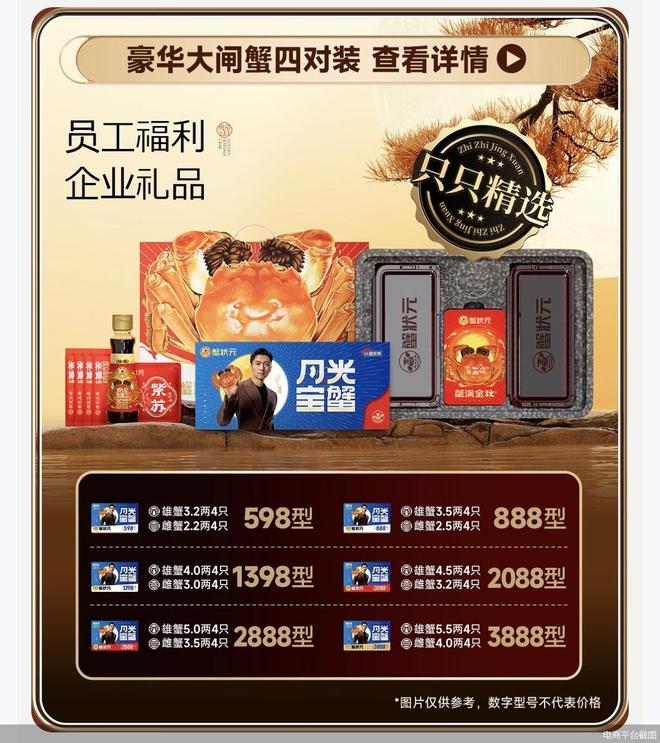
Some merchants have made it clear that the model number of the crab card does not mean the selling price. According to the e-commerce platform, Xizhuangyuan sells a variety of crab cards such as Type 598, Type 1088, and Type 2888. Different types of crab cards correspond to different specifications of crabs. For example, Type 598 comes with 3.2 taels of male crabs and 2.2 taels of female crabs, packed in four pairs, priced at 268 yuan, while Type 2888 comes with four pairs of 5.0 taels of male crabs and 3.5 taels of female crabs, with the original price of 1,298 yuan. It is worth noting that the homepage of its store also states that "pictures are for reference only, and the numerical model does not represent the price."
What makes consumers even more confused is that even if the crabs have the same specifications, the crab card models and sales prices marked by different stores are different. A reporter from Beijing Business Daily noticed that Mrs. Crab’s 1288 type crab card corresponds to 4.0 taels of male crabs and 3.0 taels of female crabs, a total of 4 pairs of 8 pieces, with the original price of 334.44 yuan, while Crab Zhuangyuan’s 4 pairs of 4.0 taels of male crabs and 3.0 taels of female crabs correspond to type 1398, which is 838 yuan before the discount. There is also a store selling Yangcheng Lake hairy crabs. According to the store, the crab card of this size is type 1888, and the original price is 497.5 yuan.
In this regard, the customer service of Crab Zhuangyuan JD.com’s self-operated flagship store stated that the stores all have the same model, and the model is related to the size and quantity of crabs. The standards for formulating models are not clear. The customer service of the above-mentioned store selling Yangcheng Lake hairy crabs said that the model number is just a specification code, which corresponds to the different sizes of hairy crabs that can be lifted. Just like car models, each store has an independent model system.
"The earliest appearance of crab cards was actually for the convenience of picking up goods, and was just a form of redemption coupons. But later, especially after entering the stage of online sales, the nature of crab cards changed and became "paper crabs". The selling price has been unlimitedly decoupled from the crab itself, and each company has different practices. "Lao Wang (pseudonym), a merchant who has been selling hairy crabs for many years, told a reporter from Beijing Business Daily that most crab cards now only have a "type" and do not specify the specific amount. The earliest crab cards were actually coupons of equal value, and type 468 was 468 yuan. Nowadays, the face value and selling price of crab cards are no longer equal. From the perspective of buyers, this phenomenon has also contributed to the growth of this phenomenon to a certain extent. Some consumers prefer high ticket prices and want to buy them at the lowest possible price.
The crab card sells for 308 yuan, and is only worth 170 yuan when recycled
On second-hand platforms, the price of crab cards of the same brand has already been greatly discounted.
Second-hand platforms show that the price of Mrs. Crab’s 2026 model 1288, 1628 and 2218 crab cards are 190 yuan, 260 yuan and 360 yuan respectively, while the current discounted prices of Mrs. Crab’s JD.com self-operated flagship stores are 258 yuan, 308 yuan and 448 yuan respectively. The discount intensity on the second-hand platform is about 20% off the discounted price in JD.com’s self-operated stores.
Coincidentally, the 598, 728 and 768 crab cards in Crab Zhuangyuan’s JD.com self-operated flagship store are priced at 268 yuan, 328 yuan and 345 yuan respectively, while the prices on second-hand platforms are 155 yuan, 188 yuan and 185 yuan respectively, with discounts ranging from 54% to 52% off.
Faced with the above-mentioned selling prices, it is not difficult to imagine that the second-hand crab card recycling market, which was active in previous years, will also experience a "chill". On second-hand platforms, many crab cards bought for more than 200 yuan can only be exchanged for 100 yuan. A merchant who recycles crab cards said that the overall recycling price this year is about 20% lower than in previous years, and some crab cards without brand endorsement are directly rejected.
Take the three types of crab cards, type 1288, type 1628 and type 2218, priced at 258 yuan, 308 yuan and 448 yuan respectively in Mrs. Crab JD.com’s self-operated flagship store. The above-mentioned merchant said that the current recycling prices of the three types of crab cards are 120 yuan, 170 yuan and 250 yuan respectively. It is estimated that the size of 1288 type hairy crabs is 8 (male 4.0, female 3.0), which is equivalent to only 15 yuan per crab.
In the opinion of industry insiders, crab cards are essentially just delivery vouchers. The amount of card issuance is not limited by the crab spot inventory, and over-issuance is prone to occur. In the past, crab cards were very popular, largely relying on the demand for gifts, and there were also "scalpers" who flipped the cards and resold them for profit. Merchants often create the illusion of high prices by marking "model numbers" with high numbers. The premium comes from the gift scene, not the value of the crab itself. This year, the spot price of hairy crabs has dropped, market demand has weakened, and the resale and circulation path has been blocked. The price of crab cards has fallen rapidly, and the premium space that was falsely high in the early stage has also been squeezed.
A front-line crab farmer revealed that the profit logic of crab card merchants has long been separated from the price difference between the purchase and sale of the hairy crabs themselves. By locking the advance payment by pre-selling crab cards in advance, merchants can directly earn the accumulated income of funds. Once the pickup channel is closed or the brand's official website is suspended, consumers often fall into rights protection difficulties due to incomplete information when purchasing cards. The corresponding card funds will be directly converted into merchants' income. At the same time, a large number of card buyers do not complete the pickup due to idleness, forgetfulness and other reasons, and the revenue corresponding to expired crab cards will also be fully included in the merchant's profit. In addition, some merchants have limited the pick-up time. The peak pick-up time of many crab cards is concentrated in late October. At this time, hairy crabs are intensively on the market. The market wholesale price has dropped significantly compared with the Mid-Autumn Festival and National Day peak season. Merchants can use the price difference in the time window to significantly reduce procurement costs.
There are many routines and the difficulties in standardizing the industry need to be solved
In addition to the numerous crab card models mentioned above and the different prices for the same model, and the confusion about the correspondence between models and prices, many consumers also encounter problems every year during the hairy crab consumption season. Beijing Business Daily reporters browsed social platforms and found that many consumers mentioned problems such as failure to redeem crab cards, being unable to contact merchants, poor quality crabs after arrival, and being unable to return them after the appointment time. Some consumers also mentioned that even if the crabs they received were of poor quality because they were sent by others, they did not complain because of face.
A merchant who has been operating an e-commerce business for many years reminded that consumers should pay attention to whether the weight contains rope. Some merchants will adjust the thickness of the rope based on the actual selling price. At the same time, there are also crab cards that have a set validity period. Consumers cannot make reservations to pick up crabs during the season, and the crab coupons become invalid after the expiration date. In addition, the picker and the buyer are different. The crab card only states the quantity but not the specification, and the specifications of the arriving crabs are not guaranteed. In addition, some businesses use word games to blur the origin of products to mislead consumers and deliberately avoid regulatory requirements. In this context, some sellers are also taking the initiative to demonstrate compliance. A reporter from Beijing Business Daily saw on the details page of some stores that some merchants specifically marked "weighing without rope (5% water loss rate), only compensation for missing weight", and some merchants said that the crab card is permanently valid if it is not used.
Lao Wang mentioned that many consumers who purchased crabs at the store have reported to the merchant that they have encountered situations where they were unable to make reservations for delivery, and the quality of the actual crabs they received was completely inconsistent with the quality of the promotional video. Such complaints are very common in the industry. The rectification of the crab card chaos cannot be completed in a short period of time. Consumers must first establish the basic judgment of "you get what you pay for" and pay attention to choosing a reasonable and feasible price when purchasing. This is the most direct way to protect their own rights and interests.
Fu Yifu, a special researcher at Suzhou Commercial Bank, said that the crab card model has been alienated from "reference selling price" to a pure marketing symbol. Behind this is the distorted transformation of the industry from "gift pricing" to "arbitrage pricing". In the past, models roughly corresponded to crab specifications and market prices. Nowadays, merchants mark up models just to create the illusion of high-end. The actual selling price is determined by channel layer-by-layer markups or discount sales, and the pricing power is divorced from the product value itself. The deeper change is that the financial attribute of the crab card once outweighed the attribute of the delivery voucher. Merchants are betting that "those who buy will not eat, and those who eat will not buy", and part of their income comes from unredeemed precipitated funds. In the long run, this model will continue to erode consumer trust, eventually forcing the industry to return from "selling cards for arbitrage" to "selling crabs to fulfill contracts." However, the cost of price chaos and trust repair during the transition period will be borne by the entire industry.
Regarding the chaos in the industry, Hou Wenjie, secretary-general of Yuce Think Tank, suggested that the crab card should be promoted to return to the essence of delivery vouchers. Actual specifications and net weights should be uniformly marked, and model numbers should not be used to replace pricing basis. Pickup reservation rules and expiration treatment plans should be clearly displayed on the sales page, and platform advance compensation and blacklist mechanisms should be established in advance. In addition, we should increase random inspections and penalties for increased weight of ropes and false propaganda about origin, reduce the cost of consumer rights protection, open channels for complaints and collective rights protection, and make prices, specifications, and contract performance verifiable and accountable.
Comments