
Abstract:
If you have ever been curious about how the notorious Theranos founder Elizabeth Holmes worked back then, there is now an extremely detailed interactive website that allows people to almost "sit at her desk" and personally look through her computers, mobile phones and company information.
Visit:
https://www.theranos.world/
This website, created by Extend engineer Bo Lau, was inspired by the vast amount of evidence released by the U.S. judicial system during the United States v. Elizabeth Holmes trial. During the trial of the case, more than 1,000 emails, presentations, text messages, and various internal documents were disclosed, and Lau reorganized these materials that were originally scattered in a large number of court documents into a virtual office environment that can be browsed directly.
After entering the website, the user is not faced with an ordinary information database, but a desk that simulates Holmes's office. Her MacBook Air and iPhone from that year are placed on the desktop. Users can click on these devices to open the corresponding content in the virtual environment.
In order to restore the user experience of that year as much as possible, the entire environment is even set in the technical background around 2016. The iPhone at that time was still equipped with a physical Home button, and the unlocking method was still the classic slide unlock, while the MacBook Air on the desktop was running OS X El Capitan.
Users can browse a large amount of real materials in the interface of iPhone and MacBook, including text messages, emails, presentations and other company documents released by Holmes in the case. These contents are not made up out of thin air by the developers, but come from court evidence disclosed during the trial of the "United States v. Holmes" criminal case.
One of the most interesting aspects of this project is that it does not simply turn Theranos-related materials into a traditional PDF database. Users can click and browse between different applications and files just like operating a real computer or mobile phone, thereby more intuitively understanding what happened inside Theranos back then.
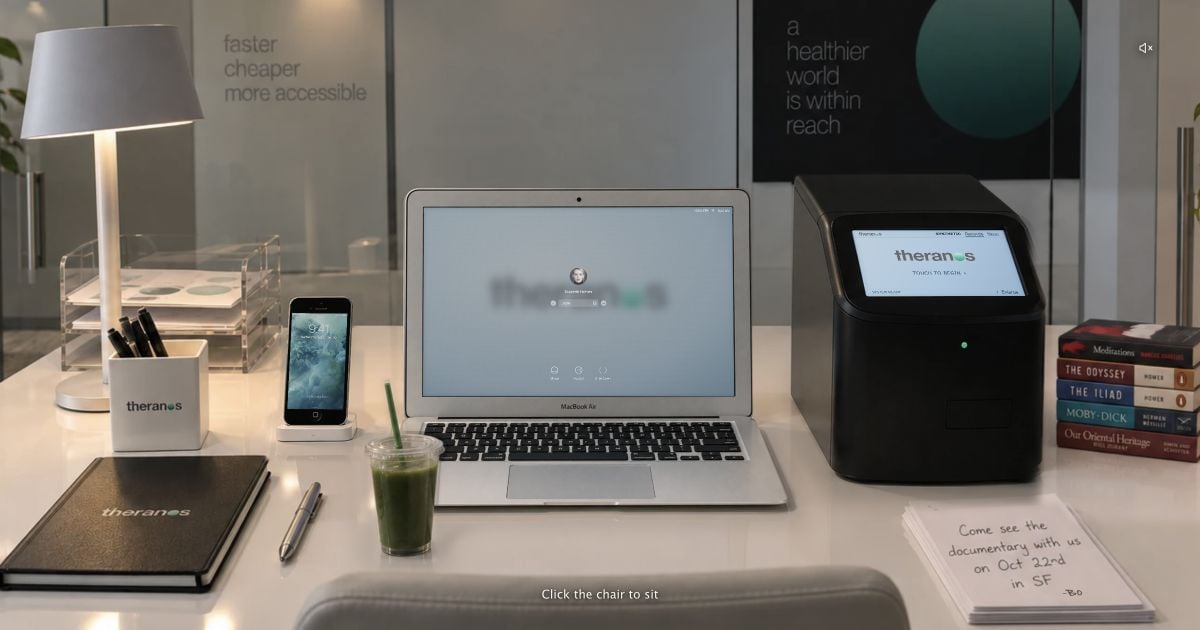
The website even provides a simulated environment that can operate the Theranos "Edison" device.
Edison was once Theranos’ most iconic technology product. Holmes and his company have claimed that this device can complete a large number of medical tests using a very small amount of blood, and have used this as the company's core technical selling point to subvert the traditional medical testing industry.
In the end, Theranos' technical capabilities fell far short of what it had advertised, and the company subsequently fell into a series of investigations, lawsuits, and regulatory crises, culminating in its complete collapse. Holmes was later convicted and sentenced to more than 11 years in prison on charges including defrauding investors.
Therefore, "running" Edison directly in this interactive website will produce a very special sense of history: users are not simply reading reports about Theranos, but are exposed to real equipment records and company documents left in that year in a simulated office environment.
Lau said that the reason why this project can be so detailed is largely due to the evidence disclosure mechanism in the American judicial process. A large number of documents that originally only required lawyers, investigators and reporters to peruse were made public during the case trial, allowing ordinary people to have access to the large amount of information left inside Theranos.
From the actual use experience, this method is indeed easier to understand than directly facing thousands of court PDFs. Traditional court documents are often organized according to legal procedures such as evidence number and submission time. It takes an ordinary reader a lot of time to find the relationship between relevant emails, text messages and internal documents.
With the virtual desk method, users can start with the equipment and interface, and then gradually enter the specific files. This turns a large amount of otherwise boring legal evidence into an experience akin to “digital archeology.”
Of course, this site is not just a purely historical archival project.
Lau's company, Extend, also used this opportunity to conduct a creative product display. Extend is a document processing company that promotes the parsing, extraction, and splitting of complex documents, and the Theranos Desk project itself demonstrates how large amounts of complex historical documents can be reorganized into an easily navigable digital environment.
Additionally, the project has ties to the upcoming Elizabeth Holmes documentary You Can See Everything. Extend is hosting viewing events around the documentary, produced by Nathan Fielder, and an interactive website is part of the promotion.
"You Can See Everything" itself is also one of the important reasons why the topic of Theranos has heated up again recently. The documentary premiered secretly at the Telluride Film Festival and attracted considerable attention. It was subsequently distributed by A24 and is scheduled to be released on October 16.
Holmes and Theranos have continuously re-entered the public eye in recent years. On the one hand, it is related to documentaries and film and television works, and on the other hand, it is also related to the subsequent development of the case. This startup, once valued at approximately $9 billion, has now become one of the most typical failure cases in the history of Silicon Valley entrepreneurship.
Theranos originally told a very attractive story: through a revolutionary micro-blood testing technology, only a few drops of blood can be used to complete a large number of tests in a very short time. If this technology is realized, it may completely change the traditional medical testing industry.
It is this attractive narrative that has allowed Theranos to attract a large number of well-known investors and board members, and it has quickly become one of the most watched startups in Silicon Valley. But as the investigation deepened, people gradually discovered that there was a huge gap between the company's actual technical capabilities and its public propaganda.
In 2015, Wall Street Journal reporter John Carreiro revealed serious problems with Theranos technology in a series of investigative reports. Since then, regulatory authorities, investors and other institutions have successively intervened in investigations. Theranos eventually collapsed in 2018, and Holmes was convicted of multiple fraud charges in 2022.
Today, this interactive website actually provides a very alternative way to re-examine this period of history. It did not re-shoot a documentary or create a traditional digital museum, but directly put the emails, text messages, presentations and equipment records that were released back then into an operational virtual work environment.
This also allows a technology entrepreneurial story that has ended for many years to regain a "liveness". Users can see what computers looked like back then, how mobile phones operate, how company files are organized, and even try to run Edison devices that were once hailed as revolutionary products.
For those who study the Theranos incident, this form may be more intuitive than simply reading news reports; for ordinary Internet users, it is more like a digital experience entering the historical scene of Silicon Valley.
This also illustrates the value of open judicial documents from another perspective. A large amount of evidence was originally just legal materials during the case trial, but after being reorganized and interactively presented, they can become a very vivid historical archive, allowing people to directly observe how an entrepreneurial myth that was once worth billions of dollars was established and how it finally collapsed.
Comments