
Abstract:
The expansion of artificial intelligence infrastructure is expected to become the largest economic bet in U.S. history, far exceeding the scale of investment in large-scale U.S. infrastructure projects such as railroads, highway systems, and the underlying infrastructure of the Internet. The Brookings Institution released the latest calculations by economist Steyn van Neuwerberg, which shows that total investment in data centers and supporting artificial intelligence infrastructure is expected to reach US$10.3 trillion between 2025 and 2032, with the average annual investment accounting for 3.6% of GDP. The U.S. economy has never been so dependent on the infrastructure expansion of a single industry.
This investment is reshaping every sector of the economy, creating hundreds of thousands of jobs and creating new billionaires.
At the same time, it also contains huge risks: a large amount of investment is supported by debt. Once growth suddenly stalls, shock waves will sweep through the U.S. economy.
There is uncertainty about investment forecasts, and the final total expenditure is likely to be significantly lower than expected. Even so, the amount of money being poured into data centers this year is unprecedented in modern times. Goldman Sachs’ latest estimate is that U.S. artificial intelligence investment will account for 1.9% of GDP in 2026. The last time a single emerging industry expanded to account for such a high proportion of the economy was during the railroad boom at the end of the 19th century.
Huge amounts of money are having an important impact on the economy in many ways:
Construction Industry
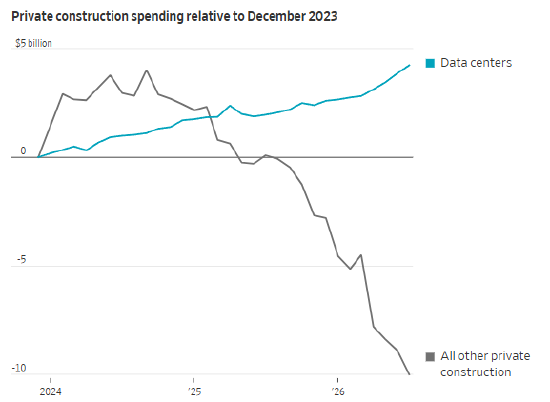
A large amount of money poured into the construction of data centers, becoming a bright spot in the overall sluggish environment of the construction industry.
U.S. Department of Commerce data shows that as of July this year, seasonally adjusted private data center construction spending reached $37 billion, about $9 billion higher than the first seven months of last year.
In the first seven months of this year, spending on other private construction projects such as residences, apartments, and shopping malls decreased by approximately US$46 billion year-on-year.
Large cloud vendors continue to occupy scarce labor and power resources, raising the operating costs of other companies. The Federal Reserve Bank of Richmond recently reported that data center construction is exacerbating labor shortages in its jurisdiction.
Informed sources revealed that an aluminum smelting plant was expected to be built in Mississippi last year, and the project was expected to create 1,000 long-term jobs. However, a new data center was announced near the proposed plant site in Fort Walker, which occupied the power needed by the smelter. The location of the smelter was eventually changed to Oklahoma.
The pressure doesn’t just come from electricity: data center projects in multiple locations are driving up land costs. "It's squeezing the space for manufacturing," said Dee Dee Caldwell, an industrial site selection consultant.
Financing and Risk
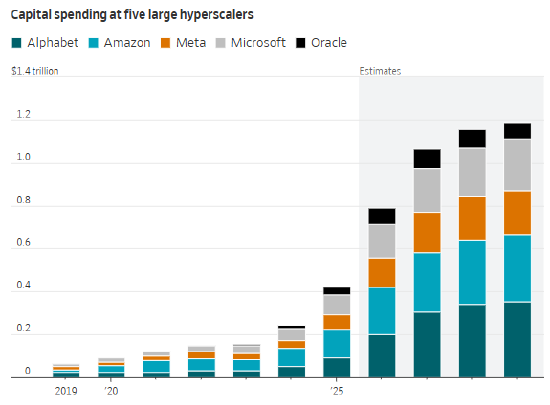
FactSet data shows that analysts estimate that in the four years to 2029, the total capital expenditures of the five major cloud giants-Alphabet, Amazon, Metaverse Platform, Microsoft, and Oracle will reach US$4.2 trillion, of which more and more funds will rely on debt financing.
If this boom bubble bursts, spending on this scale will pose risks to the financial industry. Van Neuwerberg said technology companies often borrow from banks and private credit institutions through off-balance sheet entities, with little public disclosure of such transactions. He added that this model makes it difficult for outsiders to assess real financial risks. If the revenue generated by the artificial intelligence business is not enough to repay the debt borrowed to build the data center, the risk will spread along the financial system.
Employment
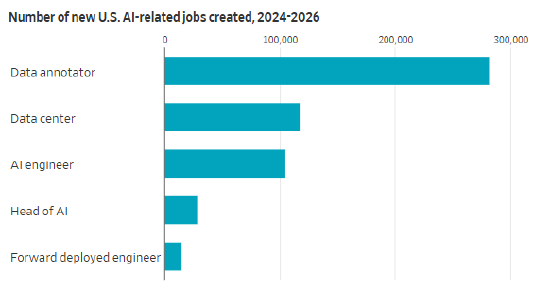
Economists remain divided over whether artificial intelligence has significantly impacted white-collar employment. But what is clear is that this round of infrastructure expansion has brought about an extreme shortage of some jobs. LinkedIn estimates that from 2023 to 2026 to the present, there will be more than 750,000 new artificial intelligence-related positions in the United States, with generous salary levels: the median salary for artificial intelligence job recruitment on the LinkedIn platform is about US$180,000, while the median salary for the entire industry is only US$80,000. "In a downturn in the overall job market, this is one of the few sectors that remains strong," said Corey Cantenga, LinkedIn's head of economics for the Americas.
White-collar positions such as data annotators and artificial intelligence engineers constitute the main force of new employment; since the beginning of 2024, employers have also added 117,000 data center positions. That’s not counting construction jobs, many of which are non-permanent.
Don Sleiman, political coordinator of Local Chapter 26 of the International Brotherhood of Electrical Workers, said that the number of union electricians in the Washington, DC area has increased from 9,000 to 17,500 in recent years. "Many people come here to work and repay their college student loans." Kwaku Afriye, 23, has an undergraduate degree in cybersecurity and previously worked in entry-level information technology positions. He was once worried that artificial intelligence would take away his job. Last year he switched careers as an electrician and is now responsible for assembling data center equipment. The apprenticeship earns about $30 an hour.
Senior electricians can earn up to twice this amount. Tyler Beam, 28, has spent much of the past two years building data centers for a company that delivers prefabricated components to Amazon data center sites across the United States. The electrician was recently making $62 an hour, plus overtime. He typically works 58 hours a week and receives double pay during certain periods. "They want to build the computer room as quickly as possible." Rising income drives consumption: Beam recently purchased a GMC Yukon off-road vehicle and was looking at a house at the same time.
Wealth Effect
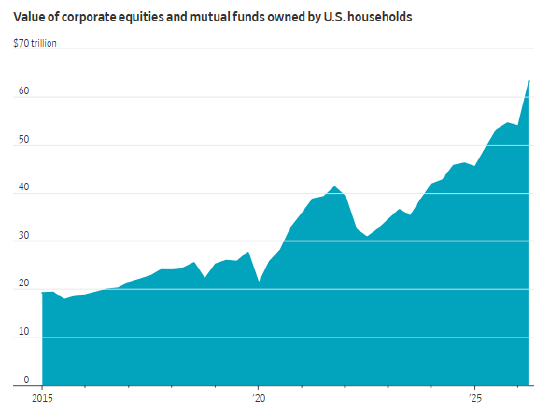
The rise in the stock market driven by artificial intelligence has brought huge paper wealth. Federal Reserve data shows that as of the second quarter, U.S. resident stock and mutual fund assets totaled $63 trillion, almost double from the end of 2022. Even if wage growth after excluding inflation is weak, this trend still supports household consumption. Wealth growth is concentrated among high-income groups. Compared with the middle class, the wealthy allocate more of their net assets to stock assets.
U.S. residential sales have been sluggish for four consecutive years, but in Silicon Valley, the wealth generated by artificial intelligence has driven a boom in luxury home transactions. Real estate agent Ken DeLeon said: "This is the best market since 2000." DeLeon recently listed a five-bedroom house with a price of $9.9 million. He received 7 offers and signed a contract for more than $13 million within two weeks. The buyer is an artificial intelligence entrepreneur.
Inflation
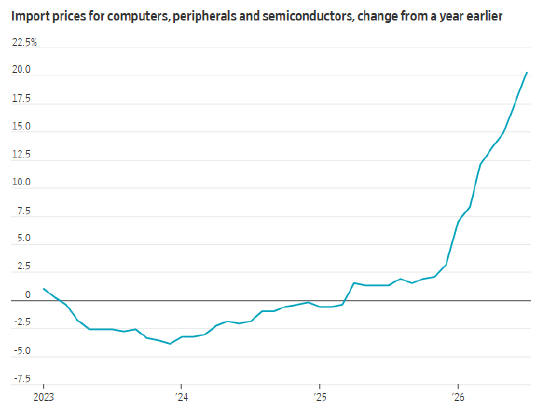
Strong demand for data center equipment, especially memory chips, has caused supply shortages and pushed up the cost of high-tech products. In August, importers' prices for peripherals such as computers and hard drives and semiconductors increased by 20% year-on-year. Higher import prices will in turn put upward pressure on the costs of some consumer goods (such as Apple mobile phones and game consoles) and boost inflation.
Austan Goolsby, president of the Federal Reserve Bank of Chicago, recently warned that investment in data centers is pushing up wages in related industries. Federal Reserve Board Governor Kevin Warsh suggested that debt borrowing by large cloud vendors is one of the reasons for higher long-term interest rates, which has made home purchases more burdensome for millions of Americans. Electricity bills in many areas with dense data centers have also risen sharply.
Comments