
Abstract:
On September 29, according to Bloomberg, AMD announced on Monday that it would acquire World Labs, an AI startup founded by "AI godmother" Li Feifei, for US$8.2 billion. AMD CEO Lisa Su and Li Feifei interpreted the deal in a joint interview.
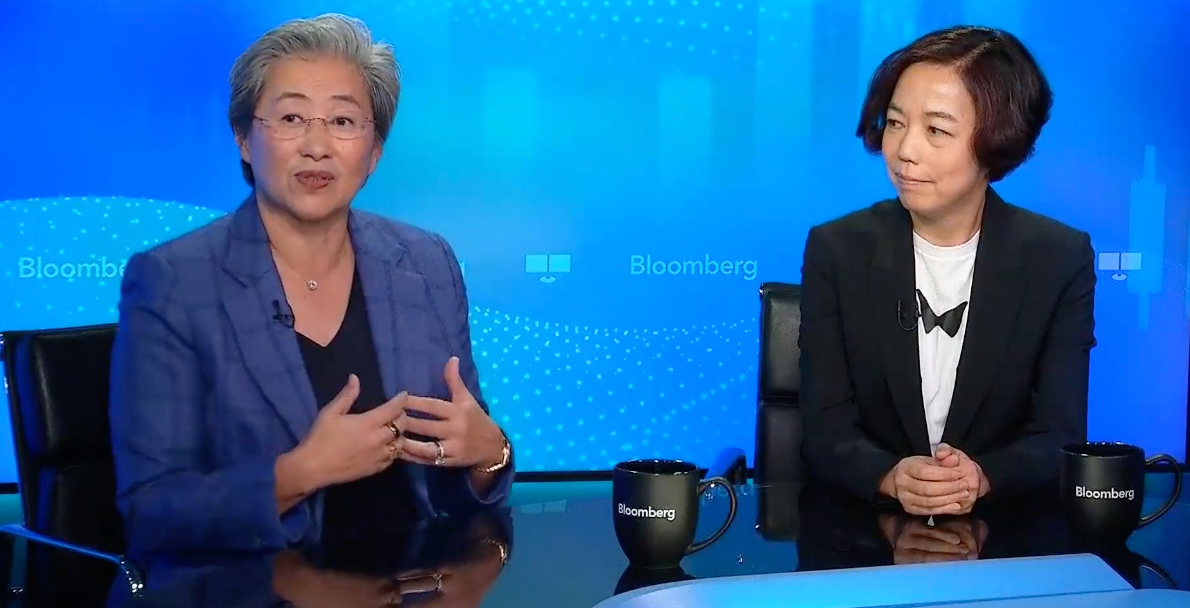
Su Zifeng and Li Feifei were interviewed
As Nvidia’s main rival in the AI chip market, AMD will gain access to a team of top researchers and their models through this transaction, while also being able to understand the evolving trends in the AI field. This should help the company plan future hardware products.
Su Zifeng said in an interview with Bloomberg TV: "The deeper you understand the entire end-to-end process, the better you can build a better system. This is why we acquired World Labs. In order to obtain the world's top talents brought together by Feifei Li and combine these talents with AMD's capabilities in hardware, software and systems."
World Labs develops so-called "world models," a type of AI software that can run applications in the physical world. These models are capable of generating and reconstructing three-dimensional environments. The company says the technologies could be used to advance areas such as robotics, scientific discovery and factory equipment.
Li Feifei, who previously served as CEO of World Labs, is a renowned researcher and computer scientist at Stanford University. As part of the acquisition, she will join AMD as executive vice president and chief scientist, reporting directly to Su Zifeng.
“As the company grows, our ambitions continue to expand.” Li Feifei said in an interview with Bloomberg TV. This also increases the company's need for computing power, she said.
"At this stage, if we can work together with AMD, we can really create an opportunity for ourselves, AMD and the entire ecosystem to accelerate the flywheel effect between software and hardware development." She said. The flywheel effect refers to a virtuous cycle: each link promotes and strengthens each other, causing the entire system to accelerate development.
The deal will also help bolster AMD's product line, allowing it to offer multiple AI models to customers. The company has been expanding its product lineup in an effort to sell more products and services to data center customers, its largest source of revenue. AMD's idea is to provide all the elements needed to quickly build a data center and put it into operation.
"You will have both open source models and proprietary models," Su said. "AMD has been contributing to this area. I think we will further expand this contribution."
Su Zifeng added that the company’s ultimate goal is to build better AI, “Our ambition is to define the future of AI computing.”
AMD's larger rival Nvidia has taken the lead in bundling equipment and services with AI chips to help customers quickly deploy and put them into operation. Now, Nvidia is using this strategy to target new types of customers, beyond the cloud computing giants that have powered much of its growth until now.
Nvidia recently agreed to acquire Hugging Face, another high-profile AI startup, in a deal that values it at approximately $13 billion.
Comments