
Abstract:
According to the "Wall Street Journal" report, Nvidia is increasing its focus on "Physical AI" (Physical AI) businesses such as robots and self-driving cars, and China has become an important market for this strategy. Although the United States restricts Nvidia from selling its most advanced AI chips to China, trade in some chips for the robotics and automotive fields remains open.
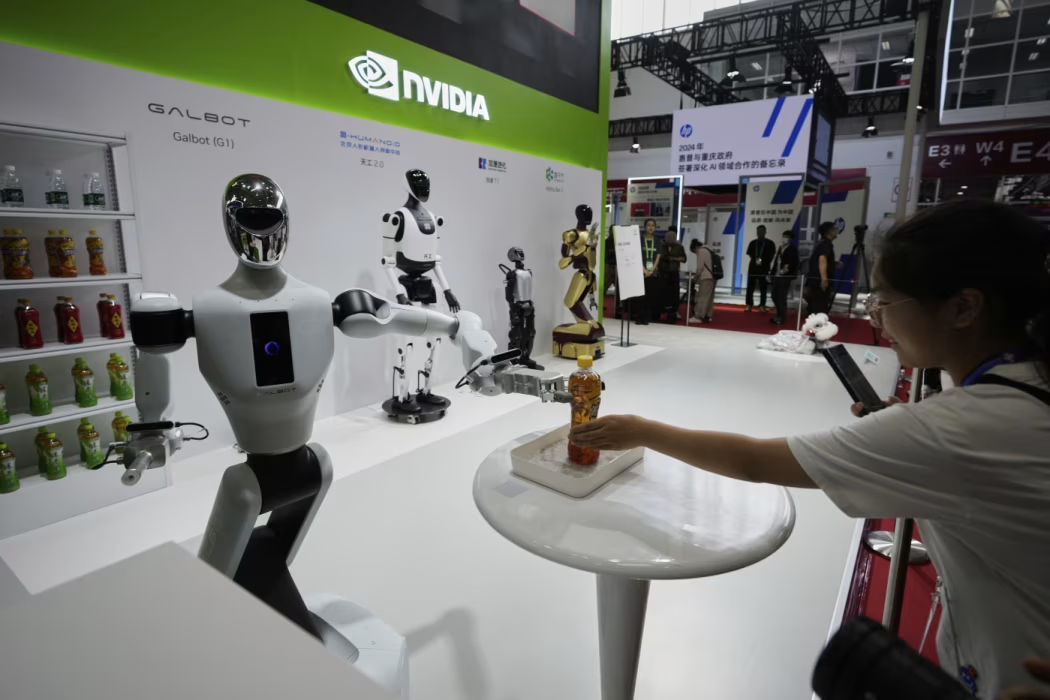
Currently, the physics AI business has brought NVIDIA approximately US$10 billion in revenue each year. Compared with Nvidia’s total revenue of US$303 billion in the past four quarters as of July this year, the scale of this business is still small, but Nvidia CEO Huang Renxun predicts that the scale of the physical AI business will increase 10 times in the next ten years.
Nvidia’s strategy is similar to its strategy in the data center AI market, which is to build a development ecosystem through the combination of chips and software. In addition to providing chips for robots and other equipment, NVIDIA also provides developers with open weight models such as GR00T and Cosmos, as well as software and hardware tools for robots and autonomous driving development.
Radian Intel CEO Michael Frank believes that physical AI provides Nvidia with a path from the data center into the broader real economy such as cars, factories, warehouses and robots.
China is an important part of NVIDIA’s physical AI layout. Counterpoint Research analyst Brady Wang said that Chinese companies have advantages in manufacturing and commercialization of new technologies, and cooperation with Chinese companies can provide Nvidia with a large number of real application scenarios.

Huang Renxun's daughter Madison Huang attended the World Robot Conference in Beijing this month
According to reports, China is the world's largest industrial robot market. In the first half of this year, Chinese companies accounted for approximately 90% of global humanoid robot shipments. At the same time, although China is promoting the development of its local AI chip industry, according to industry insiders, Chinese robot manufacturers currently still rely more on Nvidia chips and software tools when training and running robots.
In laboratories in the United States and China, NVIDIA has used humanoid robots from different manufacturers for data collection and experiments, including products from Yushu Technology, Zhiyuan Robotics and Fourier Intelligence. People familiar with the matter also said that Chinese robotics companies such as Yushu Technology have already used Nvidia’s latest Thor chip.
Nvidia is also strengthening its Chinese robotics and autonomous driving teams. According to the report, judging from NVIDIA’s company website and recruitment-related information, its Chinese team is expanding relevant personnel, and some of the research papers published by NVIDIA also include the contributions of Chinese researchers and Chinese university interns.
An Nvidia spokesperson said that the company cooperates with global companies on the premise of complying with U.S. laws. Regarding open models and open source materials, Nvidia said that physical AI will be built together by a broad industrial ecosystem rather than relying on a single company.
This model is similar to NVIDIA’s previous reliance on CUDA to build an AI computing ecosystem. Nearly 20 years ago, NVIDIA launched CUDA, which enables developers to write programs for its GPU and improves developer stickiness through the combination of hardware and software. Now, Nvidia is trying to copy similar software and hardware ecological strategies to the robot market.
In July this year, Jen-Hsun Huang said that NVIDIA is first optimistic about autonomous vehicles, believing that this is one of the first applications in robotics with sufficient market scale and real economic value. Its current customers include Alphabet's Waymo and Tesla, as well as Chinese automobile and Robotaxi companies.
However, Nvidia also faces potential uncertainties in the Chinese robot market. According to reports, some Chinese companies have begun testing products from local manufacturers such as Huawei, Black Sesame Intelligence and Horizon to cope with the risk that the United States may further expand export restrictions in the future.
Harry Qin, a former Horizon researcher and entrepreneur who currently uses Nvidia chips and software to develop robotic systems, said that using domestic alternatives is not the primary consideration at this stage, but as the sensitivity of related technologies increases, this situation may change in the future.
Comments