
Abstract:
Poor quality traffic adds another life debt. The news of the death of "Yingying (Gan Fanying)", a famous mukbang internet celebrity who had long caused vomiting, was recently revealed. After the rise of short video platforms, such tragedies have occurred many times. For vloggers, traffic means followers and clicks, as well as the accompanying business ads and money. More or less traffic has gradually become their "inner demon".
Under the complex algorithm of the platform, "Yingying" abandoned the original intention of recording and sharing life, and constantly found new ways to give up the bottom line and "go crazy" in order to gain traffic. Excessive and absurd behaviors not only harm their own health and even lives, but the distorted values behind them also mislead the public, especially causing adverse effects on the physical and mental health of teenagers.
But the irony is that the platform will take a cut of every penny earned by eating and broadcasting celebrities. And when these bloggers have "accidents", the platform often gives them a letter, but seldom reflects, apologizes, or even introduces an intervention mechanism to completely eliminate low-quality traffic.
Some experts said that although laws and regulations clearly prohibit extreme eating and broadcasting, they lack more detailed identification standards and need to make up for it; platforms should change the traffic logic of "surprise first", reduce the weight of recommendations for extreme and novel eating content, and improve account warning and intervention mechanisms.
Another internet celebrity who eats and broadcasts dies. When he was seriously ill, it was revealed that it was caused by eating and broadcasting
“Yingying” has opened accounts on both Kuaishou and Douyin.
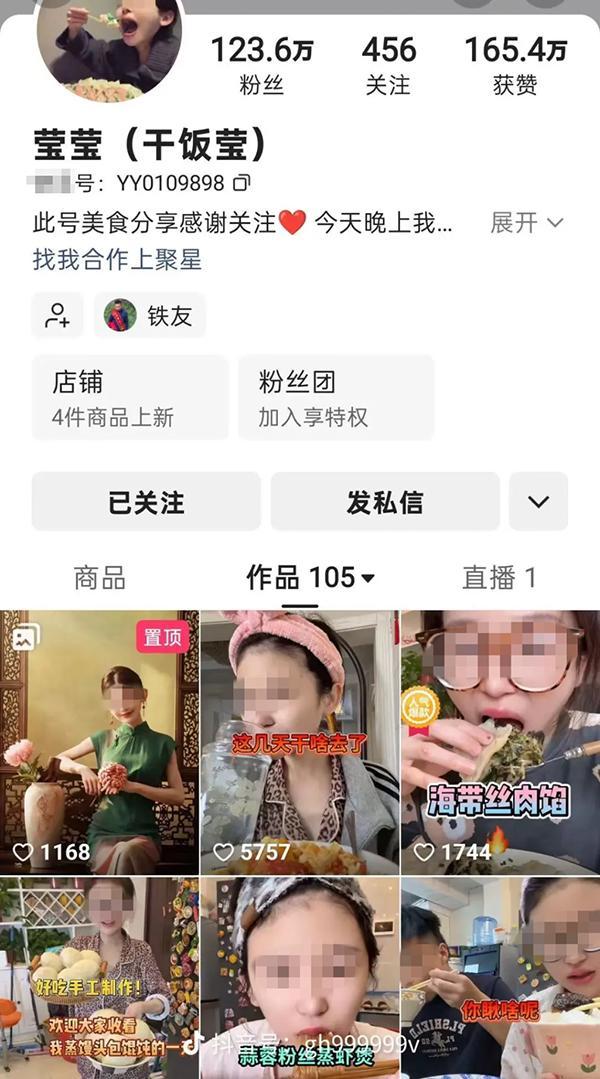
Screenshot of "Yingying" social account
Kuaishou is the main battlefield of “Yingying”. On Kuaishou, this "post-00s" girl from Liaocheng, Shandong Province registered an account with the nickname "Yingying (ganfanying)" to "chat and eat with everyone."
In a few years, "Yingying" has accumulated 1.242 million fans by sharing delicious food and showing off her gluttony.
On August 14, 2026, "Yingying" released her last video work on Kuaishou (note: this video is no longer visible). In the video, "Yingying" said that during the live broadcast two days ago, she ate and ate again and again, and was hospitalized again. "The potassium was as low as about 2.3." "Actually, I also know that it is related to eating and broadcasting." She also revealed that when she was doing live broadcasts, she sometimes had to eat sixty or seventy preserved eggs. "It's not easy to make some money." She also reminded everyone that while making money is important, health always comes first.
The reporter found that after the death of "Yingying", the Kuaishou platform processed the account of "Yingying". Even if you enter the Kuaishou account of "Yingying", you cannot directly enter the homepage of "Yingying". Unless a fan "@" her account, you can click on her homepage.
Ironically, the unfortunate death of "Yingying" actually "created" a hot spot for the short video platform: "An insider revealed that the cause of death was hypokalemia" was on the social list of the platform, and "Yingying, a popular eating and broadcasting star with millions of fans, passed away" became a hot search.
Before "Yingying", short video bloggers such as Pan Mouting, the "big stomach king" who passed away at the age of 24, and Yu Moulong, the "Bubble Bobbler" who passed away at the age of 29, had been engaged in eating and broadcasting for a long time.
The Paper reporter noticed that from the national "Anti-Food Waste Law" to the short video platform's "Code of Conduct for Online Anchors" and the "Announcement on Douyin Live Broadcasting's Continuous Control of 'Bad Eating and Broadcasting'", laws and announcements have expressly prohibited it, but "bad eating and broadcasting" are still banned repeatedly. Even after "Yingying" passed away, there are still many bloggers who continue to engage in "nutritious" eating and broadcasting. Some comments pointed out that this is still driven by traffic, and crazy eating and broadcasting are profitable.
After being downloaded, the internet celebrity of “Drinking Broadcast” never woke up again
In addition to "eating broadcasts", "drinking broadcasts" are also the "hardest hit areas".
In less than a year from May 2023 to April 2024, all four short video bloggers known as the "Big Four" by netizens died.

Among them, in May 2023, Jiangsu Lianyungang anchor "Three Thousand Brother" Wang Moufeng died after drinking a large amount of liquor during a live PK. According to Wang Moufeng’s friends, he drank at least 4 bottles of liquor that night. In the publicly circulated video, he was obviously feeling unwell after drinking the third bottle. He still said to the camera, "I can't help but decide my fate," and then continued to drink the fourth bottle. The live PK didn’t end until the early morning of the next day. A few hours later, Wang Moufeng was found by his family to have no vital signs.
Wang Moufeng once revealed on the short video platform that he had been hospitalized for acute alcohol poisoning, respiratory failure, liver damage, etc. But the doctor's diagnosis and illness failed to stop Wang Moufeng from drinking too much.
Even Wang Moufeng's death did not alert his "comrades": 26-year-old Huang Mou, a man from Sanmenxia, Henan Province, died after attending a live broadcast of a drinking party less than a month after returning from attending Wang Moufeng's funeral.
Even in May this year, there were still short video bloggers who died of overdose due to live streaming of drinking.
Lawyer: Although public interest litigation is feasible, quantifying the damage is difficult
Lin Feiran, a lawyer at Beijing Jingdu Law Firm, pointed out that the "Measures for the Management of Online Performance Business Activities" clearly prohibit live broadcast content from "destroying the physical and mental health of performers", while the "Internet Anchor Code of Conduct" requires platforms to perform review and control obligations for live broadcast content that endangers health. If the platform shares economic benefits such as rewards and traffic from the anchor's dangerous behavior, it should bear corresponding cyberspace security obligations.
Lin Feiran introduced that Article 22 of the "Anti-Food Waste Law" clearly prohibits "the production, release, and dissemination of programs or audio and video information that promote excessive eating, overeating, and other food waste." This article protects food security and social public interests. Illegal eating and broadcasting are essentially harmful to public interests. When the procuratorial organs discover behaviors in the field of food waste that harm public interests in the performance of their duties, they can directly file civil public interest litigation when there is no qualified social organization to sue. In addition, consumer associations can also file public interest litigation against mukbang that misleads the public about unhealthy eating and infringes on the legitimate rights and interests of many consumers.
“The objects of litigation here can simultaneously sue the anchors who produced the illegal content, the MCN organizations that operate the anchors, and the live broadcast platforms that have failed to fulfill their audit obligations. The litigation requests may include stopping the infringement, apologising, and bearing public welfare damages, etc.” Lin Feiran said that theoretically, starting from the legislative purpose of behavioral regulation, as long as the content promotes waste and misleads overeating, it can be deemed to have harmed the public interest, without proving the consequences of damage to specific individuals. However, in practice, there are very few public interest litigation cases directly targeting mukbang. The core difficulty here lies in the issue of damage quantification, that is, it is difficult to accurately calculate the total amount of food waste or public health damage caused by a certain mukbang content. Therefore, certain weighing and measurement of the damage results are required in this regard.
Scholars: Platforms should change the traffic logic of “novelty first”
Scholar Guo Yidan pointed out that after the state introduced special rectifications by the law and the Internet Information Department, the blatant eating and broadcasting of big eaters has been restrained, but the illegal content has continued to spread in a new way: some bloggers started broadcasting late at night, marked "food is not for one person's consumption", packaged it as a sample, and challenged They avoid censorship by using extreme spiciness, eating strange foods, etc., and use words to hide the nature of overeating. There are also bloggers who use editing, fake eating, and stunt photography to create the illusion of "super eating" to deceive the audience, while causing a large amount of food waste, violating the relevant legal requirements against food waste. Existing audits rely more on manual identification, and it is more difficult to identify disguised extreme eating and broadcasting.
In this regard, Guo Yidan suggested that relevant departments can refine the identification standards for extreme eating and broadcasting, and clearly include behaviors such as "deliberately performing excessive amounts of food, promoting gluttony, suggesting vomiting, fake eating, and curious and dangerous eating" into the scope of supervision, clarifying the boundaries between "normal food sharing" and "extreme gluttony performances", and solving the current problem of vague definitions and difficulty in determining some contents; at the same time, improve the departmental coordination mechanism, and link up with cybersecurity, market supervision and other departments to carry out regular special rectification.
Regarding platform responsibility, Guo Yidan said that the platform should optimize the content identification system and establish a special identification model for extreme eating and broadcasting. It not only identifies the "quantity of food", but also identifies comprehensive information such as live broadcast images, copywriting, barrages, and bloggers' physical conditions. It also strengthens the identification of behaviors such as broadcasting late at night, deliberately placing large portions of food, suggesting vomiting, and challenging dangerous eating, and eliminates the loophole of "textual statement exemption". Simply saying "not eaten by one person" cannot exempt the violation from determination.
In addition, the platform should change the traffic logic of "novelty first", reduce the recommendation weight of extreme and novel food content, limit the flow, remove and ban content that promotes overeating; vigorously support positive food content, encourage food sharing, home cooking, and healthy diet science content to gain traffic tilt.
Guo Yidan believes that platforms should improve account warning and intervention mechanisms. We will issue health risk reminders to bloggers who experience physical abnormalities and frequently engage in extreme eating. We will limit the flow of accounts, suspend live broadcasts, and ban accounts for accounts that have repeatedly violated regulations. We will establish a quick response channel for reporting and encourage users to report illegal content on extreme eating and broadcasting.
Comments