
Abstract:
Google researchers recently announced a rather special traffic experiment: They did not try to let all Google Maps users take the "fastest" route. Instead, they deliberately asked a small number of drivers to take a detour in some cases and dispersed the vehicles on different roads to alleviate the originally severely congested traffic bottleneck. The results show that while this approach won't lead to huge improvements, it can have measurable effects in real-world traffic environments.
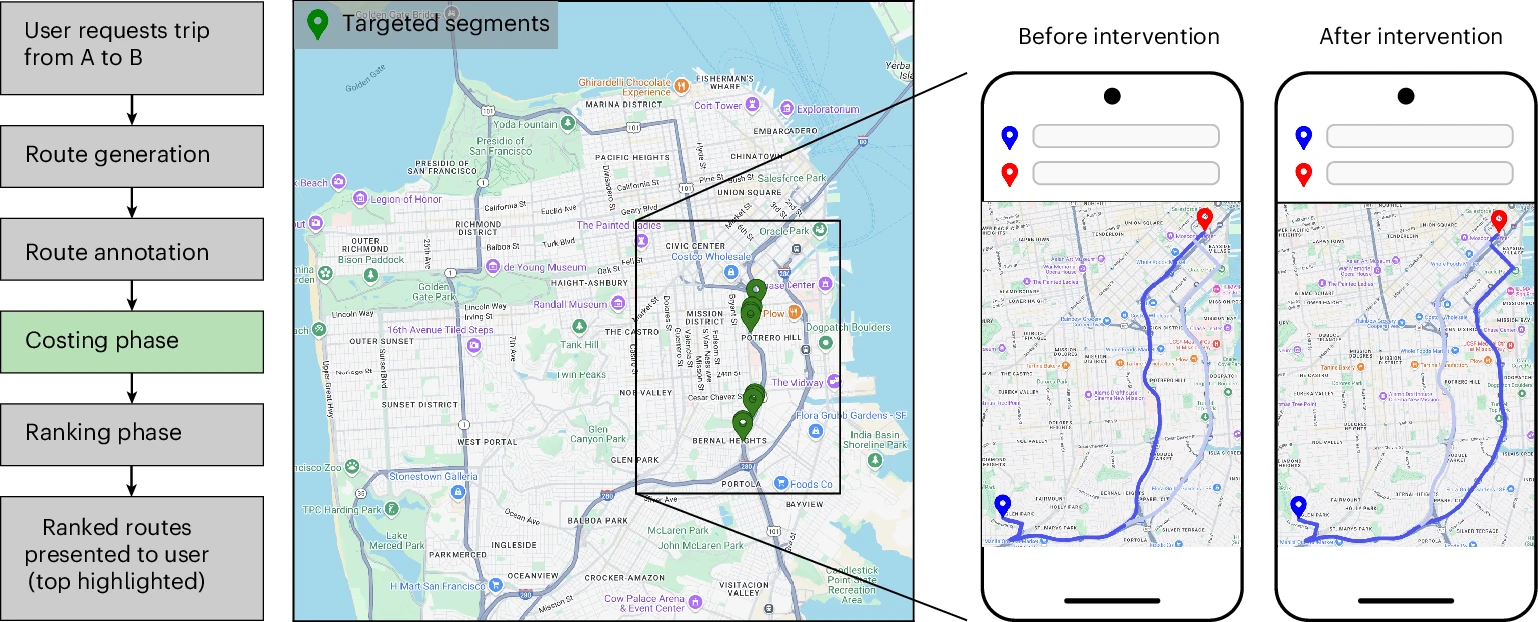
This research was conducted by a team from Google’s research department, and the relevant paper was published in the journal Nature Cities in June this year. The researchers conducted experiments for about six months in 10 cities in the United States, including San Francisco, Los Angeles, Seattle, Salt Lake City, Chicago and Atlanta. They use Google Maps to provide alternative routes to regular routes for a small group of drivers, hoping to spread the traffic that was originally concentrated on a few main roads to more roads.
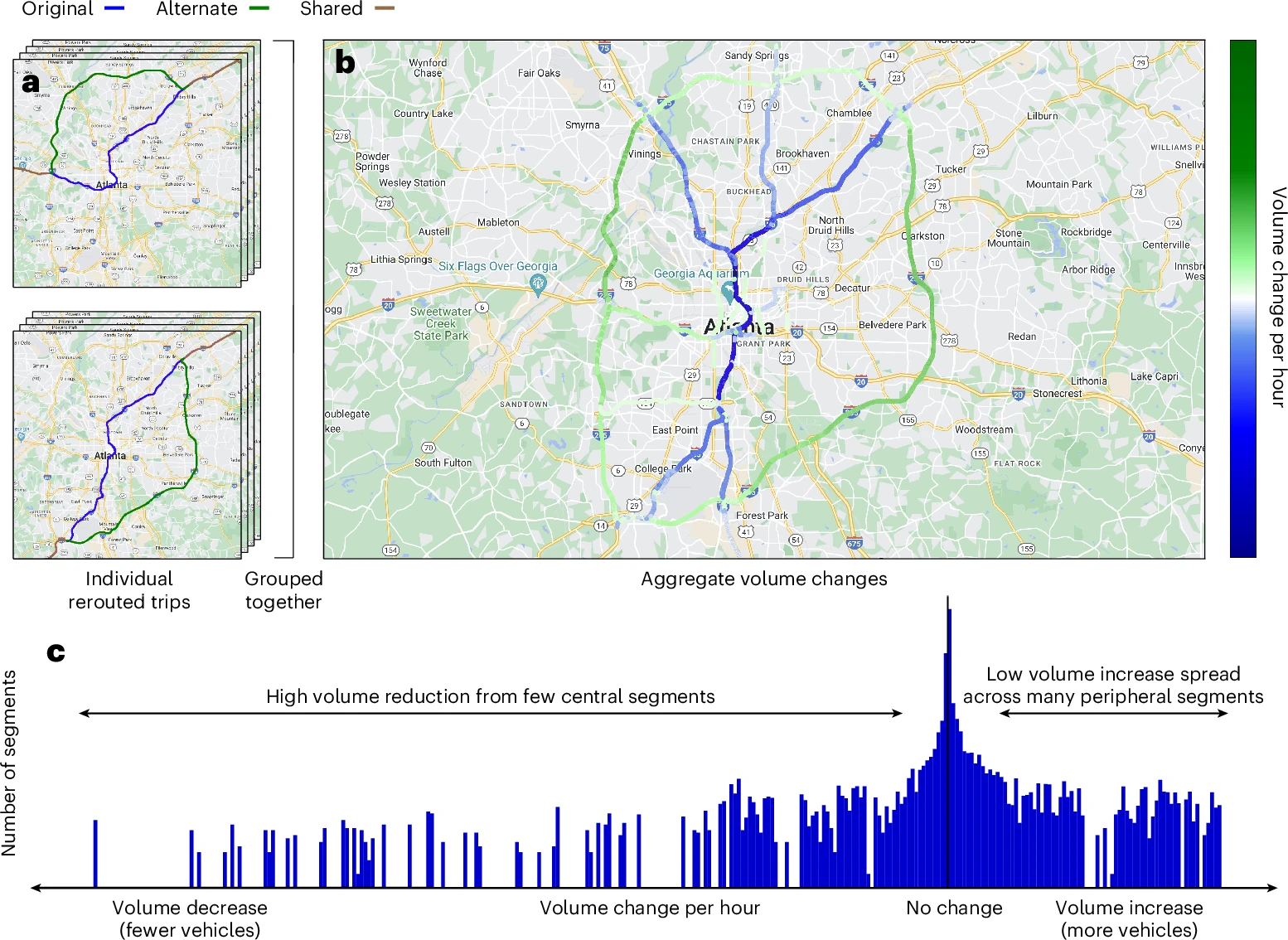
The research team selected approximately 100 road sections in each city as research objects, focusing on road sections that are prone to severe congestion during peak periods, as well as those locations that are prone to traffic bottlenecks due to road conditions. During the experiment, the researchers did not change the navigation routes of all drivers on a large scale, but only asked a small number of vehicles to avoid congestion points.
In San Francisco, for example, researchers diverted some vehicles that would otherwise travel on Route 101 to Interstate 280. For drivers who continue to use Highway 101, the travel time is slightly shortened after the reduction of vehicles, usually saving about 30 seconds or more; while drivers whose routes are rerouted will need to spend some extra time to complete their journey. In other words, a few people bear a little extra distance, but in exchange for smoother traffic flow on the entire congested road section.
From the overall results, this diversion strategy increased the average vehicle speed on the congested roads involved in the experiment by about 2% and shortened the average driving time by about 0.7%. While the numbers may not seem alarming, the researchers argue that they prove a long-standing theory in traffic engineering: that removing just a few vehicles from a road that is approaching saturation can have a noticeable impact on overall traffic flow.
There are also significant differences in effects between cities and road types. In cities such as Los Angeles that focus on highway diversion, the effect is particularly obvious, with the driving speed on relevant road sections increasing by approximately 4.6%. By comparison, overall speed increases in most cities during peak periods are about 0.5%.
Michael Manville, a professor of urban planning at UCLA who was not involved in the study, said the experiment is a good example of a long-held idea in transportation. When a major traffic artery is approaching the critical point of causing serious delays, just directing a small number of vehicles to other roads may produce a "not huge, but noticeable" improvement.
This phenomenon can be understood through the traffic changes in the morning and evening peaks. At 5 or 6 o'clock in the morning, the number of vehicles on the road is relatively small. Even if a few more vehicles are added, the traffic speed will not be significantly affected. But as time goes on, by around 8 a.m., the road may suddenly approach its capacity limit, and adding even a small number of vehicles at this time may cause traffic speeds to drop sharply and impose longer waiting times for all drivers. In turn, if some of these vehicles are diverted away before the critical point is reached, it may be possible to prevent the entire road network from falling into severe congestion.
Research also shows that this approach is not without risks. There is a phenomenon called "induced demand" in traffic engineering. That is, after the road capacity is improved, more people may choose to drive, which will eventually consume the new road capacity. Google researchers believe a similar situation could occur with traffic diversion.
Alexander Bain, co-author of the study and director of the Information Technology Research Center at the University of California, Berkeley, said that if the effect of the diversion measures is too obvious, it may attract more people to drive, eventually returning the roads to congestion. Therefore, they deliberately made only "marginal" adjustments in their experiments, so that the improvements were significant enough to have an overall effect, but not so large that they would cause a large number of potential drivers to change their travel patterns.
This also explains why Google Maps sometimes recommends a route that does not appear to be the shortest, or even longer. Navigation systems do not necessarily only consider the shortest distance for a single user, but need to consider the current congestion on the road as well as the traffic flow of other vehicles. If all drivers were directed to the same theoretical fastest road, that road could quickly become the slowest road due to the addition of additional vehicles. Appropriately distributing some users to other routes may make the entire road network run more efficiently.
The study also addresses the environmental impacts of traffic congestion. The researchers estimate that if this traffic optimization strategy can be implemented continuously over the long term, it could reduce carbon dioxide emissions by about 1,000 metric tons per year, which is equivalent to the emissions of about 200 cars for a year. Although this number is not huge for a large city with millions of cars, the researchers believe that if similar measures can be applied on a long-term and large-scale basis, the cumulative effect is still worthy of attention.
At the same time, this experiment also triggered discussions about the impact of navigation platforms on urban transportation. With more than 2 billion monthly users, Google Maps' reach far exceeds that of most competitors. Because such a large user group uses the same navigation platform, Google actually has the ability to influence the driving routes of a large number of vehicles. In theory, if a platform decided to direct a large number of vehicles from one road to another, it could directly change the flow of traffic in certain areas of a city.
However, the researchers emphasized that drivers can still choose whether to follow the route provided by Google Maps or use other navigation software. Google said that the company has been studying how to help cities solve traffic congestion and emissions problems, and this smaller, shorter study is mainly to understand how cities can improve traffic flow.
Google did not disclose whether it notified the relevant city governments before the experiment began, nor did it explain whether these cities knew that some drivers were participating in this traffic experiment. This has also sparked discussion about whether navigation companies should take the initiative to redirect urban traffic flows without the direct involvement of local governments.
Legislative action on this issue has already taken place in California. Bill 2015, introduced by East Bay Assemblymember Buffy Weeks, would require the California Department of Transportation and local governments to study the impact of navigation applications on the state's highway and road networks, including congestion, infrastructure, safety and emergency response. The bill has passed the state Legislature and is now awaiting processing by Governor Gavin Newsom.
The San Francisco Transportation Department also reminded that relying solely on navigation software to divert vehicles cannot fundamentally solve urban traffic problems. Ricardo Olea, a traffic engineer in San Francisco, said that the real way to reduce pollution, congestion and traffic delays is to reduce the number of vehicles on the road, so local policies still place more emphasis on public transportation, walking, bicycling, telecommuting, car sharing and urban planning that reduce the need to drive. He also pointed out that navigation software sometimes directs vehicles to residential roads or streets unsuitable for transit traffic in order to shorten travel times, which can cause new problems for local residents.
The researchers believe that the significance of this experiment is not to ask every driver to take a long detour, but to prove that by coordinating the route selection of a large number of vehicles, existing road capacity can be used more effectively without building new roads. In the future, if city governments can cooperate with navigation platforms, this real-time traffic diversion mechanism may be further applied to a wider range.
However, the ultimate effectiveness of this method still depends on the urban road structure, driver behavior and the algorithm design of the navigation platform. For traffic congestion, reallocating vehicles can only solve part of the problem and cannot increase road carrying capacity indefinitely. What the researchers hope to prove is that when urban roads are approaching capacity limits, sometimes it is not necessary to let everyone take the fastest route. Instead, it is necessary to let a few people take a slight detour to make the road faster for everyone.
Comments