
Abstract:
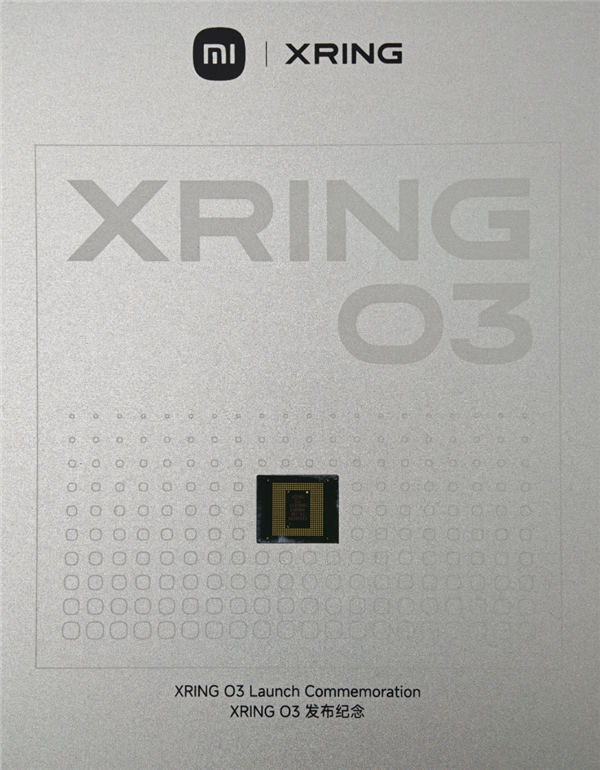
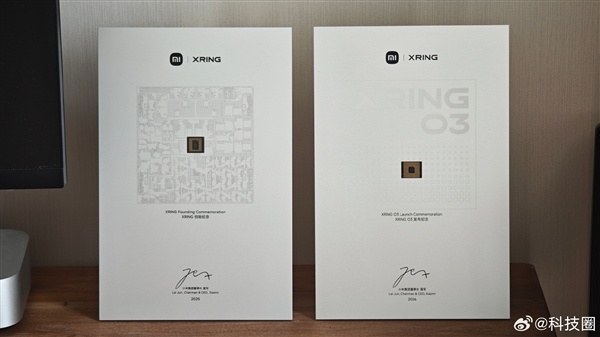
Today, many bloggers have posted the Xiaomi 18 Fold press conference invitation gift box, which includes the Xuanjie O3 chip souvenir, which is an aluminum plate inlaid with the Xuanjie O3 body, and Lei Jun’s signature below.
Last year, Xiaomi also launched such souvenirs when the Xuanjie O1 was released. The official did not sell them, but gave them away in limited quantities, including to the media and employees, and gave them to some users in a lottery.
When Lei Jun presented souvenirs to Xuanjie employees last year, there was also a letter written by Lei Jun to the employees. He said: As Xiaomi’s first high-end flagship SoC and the first self-developed SoC with 3nm advanced process in mainland China, Xuanjie O1 has eloquently declared that after more than four years of hard work day and night, we have stood at the forefront of global SoC research and development.
Lei Jun also congratulated everyone: "Your achievements have been engraved in the history of Chinese chips."
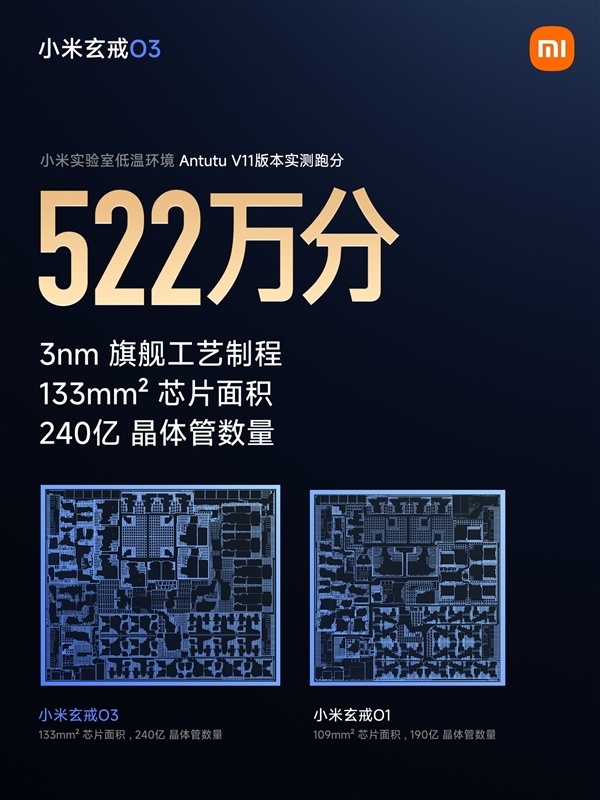
Xiaomi's self-developed chip strategy has been in the works for 10 years, and it will officially restart the research and development of large chip SoCs in 2021. It took more than four years and 13.5 billion to finally produce results and create Xuanjie O1, which ranks first in the industry.
This year, Xiaomi has brought another iteration of Xuanjie O3. Although the process is still 3nm, its performance has been greatly improved, making it the No. 1 SoC in the history of the current mobile phone industry.
The CPU adopts a ten-core full-core design and is equipped with C1-Ultra+C1-Premium+C1-Pro. The maximum main frequency reaches 4.35GHz. The multi-core running score exceeds 15,000 points for the first time, and the performance is improved by 60%.
GPU debuts the 16-core G2-Ultra NX graphics processor, an unprecedented cross-generation upgrade, with a performance increase of 85%. It is currently the strongest mobile phone graphics processing performance. In the benchmark test, it completely crushed the A19 Pro, and the power consumption was reduced by 64% compared to the previous generation.
Xuanjie O3 is also the world's first mobile processor to support LPDDR6, with a bandwidth of up to 113.8GB/s, which is 48% higher than Xuanjie O1.
Integrated 60MB of on-chip cache, including 12MB of L2 and 16MB of L3. The GPU and NPU also have independent caches, as well as a 16MB system-level shared cache.
The NPU architecture has been completely reconstructed and is specially designed for the Xiaomi MiMo end-side large model. It has an exaggerated 200TOPS tensor computing power and 3.13TFLOPS vector computing power, and the end-side AI performance is greatly improved by 45%.
Comments