
Abstract:
YouTube Music announced the launch of the AI music annotation feature, allowing listeners to identify the degree of involvement of generative artificial intelligence in song creation on the playback page. Labels will appear in the player interface and can be clicked to view more information; this set of annotations will also be extended to the main YouTube application. YouTube stated that the system combines the information reported by music partners with the platform's own detection tools to identify relevant tracks.
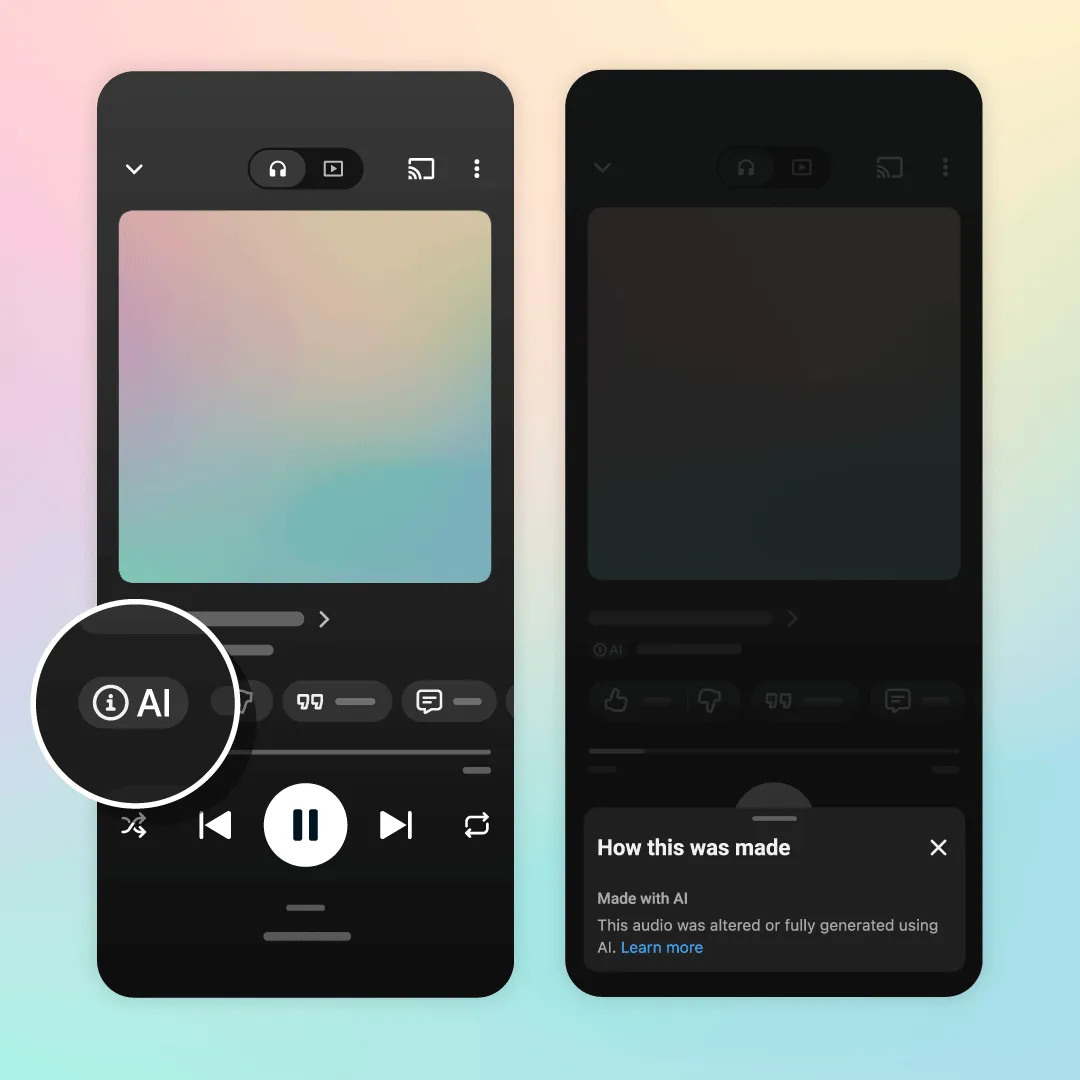
Per YouTube Help Center rules, music partners may mark content as "Created entirely with generative AI," "Partially using generative AI," or "No use of generative AI." The former includes directly generating the entire song through prompt words; the latter covers using AI to generate partial arrangements, melody or lyrics, and then the musicians join in live performance or recording. The regular pitch correction tool Auto-Tune, as well as automated mastering for adjusting equalization, compression and timbre, will not be classified as generative AI music. If the partner does not declare it, YouTube may also rely on other signals to determine whether the song is partially or fully generated by AI.
YouTube’s move is mainly to increase the transparency of disclosure, not to restrict AI music. The platform stated that the fact that a song involves AI itself does not disqualify it from monetization; YouTube is also still experimenting with AI music tools such as Dream Track, allowing some creators to generate soundtracks that include the AI voices of participating artists.
As the volume of AI music uploads increases rapidly, streaming media platforms are adopting different responses. Deezer said that during the peak period in June 2026, the platform received about 90,000 tracks completely generated by AI every day, accounting for more than half of the new uploads that day; this number refers to the Deezer platform, not the entire music industry. Deezer will mark detected AI songs and exclude them from algorithm recommendations and edited playlists. It also plans to let users filter out AI music. Tidal also tags detected fully AI recordings and allows users to turn off such content. Apple Music plans to launch the "Made With AI" tag later this year, and Spotify already has AI tags and music spam filtering tools.
Comments