
Abstract:
Although concerns about artificial intelligence replacing entry-level jobs continue to rise, a new study shows that, at least based on current data, the so-called "AI employment apocalypse" has not yet come to recent college graduates in the United States. The latest analysis report released by the CESifo Institute in Munich, Germany, points out that there is no clear evidence that generative artificial intelligence has massively squeezed employment opportunities for fresh college graduates at the overall level.
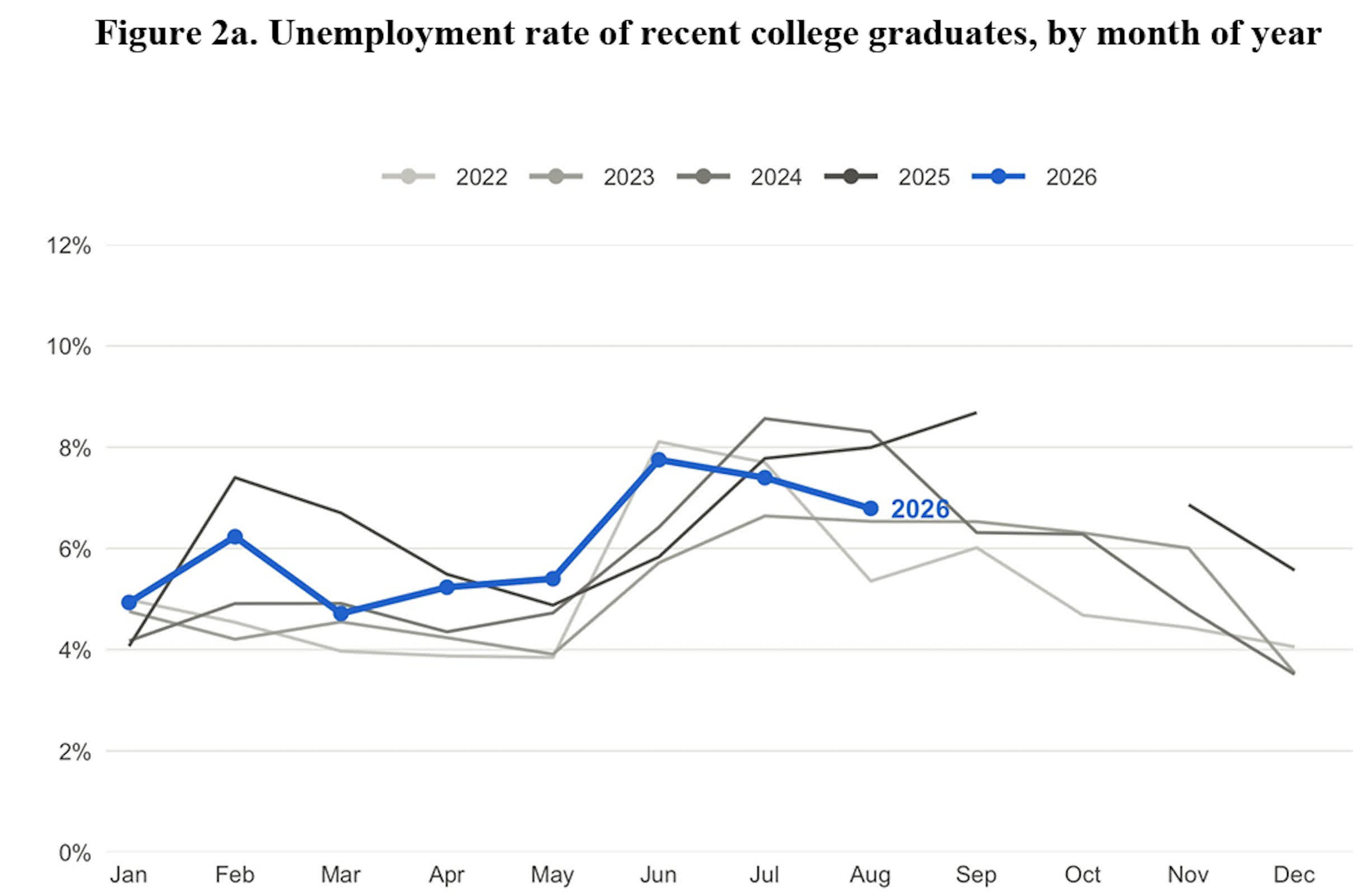
The researchers focused on young people aged 22 to 25 who hold a bachelor's degree and are not continuing their education to assess the actual impact of the rapid spread of artificial intelligence on the job market.
Research results show that in the summer of 2026, the unemployment rate for this group in the United States will be 7.3%. Although higher than 6.3% in 2022, it is still within the normal fluctuation range of the past four years and lower than the 7.8% level seen in 2024.
This conclusion is in sharp contrast to growing concerns from the outside world. In recent years, many technology companies have continued to promote AI automation, and many industry insiders have warned that companies may reduce recruitment of entry-level positions and transfer tasks originally assigned to newcomers to artificial intelligence.
Research leaders Robert Fairley and Jane Wu pointed out that fresh graduates are one of the most ideal groups to observe the employment impact of AI. Because if a company hopes to use AI to reduce costs, it usually reduces the recruitment of new employees first, rather than immediately laying off old employees who have accumulated experience.
In fact, the work content of many entry-level positions does overlap with generative AI capabilities. Tasks such as document summarization, first draft writing, basic analysis, information organization, and standardized office processes are gradually entering the capabilities of large models and AI assistants.
To verify whether these changes have materially affected the job market, the research team analyzed microdata from the U.S. Census Bureau's Current Population Survey database. The research scope covers the summer of 2022 to 2026, covering both the labor market recovery stage from the epidemic and the period of rapid popularity of generative AI after the advent of ChatGPT.
The results show that although the application scale of artificial intelligence has significantly expanded, the overall employment data does not reflect the large-scale impact on recent graduates.
The researchers also further expanded the statistical scope to include those who want to work but are not actively looking for work for the time being. Even if a looser definition of unemployment is adopted, the statistical results still do not show significant changes that are sufficient to prove that AI has caused widespread employment deterioration.
The research team then compared recent college graduates with people of the same age group but without a college degree, and conducted cross-analysis with college graduates aged 30 to 49, hoping to find whether there are special trends.
Researchers say that so far they have found no evidence that artificial intelligence has had a systemic impact on new graduates.
However, the researchers did not deny future risks.
The report points out that current data can only show that generative AI has not caused significant damage to the U.S. job market for fresh graduates at the overall level, and cannot prove that changes will not occur in the future. In fact, more and more companies have begun to integrate artificial intelligence into business processes, and related technologies are still advancing rapidly.
At the same time, other studies have reached somewhat different conclusions. For example, a previous study by Stanford University found that in occupational fields that are highly related to artificial intelligence, the employment trend of young workers is relatively weak.
Therefore, there is still controversy in academic circles about how AI will reshape the job market.
Some economists believe that artificial intelligence is more likely to change job content first than eliminate jobs immediately; other researchers worry that entry-level positions may be the first areas to be affected by the wave of automation, because these positions bear a large number of standardized tasks that are most susceptible to being taken over by algorithms.
For college graduates who are about to enter the workforce, the current data provides a certain degree of optimism. Although artificial intelligence is changing the way companies operate, at least as of 2026, the U.S. job market has not seen large-scale unemployment among recent graduates due to AI.
However, the researchers also emphasized that the real test may yet to come. As AI capabilities continue to increase and more and more companies integrate it into daily work processes, the long-term impact of generative AI on the employment structure remains to be seen in the coming years.
Comments