
Abstract:
Today, "Zunjie v800 brake pedal bracket is broken" ranked first in the hot search, and "Zunjie understands car emperor" ranked fourth in the hot search. The reason was that the car expert released a review video, testing three Zunjie V800s, 100km/h-0 emergency braking, and the brake pedal bracket broke the moment the foot was pressed to the bottom.


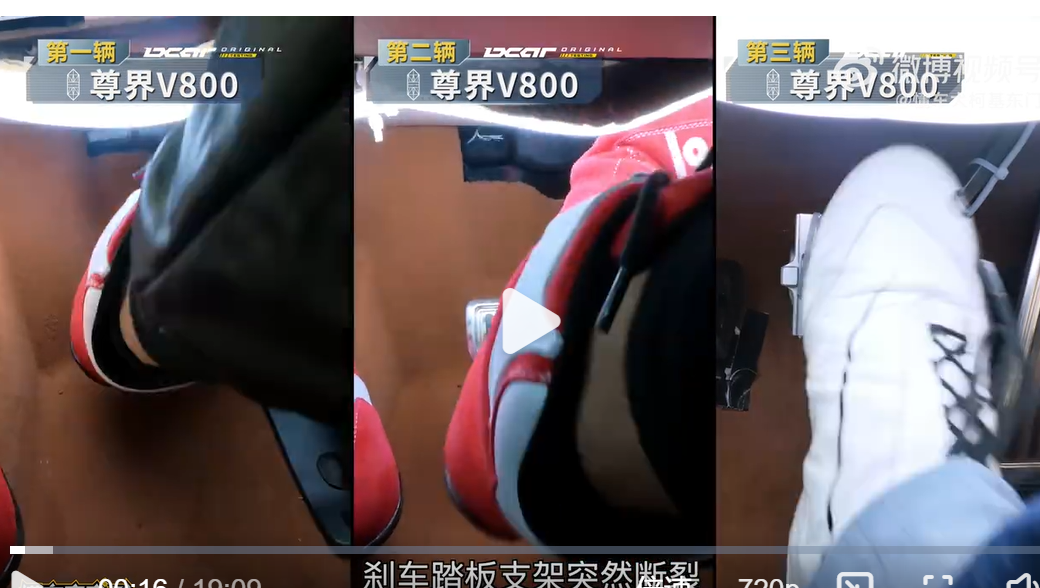
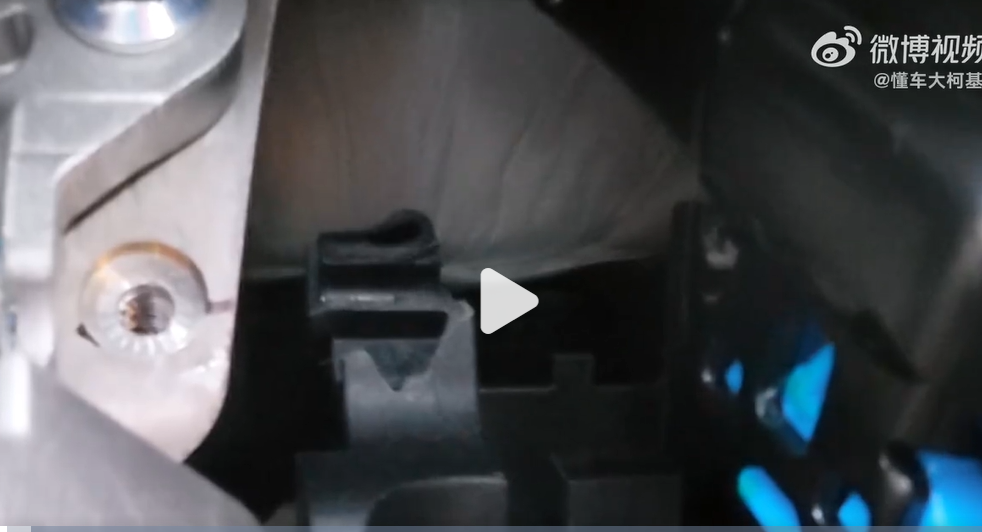
The tester said that the test vehicle is a brand new car, and the brake pedal should not be broken by anyone at any time. "I have broken the pedal when I step on it. Do I have to pick shoes and pick people when I brake in the future? Two of them were broken before."
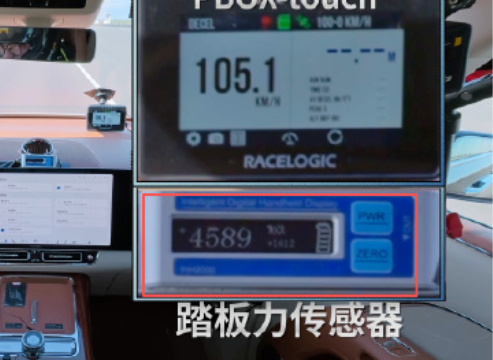
From the video, the tester saw the cone and braked with full force, and the sensor showed that the maximum force was suspected to be 4500N.
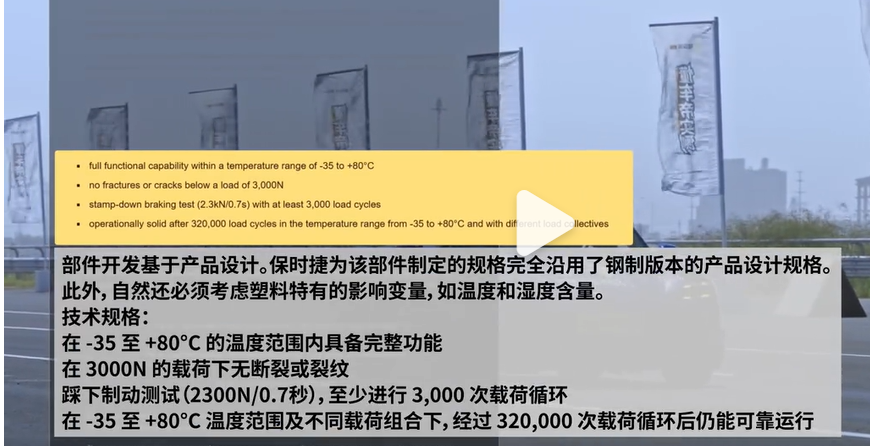
The video cites Porsche's design specifications: no breaks or cracks under a load of 3000N.
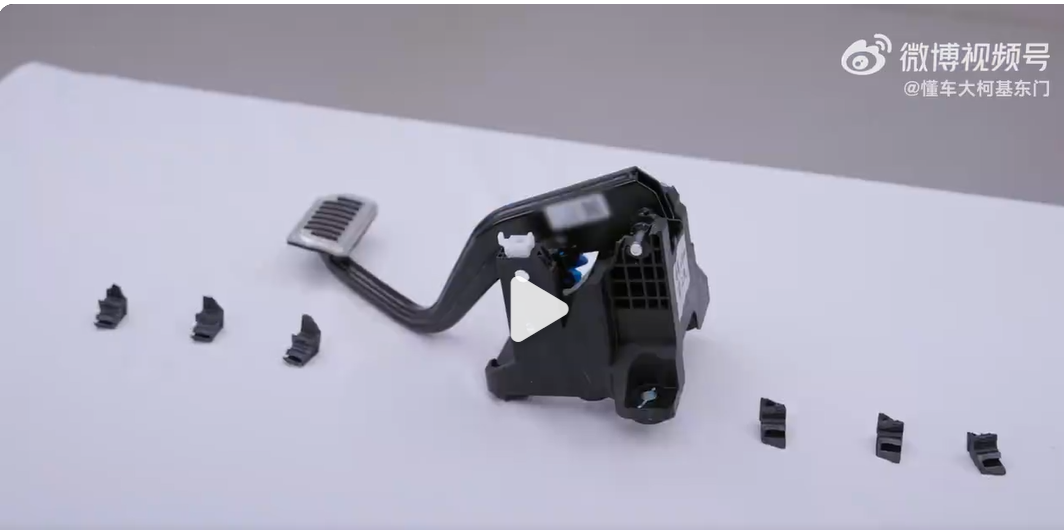
The testers removed the brake pedal assembly and found that the shape of the broken remains was highly similar. The fracture surface and fracture location are the same.
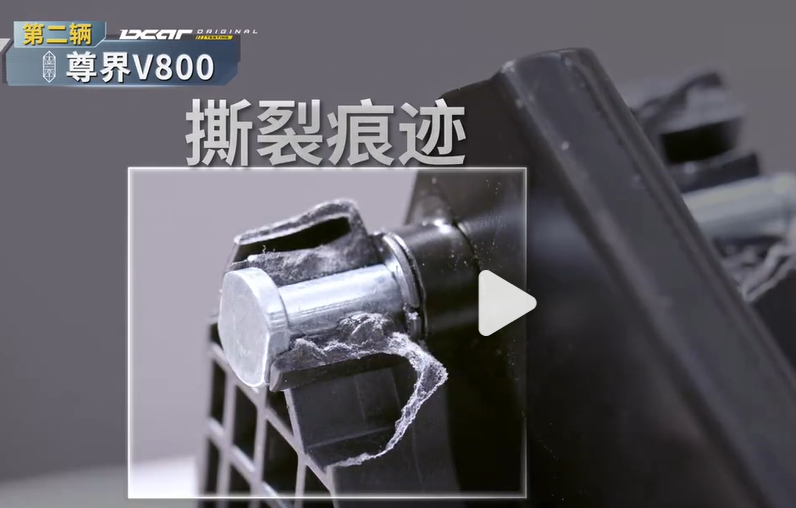
“The place with the strongest stress is actually the thinnest. The bracket is made of PP polypropylene and fiberglass.”

Many bloggers questioned the testers’ leg strength.
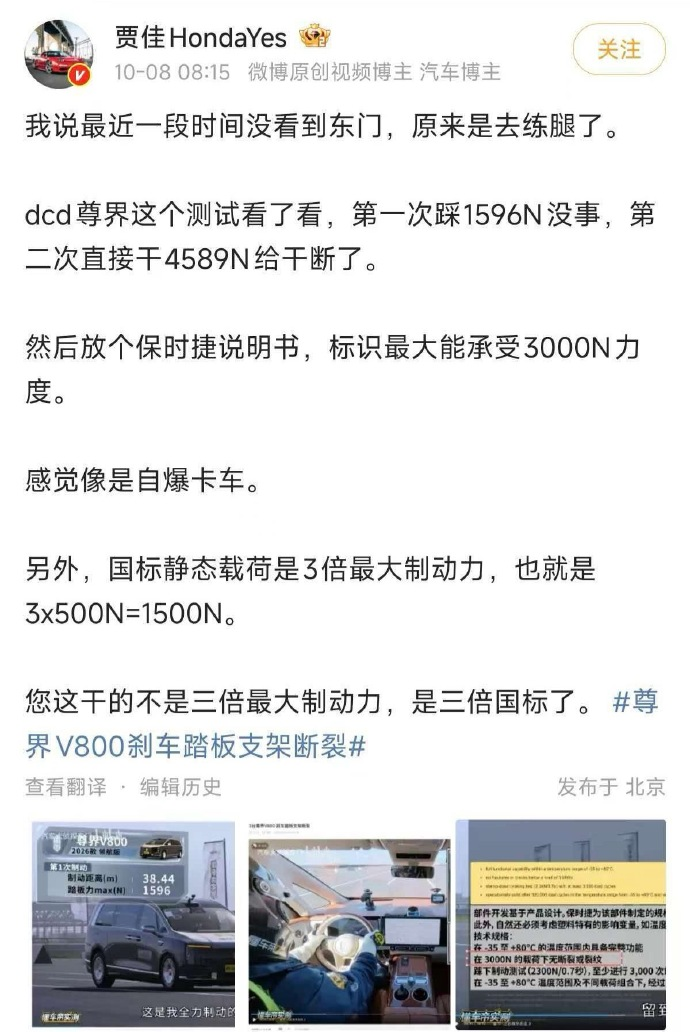
Some bloggers said that the national standard static load is 3 times the maximum braking force, that is, 3x500N=1500N. What the testers did was not three times the maximum braking force, but three times the national standard.
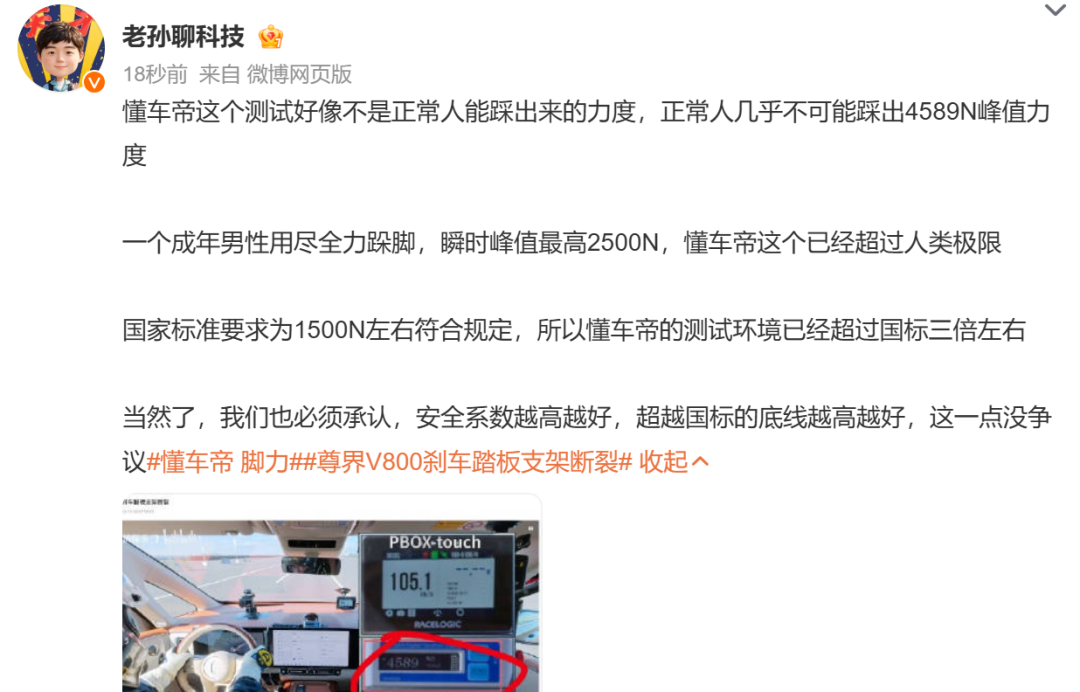
Some bloggers believe that the test of "Understanding Car Emperor" does not seem to be a force that normal people can pedal. It is almost impossible for normal people to pedal at a peak force of 4589N.
An adult male stomps his feet with all his strength, and the instantaneous peak value is up to 2500N. This car emperor has exceeded the human limit. The national standard requires about 1500N to meet the regulations, so the test environment of Dongchedi has exceeded the national standard by about three times.
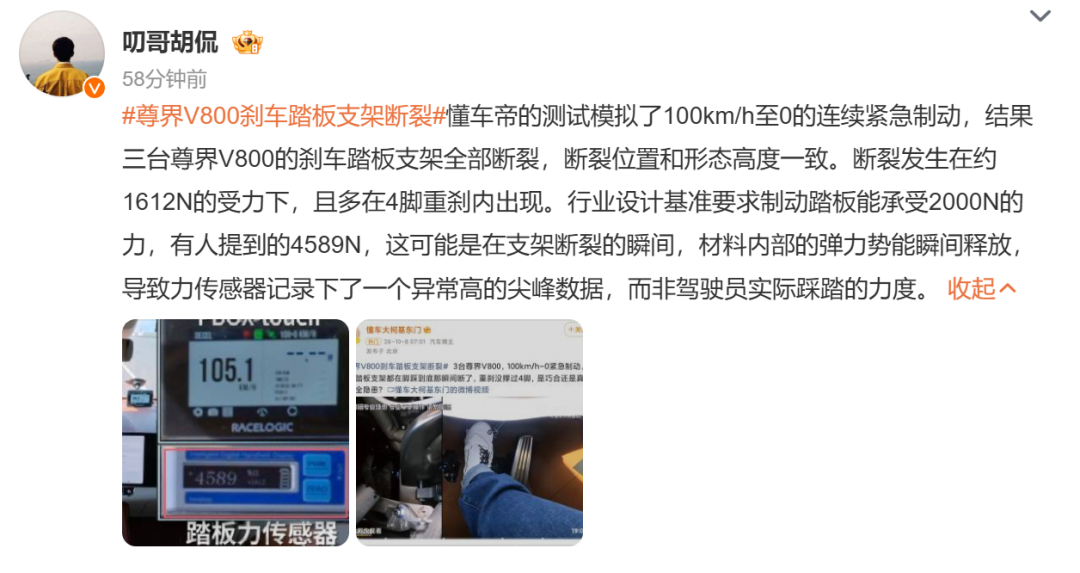
However, some bloggers found that the break occurred under a force of 1612N. The 4589N may be caused by the instantaneous release of the internal elastic potential energy when the bracket breaks, rather than the actual pedaling force of the driver.
So have there been any similar cases of pedal breakage before?
Looking at the recall cases of similar brake pedal bracket fractures in the history of the automotive industry, the most famous one is the 2020 Ford Mustang.
That year, Ford recalled 2,627 imported Mustangs. The cause of the failure was highly similar to this incident: the manufacturer replaced the brake pedal bracket material with polypropylene, which had insufficient design margin. Under emergency braking conditions, the pedal pivot position bracket may break, directly losing the foot brake, and there is a risk of collision. The official plan is to replace the pedal assembly for free.
In addition, Hyundai Ba Rui and others have also had recall records of insufficient strength and risk of breakage of the brake pedal bracket. This type of failure is a serious safety hazard of D level in the automotive engineering classification. Once it occurs in batches, the recall process needs to be initiated according to regulations.
In 2024, NIO had an incident where the accelerator pedal broke. The owner strongly questioned the quality of the vehicle and pointed out that the accelerator pedal material seemed to be "inferior plastic", believing that this was directly related to driving safety.
Weilai responded that the ES6 with a broken accelerator pedal was a second-hand car purchased by the owner through a third party. The car had been in a serious accident before and was classified as a total loss by the insurance company; currently, most suspended accelerator pedals in cars are made of engineering plastics, and their design strength meets industry standards.
How strong is the braking force of an adult male?
Regarding the braking force of adult men, industry measured data has a relatively clear range: for daily emergency avoidance on the road, most ordinary people depress the brakes with full force at 400-600N; for drivers with strong strength who stand up and stamp their feet to exert force, the instantaneous peak value is generally 1000-2000N. According to literature and human body mechanics tests, healthy adult men stamp with one foot with all their strength, the ultimate peak value mostly does not exceed 2500N, and it is almost difficult to stably and continuously output 4500N. load.
How does the national standard stipulate brake collapse force?
GB7258's requirement for vehicle braking performance is that the pedal force does not exceed 500N when the maximum braking force of a passenger car is reached, which is the upper limit of operating force for daily use; while the static strength requirement of the QC/T 788 pedal device industry standard is that a load of 2000N±50N is applied to the center of the pedal for a period of time without cracks or damage, and the permanent deformation cannot exceed the standard. This is the bottom line of the structural strength of the pedal itself, and is not the force required for daily driving.
This is also where the disagreements between the two parties to the dispute lie.
Those who support the logic of car emperor testing believe that the national standard of 2000N is only the minimum bottom line. The engineering design of high-end models, especially heavy-duty MPVs, will reserve higher safety redundancy. The design goals of many luxury brand pedal brackets are generally 2700-3000N, and some specifications even require 3000N to prevent breakage in high temperature environments.
In real emergencies, adrenaline surges and pedaling force exceeds normal levels. The design cannot be based solely on the static foot strength of ordinary people. Even if pedaling rarely reaches extremely high peaks in reality, the pedal bracket cannot break directly under full emergency braking conditions.
Three new cars, with the same location and the same fracture, are reproducible structural defects, not a single accidental damage.
At present, Zunjie has not responded yet. Whether this test is a real situation or an irregular evaluation requires further observation and confirmation.
Comments