Lei Jun confirmed the rumors of Xiaomi making cores. On the evening of May 15, Lei Jun posted on Weibo that "Xiaomi's independently developed and designed mobile phone SoC chip is called Xuanjie O1 and will be released in late May."In addition, he did not disclose detailed information such as the manufacturing process of this chip, which was very restrained. It may be announced as the highlight of the press conference.
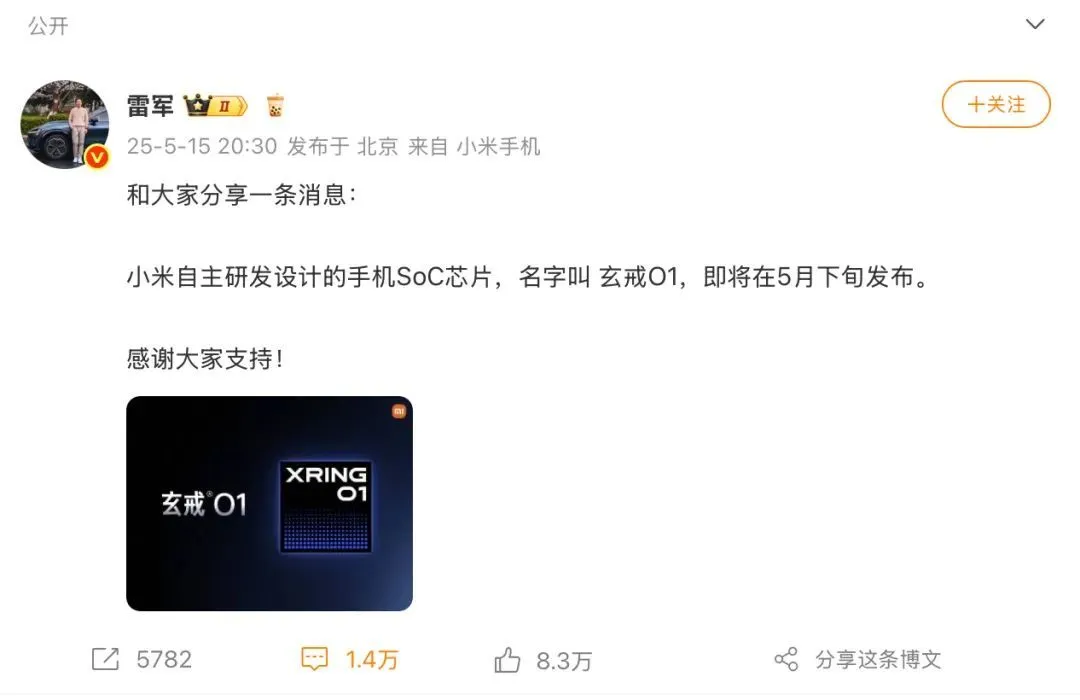
Source: Lei Jun Weibo screenshot
Immediately, related topics became hot searches, and my Moments and WeChat groups were flooded with similar updates and pictures, including many Xiaomi employees.
It can be a reasonable guess that in view of the "most difficult moment" Lei Jun has experienced in the past month, Xiaomi is consciously controlling its popularity in the promotion of Xuanjie O1. On the one hand, we do not want to be affected by the traffic backlash caused by the SU7 incident; on the other hand, we do not want to raise the tone too high, raising market and user expectations, and ultimately triggering a wave of public opinion.
But it is undeniable that if the Xuanjie O1 is successfully released, it will mark the return of Xiaomi's self-developed mobile phone chips to the forefront, and its importance may be as important as Lei Jun's decision to build a car.
This is not Xiaomi’s first self-developed SOC chip. Looking back at Xiaomi's road to self-developed chips, I roughly divide it into two stages: the surging era that started from Pinecone; and the "Xuanjie" era that started again.
The birth of the "Pinecone" brand cannot avoid Huawei. In 2014, Huawei officially launched the first-generation Kirin chip 910. In the same year, Xiaomi established Songuo Electronics Company and started its core manufacturing business. Its initial goal is to develop its own mobile phone main chip.
Lei Jun’s plan to build chips is clear. In his view, chips are the commanding heights of mobile phone technology. If Xiaomi wants to become a great company, it must master core technologies.
After nearly three years, Pinecone Electronics launched its first self-developed SOC, the Pinecone Surge S1, which was first installed on Xiaomi 5C. According to the official parameter description at the time, ThePaper S1 is positioned as a mid-range mobile phone chip, using TSMC's 28nm process, 4+4 large and small cores with a full A53 architecture, the large core clocked at 2.2GHz, the small core clocked at 1.4GHz, the GPU is ARM Mali T860 MP4, and the baseband is an upgradeable design.
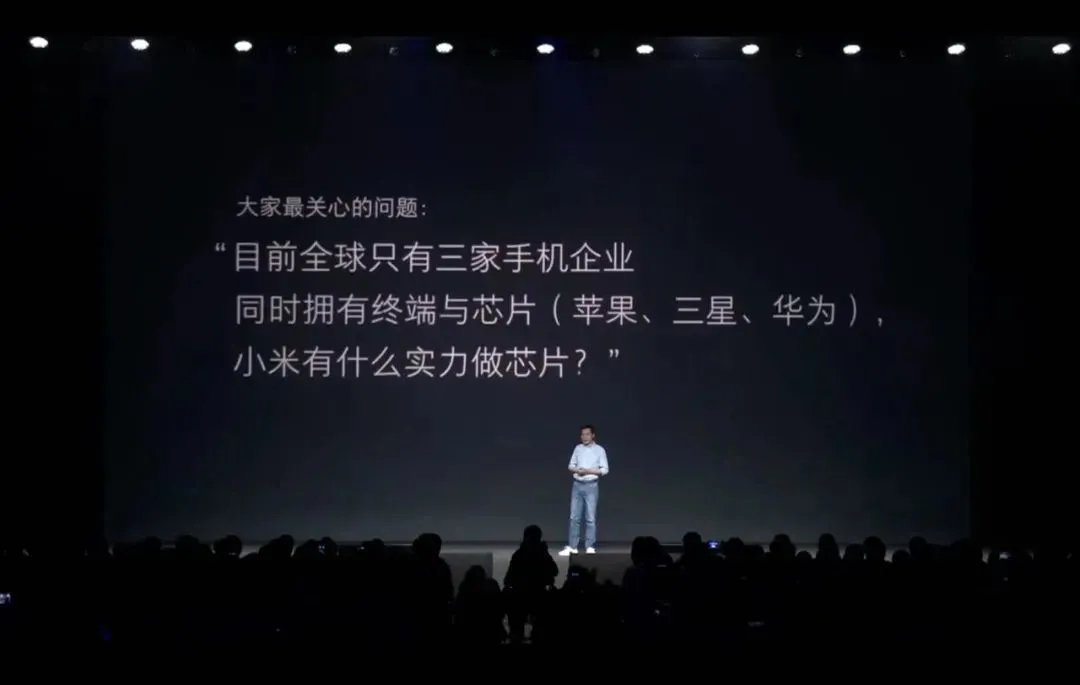
Image source: Xiaomi Pascal S1 released
Lei Jun gave ThePaper S1 very high praise and expectations. Even though he did not have such high traffic at the time, he still proudly hinted that Xiaomi has become the fourth manufacturer in the world to develop chips and mobile phones at the same time after Apple, Samsung, and Huawei.
However, ThePaper S1 has not withstood the verification of the market. It is considered to have a relatively backward process and insufficient baseband capabilities. This has also led to the market performance of Xiaomi 5C not meeting expectations, and Xiaomi's chip business has also entered a period of adjustment. Since then, the rumored ThePaper S2 has not been officially released, and Xiaomi has temporarily shelved its mobile phone SoC research and development plans.
However, Xiaomi has not given up on developing its own chips. Lei Jun mentioned in Xiaomi's 10th anniversary speech in 2020, "Although this project (Pengpai chip) has encountered great difficulties, Xiaomi will persevere and move forward."
This corresponds to the business trend that Xiaomi has begun to "break it into parts", "save the country through curves", and turn to self-research of "small chips". In the following years, Xiaomi successively launched several peripheral small chips such as Pengpai C, P, G, and T, which are:
The self-developed ISP imaging chip ThePaper C1 is installed on Xiaomi's first foldable screen MIX Fold and is responsible for image processing. According to official statements, with the help of ThePaper C1’s self-developed algorithm, the phone’s performance in 3A (autofocus AF, white balance AWB, and automatic exposure AE) can be greatly improved.
Charging chip Pengpai P1. The main solution is the contradiction between high power and large capacity batteries. With the support of this chip, Xiaomi Mi 12 Pro supports 120W fast charging, which is almost 400mAh larger than a dual-cell battery of the same size and power.
The battery management chip Pengpai G1 dynamically adjusts the discharge status of the mobile phone by evaluating the user's daily habits of using the mobile phone. Officials say that with the support of ThePaper G1, the overall battery life of the phone can be increased by 3% to 5%.
Both P1 and G1 are related to batteries. The difference is: P1 is responsible for managing fast charging, while G1 is responsible for maintaining battery health. In addition to these three more important "small chips", Xiaomi has also launched the self-developed The Paper R1, which is responsible for intelligent current sharing, and the Paper T1, which is responsible for enhancing the signal.
These actions of Xiaomi are also interpreted as relying on the research and development experience of one small chip after another to create a complete AP.
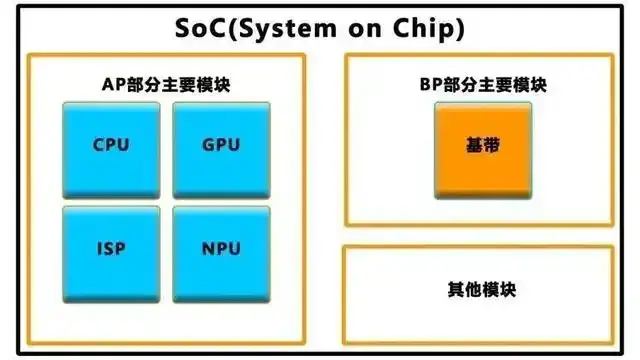
It should be added that an SoC is mainly composed of AP, BP and other modules.
Among them, AP includes what we often call CPU, GPU, NPU, etc.; BP is the part responsible for communication processing, that is, baseband, antenna, etc.
Xiaomi's self-developed mobile phone chips will enter the "Xuanjie" era around 2021. Public reports show that in 2021, Xiaomi established Xuanjie and restarted the research and development of self-developed mobile phone SoC chips. The general manager and executive director of the company is Zeng Xuezhong, senior vice president of Xiaomi. Before joining Xiaomi, Zeng Xuezhong served as the CEO of domestic mobile phone chip manufacturer Unisoc.
According to Qichacha, as of the end of 2023, there were 820 insured persons in Xuanjie. In addition, Xuanjie was later incorporated into Beijing Xuanjie Technology Co., Ltd., which was established in October 2023. The company has a registered capital of up to 3 billion yuan.
Previous reports pointed out that Xiaomi has also established a chip platform department under the organizational structure of the mobile phone product department, appointing Qin Muyun as the head of the chip platform department and reporting to Li Jun, general manager of the product department. Qin Muyun previously worked at Qualcomm as senior director of product marketing for Qualcomm, and later joined Xiaomi.
It is worth noting that the chip research and development has been separated from the original system and an independent company has been established for operation. This move is considered to be to deal with the risk of potential trade restrictions. It is reported that this new company will remain legally and operationally independent from Xiaomi, similar to the relationship between Huawei and its HiSilicon Semiconductor.
In February this year, MediaTek CEO indirectly stated in the Q4 fiscal year conference call that Xiaomi's self-developed mobile phone SOC chip may be plugged into MediaTek's baseband chip. According to his disclosure, ARM and Xiaomi are promoting an AP chip research and development project, and MediaTek is also participating and providing modems. That is, the baseband is commonly understood.
In other words, Xiaomi’s self-developed SOC chip baseband part may use MediaTek products.
According to current information, the Xiaomi Xuanjie O1 chip is based on TSMC’s N4P process technology and adopts an eight-core three-cluster CPU architecture design, including an Arm Cortex-X925 CPU ultra-large core and an integrated Immortalis-G925 GPU. Its comprehensiveness is approximately the same as that of the Snapdragon 8 Gen2.
In other words, if the Xuanjie O1 process and other information finally announced by Lei Jun is as rumored, it also means that Xiaomi has made a second effort to develop its own SOC chips, choosing the relatively mature Arm public version architecture and taking the "public version architecture + plug-in baseband" route to reduce research and development risks.
There is still a certain gap between this and the complete self-development that most people expect. The latter model is "self-developed IP + integrated baseband".
This may still cause a lot of controversy. For example, some people will complain, "It's like installing a second-hand engine in a Ferrari. It runs well, but it easily stalls."
But this does not prevent Xiaomi from taking another crucial step in developing its own mobile phone SOC chips. Lei Jun said last year that Xiaomi's goal for the new decade is to become a leader in the world's new generation of hard-core technology, moving from Internet model innovation, application innovation, and product innovation to hard-core technology innovation. Xiaomi Group will invest more than 100 billion yuan in R&D in the next five years, investing heavily in underlying core technologies.
This is the powerful engine of Xiaomi’s high-end strategy. Xiaomi's independent research and development and design of mobile phone SoC chips may be the most important part of it. As for whether it will get stuck in the end, the problems will be solved as we move forward.
Now it seems that after ten years of core creation, Lei Jun is still "surging", but his name has been changed to "Xuan Jie". Just as People's Daily Online commented on Weibo after Lei Jun announced the news of Xuanjie O1, "In the past year, Xiaomi has successively brought breakthrough innovations in the fields of new energy vehicles and domestic chips. This proves that as long as we work hard, there is no insurmountable mountain. As long as we catch up, latecomers will always have a chance."