Meta MondayAnnounceAdditional measures will be taken to crack down on accounts that share "unoriginal" content on Facebook - those that repeatedly use other people's words, photos or videos. Meta said it has removed about 10 million accounts this year for impersonating large content creators.
Additionally, Facebook took action against 500,000 accounts that engaged in "spammy behavior or false engagement." These actions include downgrading accounts' comments and reducing the distribution of their content to prevent these accounts from monetizing.
Just a few days ago, YouTube announced that it would be clarifying its policies on unoriginal content, including batch-produced and duplicate videos, which is made easier to generate with the help of artificial intelligence technology.
Like YouTube, Meta says it won't penalize users who interact with others' content, such as making reaction videos, joining trends or expressing their own opinions. Instead, Meta’s focus is on reposting other people’s content, whether through spam accounts or accounts pretending to be the original creator.
The company said accounts that abuse the system and repeatedly use other people's content will lose access to Facebook monetization programs for a period of time and will see their posts receive less distribution. When Facebook detects a duplicate video, it also reduces the distribution of copies to ensure the original creator gets views and credit.
Additionally, the company said it is testing a system that adds links to duplicate videos that direct viewers to the original content.

The update comes as Meta is facing criticism from users across platforms, including Instagram, who accuse it of wrongfully and excessively enforcing its policies through automated means. A petition with nearly 30,000 signatures asks Meta to address issues with accounts being mistakenly disabled and a lack of human support that has left users feeling abandoned and hurt many small businesses. Despite receiving attention from the media and other high-profile creators, Meta has yet to publicly address the issue.
While Meta’s latest crackdown focuses on accounts that steal other people’s content for profit, there is also a growing problem of unoriginal content.
With the rise of artificial intelligence technology, major platforms are flooded with "AI slop", which refers to low-quality media content produced using generative artificial intelligence. For example, on YouTube, with text-to-video AI tools, it’s easy to find AI voiceovers superimposed on photos, video clips, or other repurposed content.
Meta's update appears to be focused solely on reused content, but its post suggests it may also be thinking about AI "junk" issues. In a section that provides "tips" for producing original content, Meta notes that creators should not just "piece together snippets" or add watermarks when using content from other sources, but should focus on "authentic storytelling" rather than producing short videos of low value.
It goes without saying that these types of unoriginal videos are also easier to produce with AI tools, as low-quality videos are often just a series of images or clips (real or AI), with AI narration.
In the post, Meta also warned creators not to reuse content from other apps or sources, which has long been a rule. It also states that video subtitles should be of high quality, which may mean reducing the use of automated AI subtitles that have not been edited by the creator.
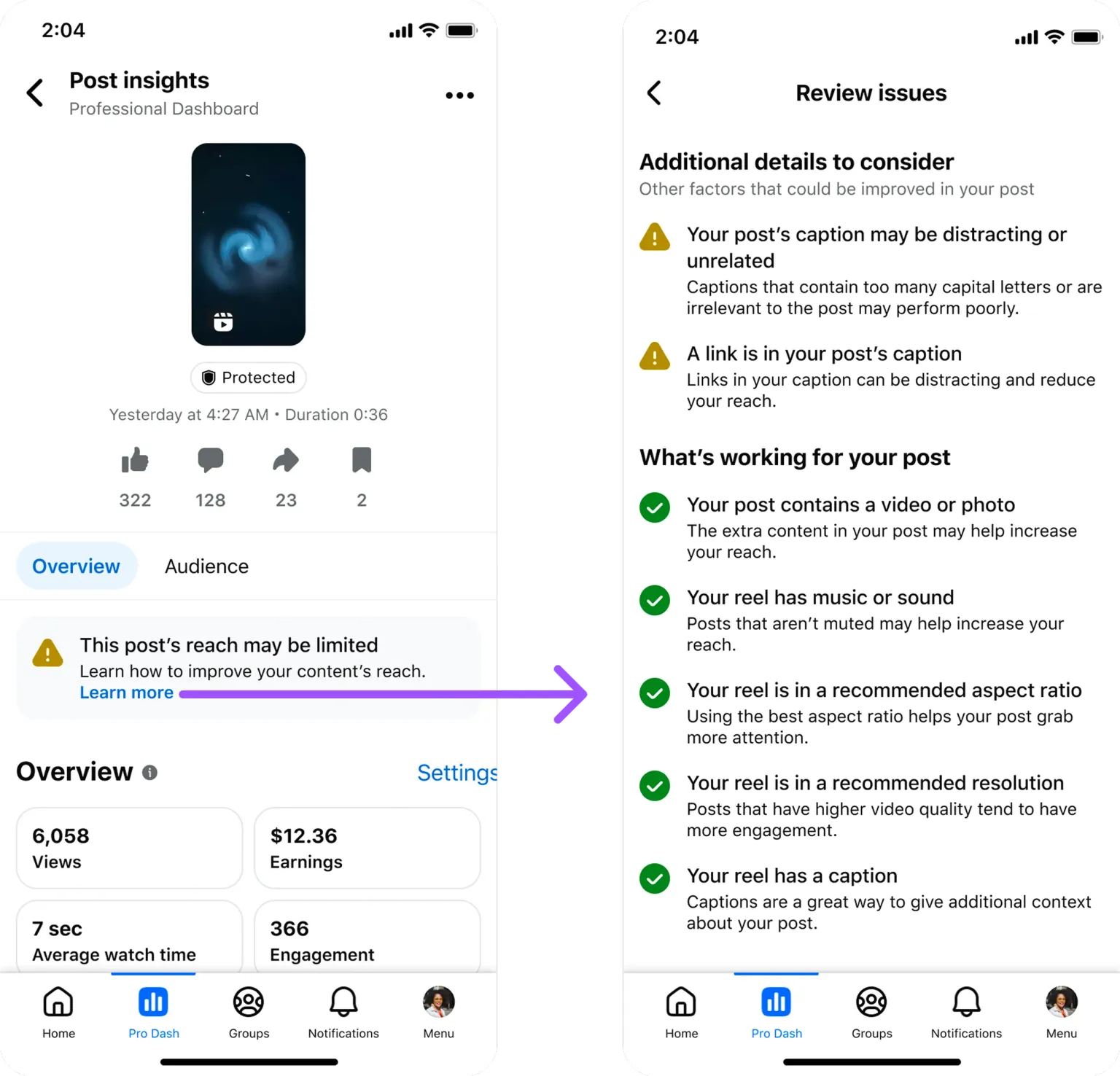
Meta says the changes will be rolled out gradually over the next few months to give Facebook creators time to adjust. If creators think their content isn't being widely shared, they can see new post-level insights in Facebook's Pro dashboard to find out why.
Creators can also see if they are at risk for content recommendation or monetization penalties from the Support home screen in the main menu of their page or professional profile.
Meta typically shares its content removals in its quarterly transparency reports. Last quarter, Meta said that 3% of its global Facebook monthly active users were fake accounts and that it had taken action against 1 billion fake accounts between January and March 2025.
Recently, Meta abandoned the practice of fact-checking the content itself in favor of Community Annotations, which, similar to X, allow users and contributors to determine whether a post follows Meta's community standards and is accurate.