The latest research from Japan's Okinawa Institute of Science and Technology (OIST) found that the brain learns from failures in a unique way during social competition, influencing future behavior patterns through specific types of neurons. In the animal kingdom, everyone has experienced failure, whether it’s a competition, a job search, or a debate. So, how does the brain convert failure into experience and adjust behavior? The study conducted experiments on male mice, which establish social hierarchies through one-on-one "showdowns" with winners and losers each accepting their status.
Although the research subjects were mice, the scientific research team believes that these findings may also help understand human social interactions and related neural pathways.
Professor Jeffery Wickens, head of OIST's Neurobiology Research Department, said, "You may think that dominance in the animal kingdom depends entirely on physical attributes such as size, but we found that it is actually a selection based on past experience. The brain neural circuits involved in the study are highly similar between mice and humans, which means that the mechanism is likely to be applicable to humans as well."
The specific experiment used a pipeline confrontation test: two mice entered from both ends of the pipeline, and the more dominant mouse eventually forced the other mouse back. After successive duels, the researchers were able to clarify each mouse's social class, and further re-paired the dominant mice in different cages, and also let the lower-status mice compete with each other. The results of the duel between the new partners caused some of the original strong players to drop in the rankings, while the weaker players rose in the rankings due to their victory. After the experiment, the social status of each mouse in the original cage changed accordingly, showing the "winner effect" and the "loser effect" - that is, mice with victory experience are more dominant in subsequent competitions, while mice that have experienced failure are more withdrawn.
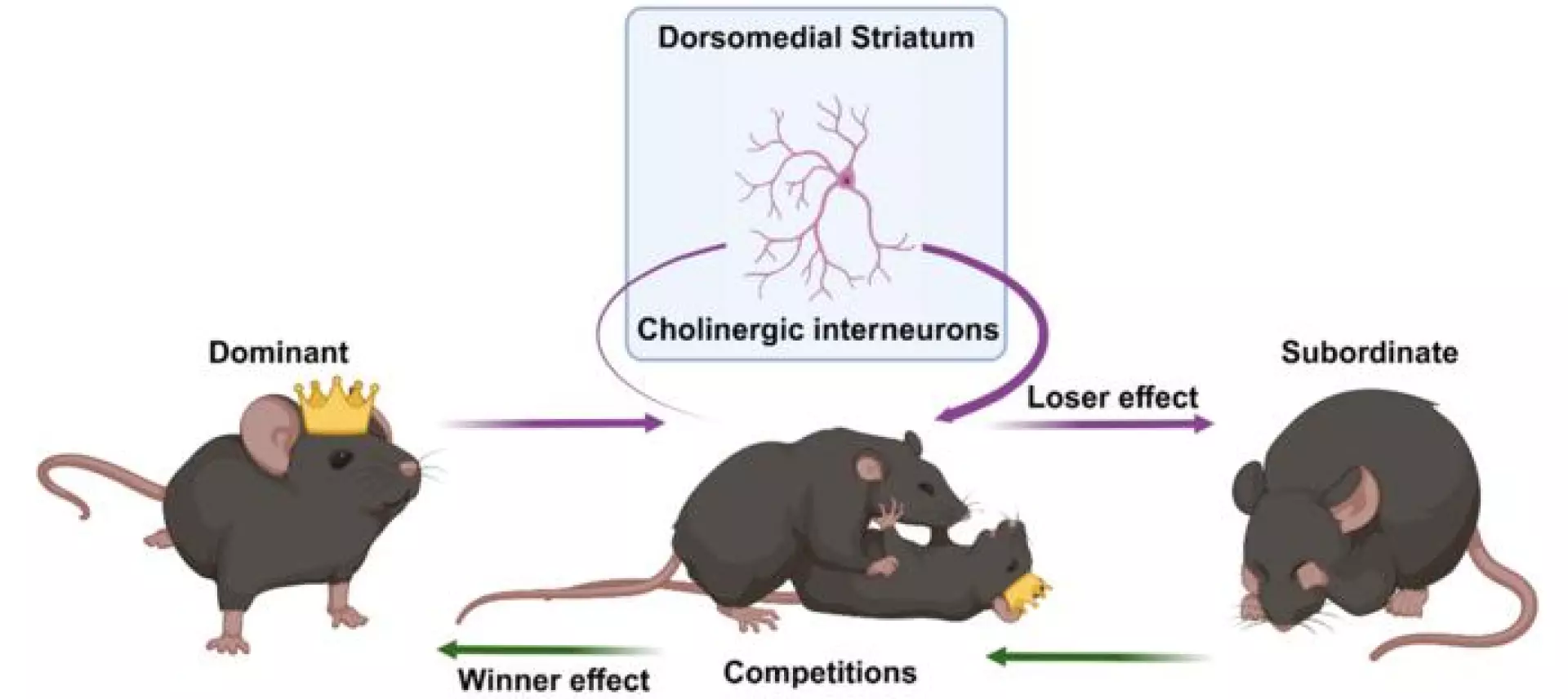
Lead author Mao-Ting Hsu said that the formation of this "loser effect" is due to the activity of specific neurons in the brain-cholinergic interneurons. By tracking brain activity, the team found that the "loser effect" is directly related to a group of cholinergic interneurons in the dorsolateral striatum (DMS). This type of neuron has long been focused on in terms of behavioral flexibility and adaptability. When the researchers inhibited the activity of these cells, the losing mice no longer accepted a disadvantaged position—but the winning mice still consolidated their dominance. This means that the "winner effect" and the "loser effect" are regulated by different brain circuits, and the latter involves decision-making pathways rather than reward systems.
So what lessons do these findings have for humanity? Researchers pointed out that although social behavior among humans is more complex, a similar "loser effect" may also exist in our brains, but it is difficult to isolate and study it separately. Hsu added, "Human social dynamics are clearly more complex: the 'eldest' in the family may be the last in the company, and dominant behavior will change in different situations. There is currently a lack of direct evidence of the neural circuits involved in this type of flexible social behavior, but the brain structure between humans and mice is similar, and similar studies can help us further understand human social dynamics."
The research has been published in the journal iScience.