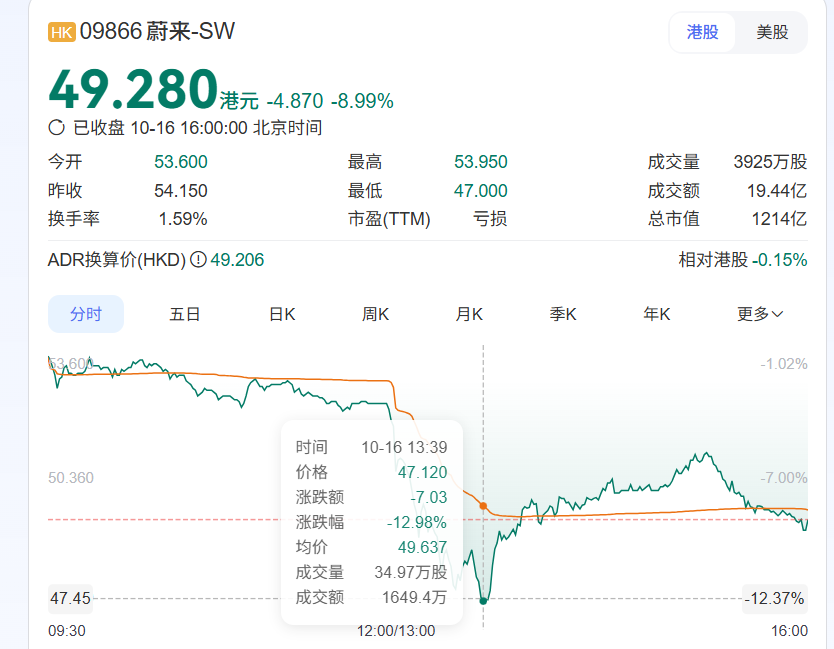
NIO's Hong Kong stocks fell sharply today, plunging 13% during the session and closing down 8.99%, with a quoted price of HK$49.28 and a turnover of HK$1.944 billion.On the news,A piece of news that "The Government of Singapore Investment Corporation (GIC) sued NIO" attracted attention in the industry.
It is understood thatGIC accused NIO of inflating its revenue and profits through Wuhan Weineng Battery Assets Co., Ltd., a company jointly established with its partners, and misleading investors, causing GIC to suffer investment losses.
Some media reports stated that,This matter stems from a short-selling report three years ago, and is not based on Weilai’s recent operating dynamics.
In June 2022, the short-selling institution Grizzly Research issued a short-selling report on NIO. At that time, Weilai clarified the matter, saying that the report was worthless and contained a large number of errors, unsubstantiated speculations, and misleading conclusions and interpretations.
August 26, 2022NIO released a report stating that the company has completed an independent internal review of the short-selling report. The entire review was conducted by an independent committee with the assistance of third-party professional consultants, including forensic accounting experts from an international law firm and a well-known forensic accounting firm (not NIO’s auditor). No irregularities were found and all accusations were not established.
In response to the Grizzlies' short-selling report, Deutsche Bank, Morgan Stanley, JP Morgan, Daiwa Capital and other institutions have successively issued reports stating that they do not support the Grizzlies' report conclusions.
Colleagues pointed out that Grizzly’s question about NIO’s battery asset management business (BaaS) was a misunderstanding of the BaaS model and confused relevant concepts and data.
Deutsche Bank's research report stated: "Grizzly's concerns about NIO's battery asset management business are unfounded and elements of the business model have been seriously misunderstood."
In fact, it is not uncommon for GIC to initiate lawsuits against listed companies.
Previously,GIC initiated lawsuits against many multinational companies such as Qualcomm, Merck, Celgene, Huizhi, and BP, accusing these companies of causing losses to their investments due to some of their actions.
Regarding the behavioral purposes of GIC, some analysts from investment institutions pointed out that the first is financial demands, and the second is part of a risk management strategy to hedge potential investment losses through legal means during periods of market volatility.