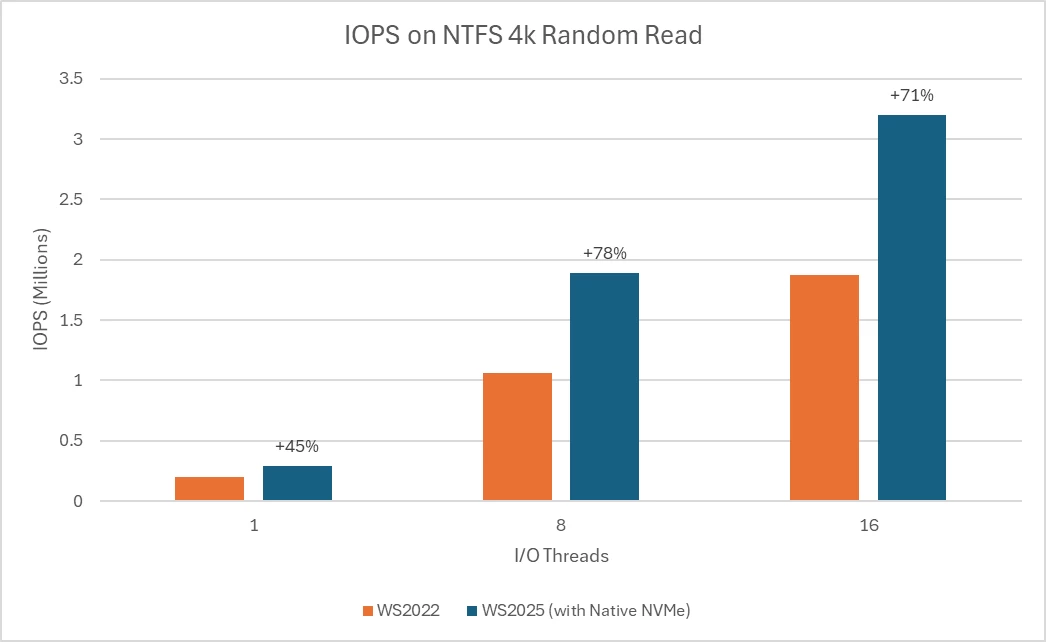
Microsoft confirmed that the native NVMe storage support feature previously promised in the Windows Server 2025 roadmap has officially entered the general availability stage of Windows Server 2025 with the October 2025 cumulative update (KB5066835). However, it is still in the "opt-in" mode and needs to be manually enabled by the administrator through the registry or group policy.
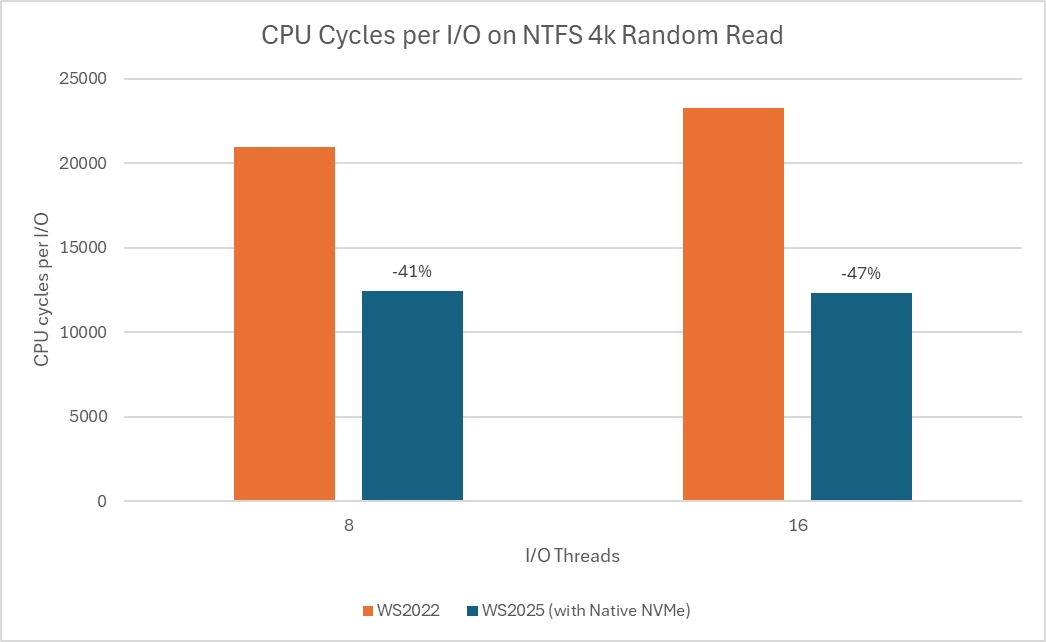
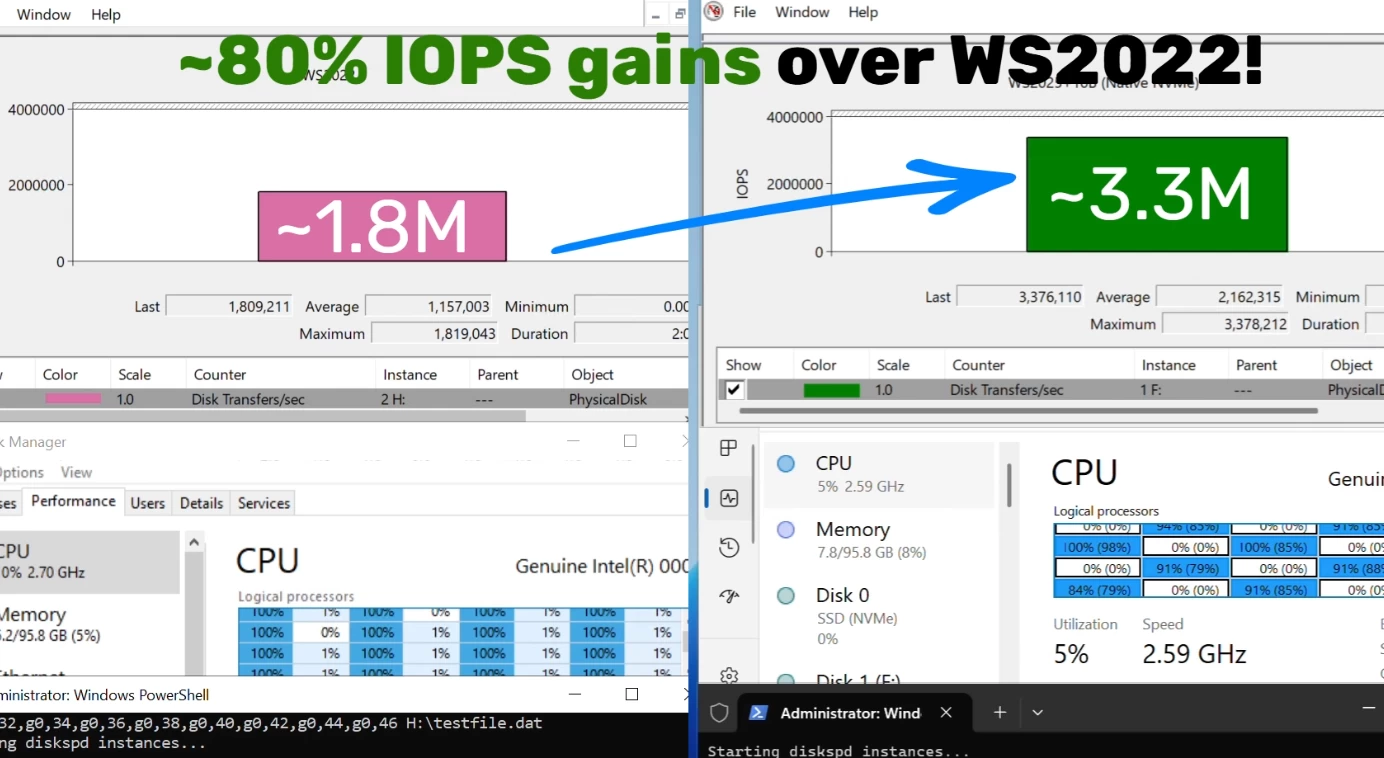
When Microsoft announced the Windows Server 2025 plan as early as April 2024, it emphasized the introduction of optimized NVMe support, which will achieve an IOPS improvement of approximately 70% in terms of random I/O performance compared to Windows Server 2022, and later detailed the performance evaluation methods and optimization points through updates to the DiskSpd tool. Now, Microsoft has further increased the officially announced performance increase to about 80%. At the same time, in the 4K random read scenario of NTFS volumes, the CPU cycles required for a single I/O can be reduced by about 45%, which means that in high-load storage environments, the system can release more computing power for the business itself rather than storage overhead.
At the heart of this performance improvement are architectural changes to the I/O path. Microsoft explained that Windows Server 2025 no longer treats all storage devices as SCSI devices originally designed for mechanical hard disks by default, but directly provides native, multi-queue access paths to NVMe SSDs, thereby bypassing the additional delays caused by shared locks and kernel synchronization mechanisms in traditional SCSI stacks. Through this more streamlined and lock-free I/O path, the system can significantly reduce round-trip latency, fully unleash the parallel capabilities of the NVMe hardware itself, and approach the physical performance upper limit of the storage device.
In its technical description, Microsoft summarizes native NVMe support into four major advantages: First, "massive IOPS improvement", multiple queues are directly connected to NVMe devices, giving the server the opportunity to truly fully meet the design capabilities of SSD; second, "lower latency", which reduces locks and synchronization in the I/O path, shortening the round-trip time of each operation; third, "higher CPU Utilization efficiency", a lighter stack structure allows computing resources to return to the business load itself; fourth is "future-oriented functions", which provide native support for advanced NVMe capabilities such as multi-queue and direct submission, laying the foundation for the next generation of storage innovation. Interestingly, with the evolution of the NVMe 2.0 specification, NVMe is no longer limited to SSDs and has begun to expand into the field of mechanical hard disks, paving the way for a more unified storage interface in the future.
At the deployment level, the native NVMe feature is currently turned off by default, and administrators need to manually enable it through the registry or group policy after installing the latest cumulative update containing KB5066835. The PowerShell sample command given by Microsoft is toHKEY_LOCAL_MACHINESYSTEMCurrentControlSetPoliciesMicrosoftFeatureManagementOverridesWrite a specific DWORD key value; at the same time, you can also import the corresponding policy template into the local Group Policy Editor through the MSI package provided by Microsoft, and then enable the relevant policy items under "Computer Configuration" to control this function. Since Windows Server 2025 shares a large amount of code base with Windows 11 24H2, and Windows 11 25H2 belongs to the same branch as 24H2, the industry is also paying attention to whether this storage stack change will be extended to the personal version of Windows in the future, especially the possibility of unlocking similar benefits in gaming and high-performance desktop storage scenarios.