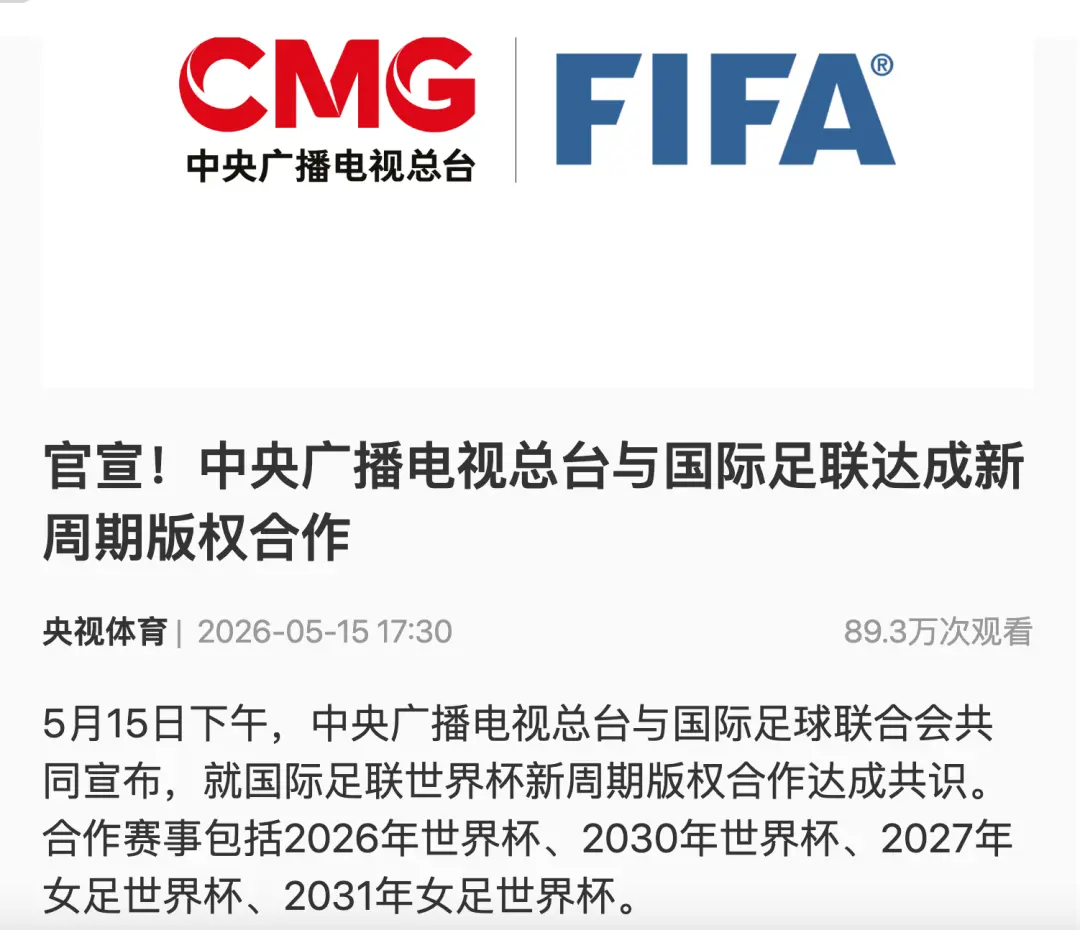
On the afternoon of May 15, China Central Radio and Television officially announced the results of the World Cup copyright negotiations. Little is known about the twists and turns in the negotiation process, and it is even harder to see from official press releases. Regarding the agreement reached between FIFA and CCTV, FIFA Secretary-General Mattias Grafström said in a face-to-face communication with Lanxiong Sports on the afternoon of May 15 that there were no details to be disclosed.
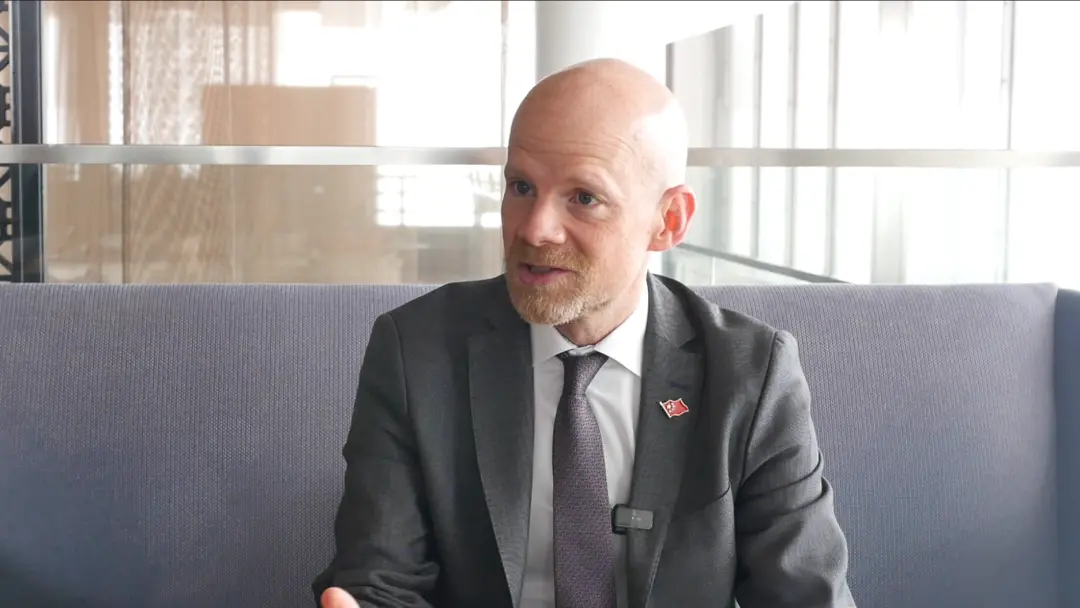
▲Mattias Grafström had an in-depth conversation with Lanxiong Sports. Detailed video conversation content will be released soon, so stay tuned.
As disclosed by public information and learned by Lanxiong Sports, the main itinerary of the FIFA team's trip to China includes visits to the State Sports General Administration and the Chinese Football Association, CCTV, FIFA partner Lenovo Group (Beijing headquarters), World Cup sponsor Mengniu Group (Beijing office), Beijing Guoan Club and Workers' Stadium, as well as meetings with senior executives of Hangzhou Fude, the general licensee of the US-Canada World Cup in Greater China, etc. Among them, the World Cup negotiations between FIFA and CCTV are mainly concentrated on the two full days of May 13th and 14th, as well as the morning of the 15th.
In the previous article on World Cup copyright, we pointed out that CCTV and FIFA had not had any substantive contact for several months because of obvious differences in the total price and the price distribution of the two World Cups (mainly the total price difference was about US$100 million). According to relevant people close to the negotiation, Lanxiong Sports revealed that until the end of the evening of May 13, there was still a large price gap between FIFA and CCTV. During the negotiation that day, CCTV further lowered its offer considering that the World Cup was about to start and missed a lot of advertising investment time. FIFA said it was unacceptable, and the negotiations between the two parties once again reached a deadlock.
The copyright of CCTV is pending. Not only the news media and fans are paying attention, but the World Cup sponsors from China are also very anxious - whether it is Lenovo, Hisense, or perhaps Mengniu, overseas business is important, and no matter how big it is, the local market will always be their home base. If the World Cup cannot be successfully broadcast in the Chinese mainland market, the World Cup marketing of these sponsors will be greatly affected.

▲Among the top two sponsors of this World Cup, Chinese companies account for three.
According to information obtained by Lanxiong Sports, as FIFA's official technology partner and the highest level sponsor of the World Cup, Lenovo Group Chairman and CEO Yang Yuanqing asked in a communication with the relevant person in charge of his company's marketing department after seeing the news whether they could contribute to the negotiations between CCTV and FIFA.
The marketing department of Lenovo Group subsequently communicated with the FIFA team on the phone and learned that there was still a big price gap between the two parties.
As an executive of a top sponsor of the World Cup, the head of Lenovo Group’s marketing department actively tried to join in the mediation out of consideration for the activation of his own company’s World Cup sponsorship. On the evening of the 13th, during a dinner meeting with the FIFA team in Beijing, in the name of a sponsor, the person in charge once again expressed to FIFA the significance of CCTV's live broadcast of the World Cup. That is, if the World Cup is not broadcast in mainland China, not only will fans not be able to watch the live broadcast, but the sponsorship of Chinese companies will also be greatly reduced. This is a lose-lose situation.
On the afternoon of the 14th, the person in charge acted as an intermediary that FIFA and CCTV mutually trust, and suggested that FIFA propose the lowest price. At the same time, intensive coordination was carried out to communicate with CCTV and strive to resolve the differences between the two parties.
Until late at night on the 14th, the lowest price reported by FIFA was recognized by CCTV. The two parties finally reached an agreement and formally reached an agreement on the morning of the 15th.
This assist from a top sponsor played an important role in the impasse over World Cup rights. In any case, only if FIFA and CCTV World Cup copyright can be finally negotiated can a win-win situation be formed for fans, broadcasters, FIFA, sponsors and other parties.
Although the price finally negotiated between CCTV and FIFA has not been disclosed, one thing should be clear:In this negotiation and the final signing result, FIFA made major concessions.
In addition to the news obtained by Lanxiong Sports in the previous article, there is also a public direct evidence that can also support the judgment: the copyright package for the new cycle of the FIFA World Cup officially announced by CCTV includes not only the 2026 FIFA Men's Football World Cup in the United States, Canada, Mexico and the 2030 Western Portuguese and South American Three Nations, but also the two Women's Football World Cups in 2027 and 2031. This rather unexpected information can also be regarded as a signal of some kind.
Anyone who is familiar with global sports business knows that in recent years, with the comprehensive rise of women's sports, especially women's football, on a global scale, the commercial value of women's football events has experienced explosive growth. Events such as the FIFA Women's World Cup and the UEFA Women's European Cup are no longer accessories to the top international men's football competitions, but women's football flagship events whose commercial value has reached the standards of being sold separately by FIFA and UEFA.
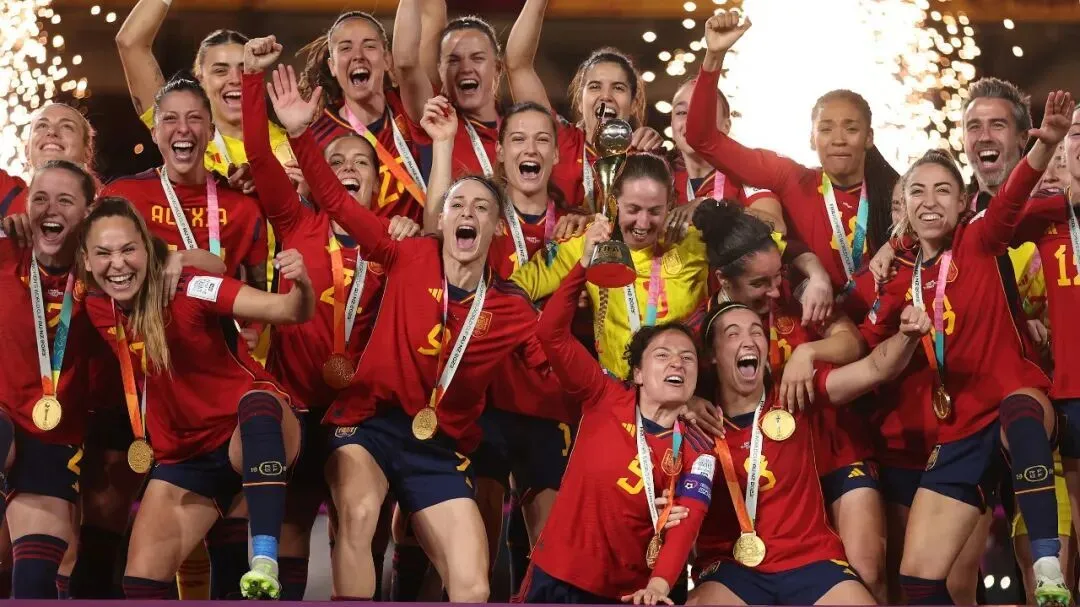
▲The rights to the Women's World Cup have been sold separately by FIFA, but CCTV and FIFA have recently reached a World Cup copyright agreement, including two Women's World Cups.
Judging from the sales results, the commercial value of the Women's World Cup and Women's European Cup has also been widely recognized internationally. For example, for the 2023 Women's World Cup, CCTV purchased the copyright separately from FIFA. It was neither included in the copyright package for the 2018 Russia + 2022 Qatar World Cup, nor the copyright package for the 2026 United States, Canada, Mexico, and the 2030 West Portugal and South America World Cup. For another example, starting from the 2027 Women's World Cup, this event will also be sold independently in the U.S. market. The U.S. market rights for the next two FIFA Women's World Cups have been purchased by Netflix at a high price. The same goes for the Women's European Cup.
Considering that FIFA and CCTV have previously been at a stalemate in copyright negotiations for the next two FIFA Men's World Cups, the outside world has reason to make a reasonable inference: the two Women's World Cups in 2027 and 2031 were added to the rights package by FIFA in order to facilitate the success of negotiations with CCTV on the two Men's World Cups in 2026 and 2030.
Although the process was tortuous and only through third-party mediation did FIFA and CCTV reach an agreement, FIFA is still quite satisfied with the result.
"To sum it up in one word: friendly. We had a good negotiation process with our friends and partners at China Central Radio and Television." FIFA Secretary General Mattias Grafström told Lanxiong Sports.
Referring to Lenovo Group's help in the negotiations between FIFA and CCTV, Mattias Grafström said, "You know, we have good partners in China, and they are also happy to see the World Cup rights negotiated."
After successfully completing the World Cup negotiation task with CCTV, the FIFA team members involved in this round of negotiations are leaving China one after another. Mattias Grafström will fly out of Beijing on the 16th.
At 16:00 on May 17, CCTV will hold a launch event for the United States, Canada and Mexico World Cup integrated media communication service plan in Beijing, which is commonly known as the World Cup Advertising Investment Promotion Conference in the advertising and marketing industry.
There is less than a month until the World Cup kicks off. Regarding maximizing the commercial value of the World Cup, Mattias Grafström said, "There is still one month to solve the problems that need to be solved, so from our perspective, there is nothing to worry about."