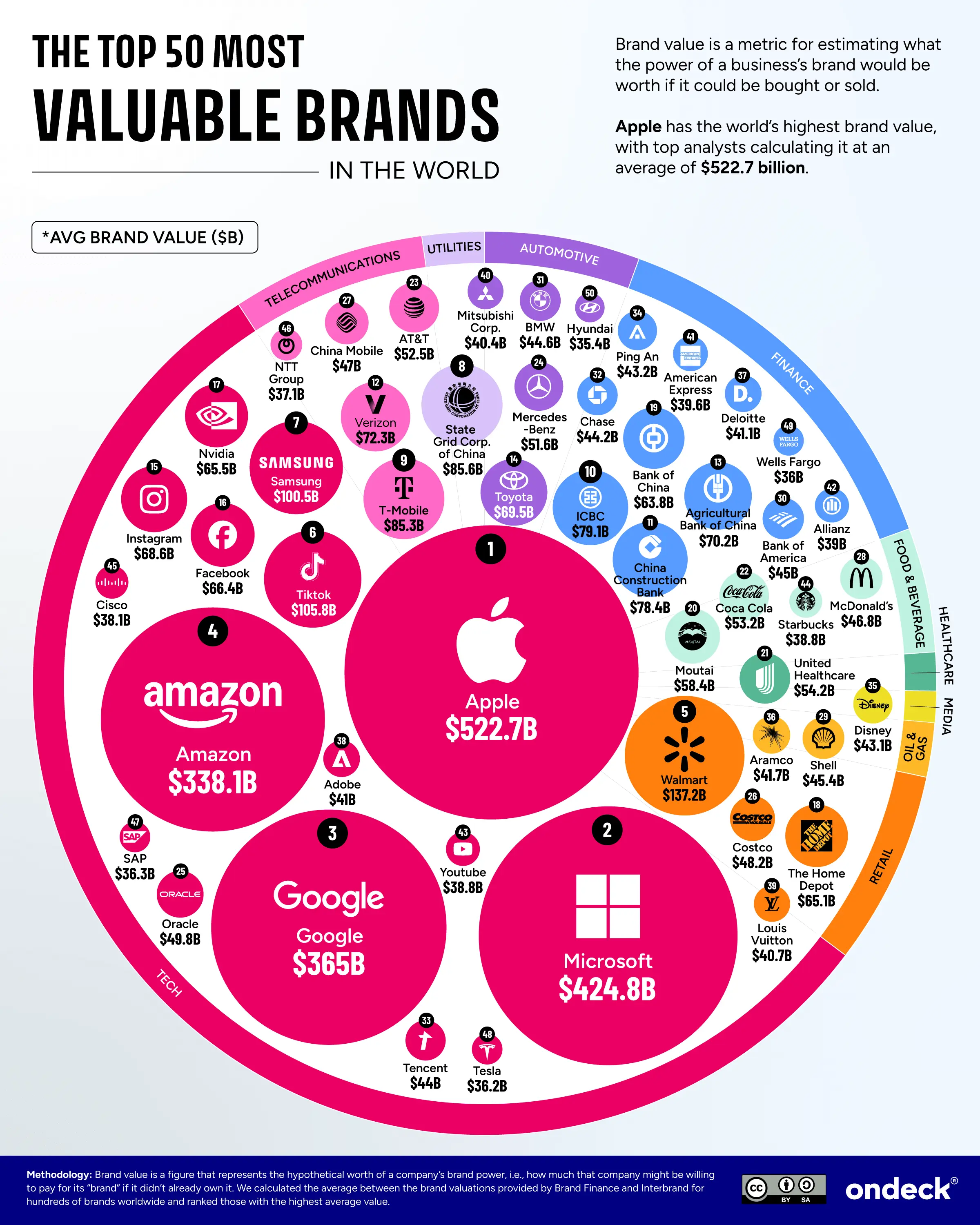
A latest report released by financial technology company OnDeck shows that Microsoft still ranks second in the world in brand value rankings, second only to Apple. The report estimates that the value of the Microsoft brand itself reaches US$424.8 billion, higher than Google's US$365 billion and Amazon's US$338.1 billion, while Apple ranks first with a brand value of US$522.7 billion.
The ranking comes as Microsoft just confirmed the largest round of layoffs in the history of its Xbox business. The company laid off 3,200 employees and divested several game studios in the restructuring. Xbox chief Asha Sharma cited financial conditions as one of the main reasons for the layoffs, saying Microsoft's gaming unit's profit margins clearly lag those of competitors.
In terms of brand value, the strength of Microsoft's overall business is still highly recognized by the capital market and research institutions. OnDeck pointed out in the report that the so-called brand value is different from market capitalization or the overall valuation of the company. It refers to how much a company would theoretically have to pay to "buy back" the brand if it does not own its own brand. Taking Microsoft as an example, if it is assumed that Microsoft is privatized and transferred to a new owner one day, then Microsoft would need to pay approximately US$424.8 billion to regain the right to use the "Microsoft" brand.
OnDeck's brand value assessment is based on a number of indicators, including a company's financial performance, future earnings potential, industry competitiveness and consumers' emotional attachment to the brand. The report believes that even without relying on the data in the report itself, it can be reasonably inferred that Microsoft scores well in the above indicators based only on the public's awareness of Microsoft's products and services and the company's layout in fields such as cloud computing, enterprise software, office suites, and AI.
It is worth noting that the list also reflects another layer of reality: Microsoft has been criticized at the user level for some time in the past. Users have expressed dissatisfaction with the company's push for AI features in Windows 11, arguing that many AI features have no real value. In addition, Windows updates have been criticized for frequent stability issues. Some updates can cause some applications to freeze or crash during use. In terms of the game business, Microsoft has eliminated or significantly downsized popular game studios including id Software, which has triggered a strong backlash from the player community.
However, these negative voices will not be directly reflected in the calculation process of brand value. The report points out that current brand valuation models do not take users’ immediate emotions or short-term word-of-mouth fluctuations as key variables. This also means that even if Microsoft continues to cause controversy in terms of product strategy, AI promotion, and game business adjustments recently, it can still maintain its position as the "second largest brand in the world" by relying on its overall business performance and long-term market position.
Judging from the ranking structure, Apple, Microsoft, Google and Amazon form the most valuable brand matrix in the world, representing the core strength of the digital economy and Internet era. In this landscape, Microsoft has consolidated its dual influence in the enterprise and consumer markets through Azure cloud services, Office productivity tools, enterprise-level solutions, and an expanding AI product line. Although individual business lines are facing layoffs, restructuring or pressure from user public opinion in the short term, from the perspective of brand equity, Microsoft is still regarded as one of the companies with the most commercial value and market bargaining power in the world.
This brand value report released by OnDeck shows that in the eyes of capital markets and brand research institutions, Microsoft's overall brand strength remains solid. For Microsoft itself, how to balance business restructuring, product strategy and user experience while maintaining high brand value may become the core challenge it must face in the next few years.