
Abstract:
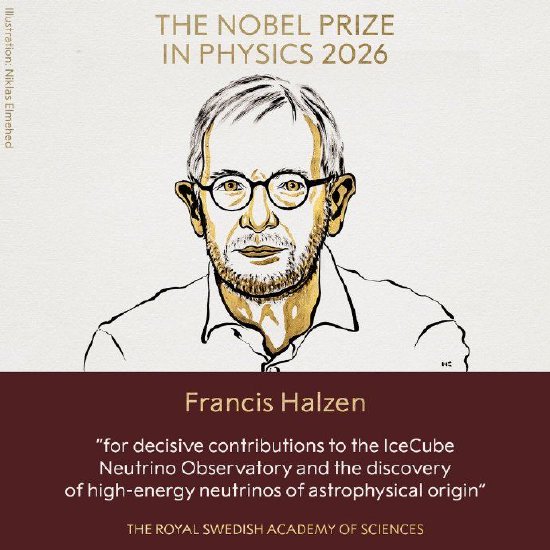
The Royal Swedish Academy of Sciences has decided to award the 2026 Nobel Prize in Physics to Francis Halzen in recognition of his decisive contributions to the IceCube Neutrino Observatory and the discovery of high-energy neutrinos from astrophysical sources.
Francis Halzen realized that Antarctic ice could be used to track particles called neutrinos. His ideas and academic leadership are the core foundation for the establishment of the IceCube Neutrino Observatory. The observatory has light sensors spread across a cubic kilometer of ice. With the IceCube detector, researchers can capture neutrinos produced by high-energy activity in the distant universe.
Neuttrinos are everywhere but difficult to detect. They can pass right through the earth and through our bodies without us noticing. Only in extremely rare cases do individual neutrinos interact with atomic nuclei, and with the right equipment it is possible to detect them.
Scientists have long known that there are natural sources of high-energy particles in the universe, which can emit particles with up to one million times the energy that can be achieved in laboratories on Earth. There are still a lot of mysteries about these particle sources: what are they, where are they located, and what are the core physical processes inside them?
Ultra-high energy neutrinos are born in the same cosmic environment as other particles. But unlike other particles, neutrinos do not change direction or lose energy when they reach Earth. This means that it can provide information that cannot be obtained by other observation methods.
Francis Halzen first proposed the idea of capturing neutrinos in Antarctica in 1988. When neutrinos hit atomic nuclei, they create flashes of light that can be picked up by sensors inside pristine glacier ice. Antarctic ice has many advantages: it is almost immune to interference from all types of signals, is geologically stable, and has no earthquakes. Halzen's idea quickly gained support from other researchers, and just a few years later, the research team carried out preliminary tests of the sensor in the ice.
The number of ultra-high-energy cosmic neutrinos is extremely rare, so a huge volume of ice is needed to observe enough collision events. The IceCube detector was built in 2011 and covers one cubic kilometer of ice. Researchers soon detected the first batch of high-energy neutrinos; a few years later, they published results confirming that the detected neutrinos originated from distant space beyond the solar system. Humanity has thus officially begun its exploration of the source of neutrinos in the universe.
Mark Pierce, Chairman of the Nobel Committee for Physics, said: "Francis Halzen led an international team of scientific researchers and engineers to build this outstanding detection equipment for mankind. His tenacity and scientific vision opened up a new kind of astronomy."
The neutrino interaction signals that IceCube continues to collect will help researchers further understand the violent cosmic environment that produces high-energy neutrinos, and may even discover previously unknown cosmic phenomena.
Comments