
Abstract:
An international scientific research team recently proposed a new quantum information reading method, which is expected to obtain the qubit state without significantly disturbing the quantum system, providing a more efficient technical path for the monitoring and control of future quantum computers. Research shows that a type of quantum device called "Andreev qubits" can expose its internal state through the current signal it generates, thereby reducing the destruction of quantum information during traditional measurements.
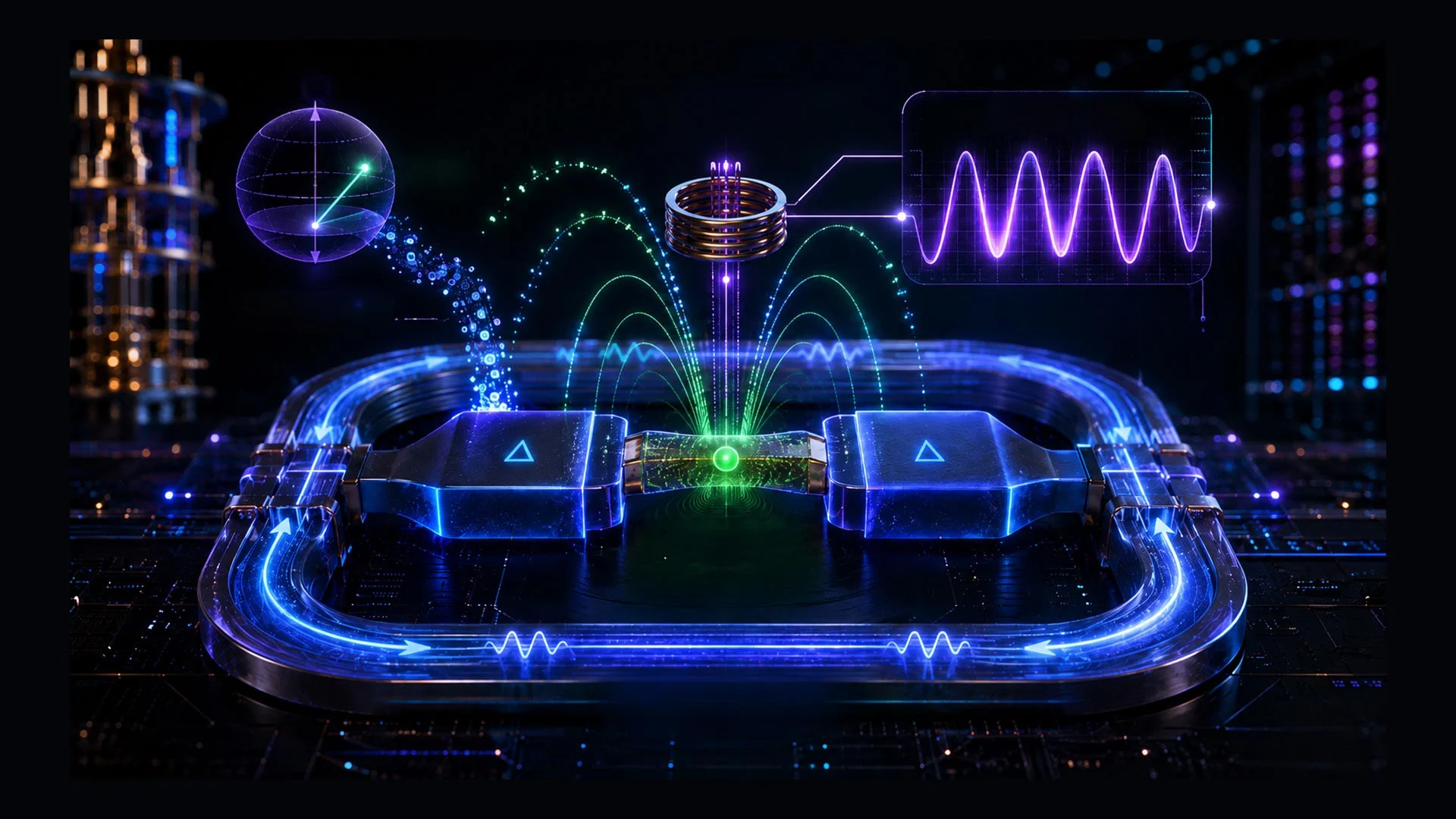
In classical computers, bits can only assume two states: 0 or 1. However, qubits in quantum computing can not only represent 0 and 1, but can also be in a quantum state formed by the superposition of the two. It is this characteristic that makes quantum computers expected to far outperform traditional computers in specific tasks. But at the same time, quantum states are extremely fragile, and both environmental interference and the act of measurement itself can change their state and cause information loss.
This research focuses on Andreev qubits. Such qubits are based on special quantum states formed between superconducting materials. The system designed by the research team consists of an extremely thin indium arsenide nanowire. The two ends of the nanowire are connected to superconducting materials, and a quantum dot is formed in the middle to limit the electron activity space. The state of the Andreev qubit is formed in this microscopic environment.
José Carlos Egues, one of the leaders of the research and a professor at the São Carlos Institute of Physics at the University of São Paulo in Brazil, said that under the framework of traditional quantum mechanics, direct measurement of qubits often causes them to collapse into a certain state, thereby destroying the originally preserved information. Therefore, many current quantum computing solutions will introduce auxiliary qubits as "intermediaries" to first transfer information to the auxiliary qubits and then measure the latter to minimize the impact on the target qubits.
However, this method requires additional equipment and operating steps, which increases the complexity of the system. The research team proposed a different idea, which is to directly use the signal generated by the target qubit itself to read information without resorting to auxiliary qubits.
According to theoretical calculations, the qubit is placed in a closed superconducting circuit, and there is a supercurrent flowing without resistance in the circuit. Research has found that when qubits are in a superposition state, quantum interference between different states causes some supercurrents to produce periodic oscillations. This oscillating signal is the key for researchers to obtain quantum information.
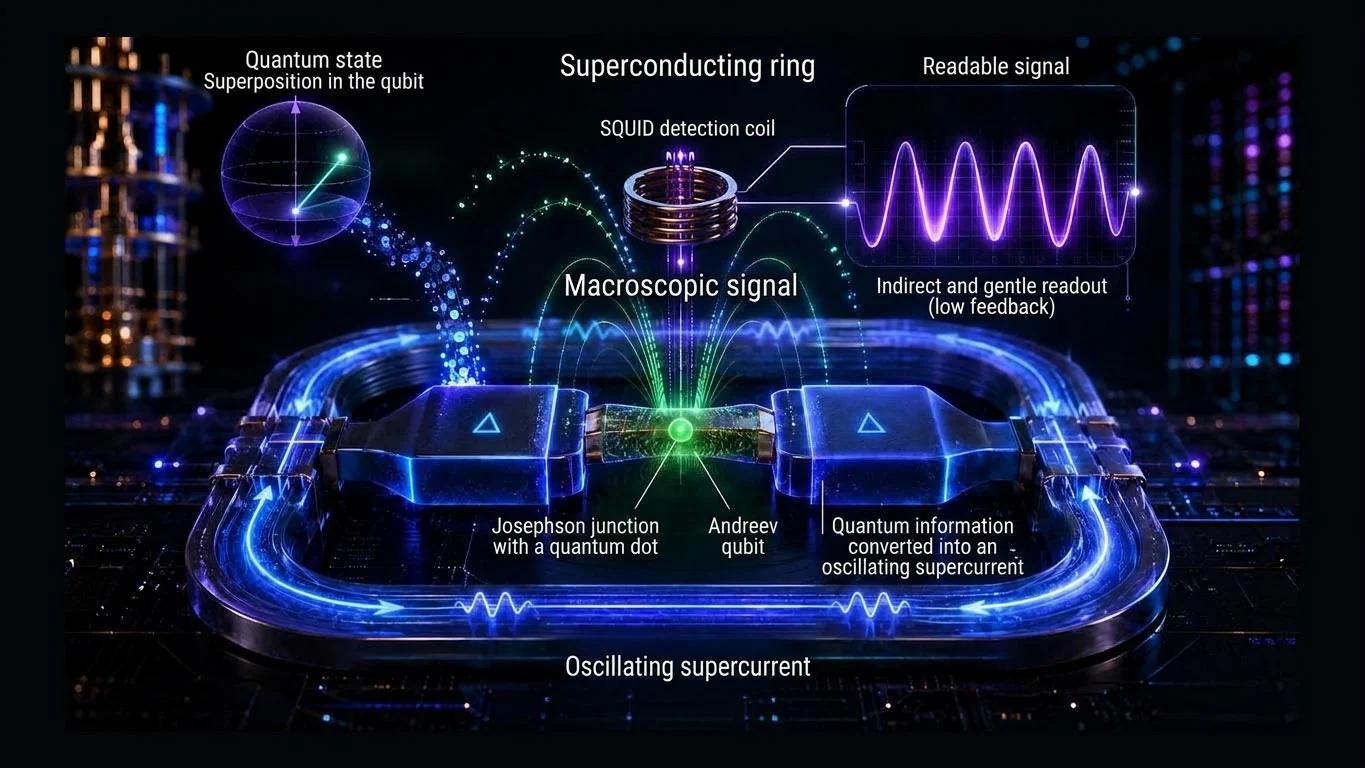
Normally, this type of oscillation phenomenon requires the application of voltage to produce, which is the famous AC Josephson effect. The system proposed in this study does not require external voltage, and the oscillation is entirely derived from the evolution process of the qubit's own state. This means that the qubit will actively "release" its own state information.
In order to detect this weak signal, the researchers designed and used SQUID (superconducting quantum interferometer) as a reading device. SQUID is able to detect extremely weak magnetic field changes. The research team vividly stated that the qubit and SQUID can be regarded as two compasses close to each other. The current in the qubit will generate a magnetic field, and the SQUID will sense this change in the magnetic field. Since the coupling between the two is extremely weak, the perturbation produced by the measurement device on the qubit itself is also very limited.
Further analysis revealed that all key information about the qubit's state was encoded in the supercurrent. Supercurrent contains both a constant part and an oscillating part. The constant current value and the amplitude of the oscillation can reveal the proportion of 0 and 1 in the quantum state, while the time when the oscillation starts reflects the phase relationship between the two states. By recording how the current changes over time, the researchers were able to reconstruct the qubit's original quantum state.
This approach also has the important advantage of allowing researchers to continuously track the evolution of qubits without having to reinitialize them after each measurement, making it easier to observe the dynamic behavior of quantum systems.
The research team added realistic factors such as measurement noise and detection coil feedback into the simulation experiment. The results show that the measurement accuracy can reach 99.52%, 99.81% and 99.85% respectively, depending on the number of measurements. These indicators have reached the accuracy requirements commonly used in current quantum error correction technology.
The researchers pointed out that this solution does not fundamentally solve the basic problem of the inevitable impact of quantum measurements, but it can reduce this impact to a very low level while getting rid of the reliance on auxiliary qubits in traditional non-destructive measurement solutions.
This study was jointly completed by researchers from the University of São Paulo in Brazil and the Beijing Institute of Technology in China. The relevant results have been published in "Physical Review B". The research team stated that the SQUID technology used to detect ultra-weak currents and magnetic fields is already quite mature, so there is no need to wait for new materials or manufacturing technology breakthroughs to implement this solution. All parameters used in the study are derived from real systems. The only thing that has not been actually built is the specific device structure and experimental layout proposed by the research team.
The researchers believe that as long as the corresponding experimental verification is completed, this new method of reading quantum information through the supercurrent of the qubit itself is expected to become an important technical basis for future quantum computers to achieve high-precision, low-interference monitoring.
Comments