
Abstract:
Chinese researchers have developed a thin protective coating for lithium metal anodes, which is expected to solve key technical problems faced by all-solid-state batteries for a long time. In laboratory tests, batteries treated with this coating maintained 82.3% of their initial capacity after 300 charge-discharge cycles; in comparison, a control battery using untreated lithium metal maintained a capacity retention rate of only 43.0%.
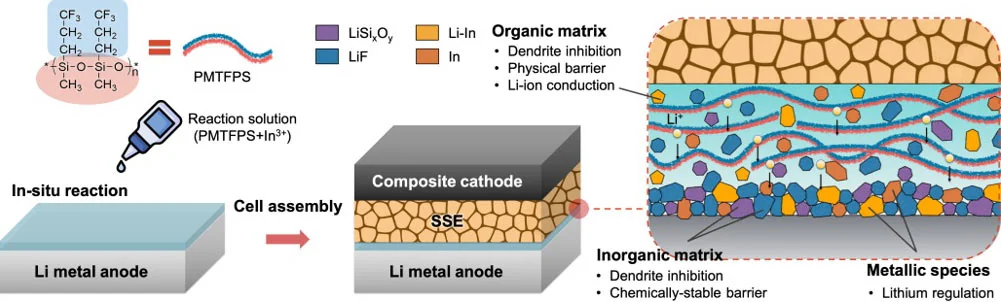
This research was completed by the scientific research team of Xi'an University of Electronic Science and Technology, and the results were published in "Science China Chemistry". Researchers use a simple liquid chemical treatment to form a protective layer on the surface of lithium metal, providing new ideas for improving the stability and service life of next-generation batteries.
Lithium metal is regarded as an important candidate material for high-energy-density batteries, and is even called the "Holy Grail" in the field of energy storage. Theoretically, lithium metal can store nearly ten times the amount of electricity per gram of the graphite negative electrode used in traditional lithium-ion batteries. If this advantage can be fully utilized, future batteries are expected to store more energy under the same weight, thereby reducing the weight of the battery pack and bringing longer cruising range to electric vehicles.
However, lithium metal is prone to uneven deposition during the charge and discharge process, forming sharp structures called lithium dendrites. These dendrites may continue to grow and eventually pierce the internal structure of the battery, causing short circuits and safety risks. At the same time, there are also chemical stability issues between lithium metal and sulfide solid electrolyte, and interfacial reactions will affect battery performance and cycle life. These problems have always been important obstacles to the practical application of lithium metal all-solid-state batteries.
To solve this problem, a team involving researchers including Li Siwu, Wu Weiwei, and Yu Chuang combined a silicon-based polymer with indium chloride to create a liquid precursor that can be directly coated on the surface of lithium metal. After the coating material reacts with lithium, a composite protective film with a thickness of only about 12 microns will be formed in situ on the surface, which contains components such as lithium fluoride and lithium indium alloy nanoparticles.
This protective film does not simply isolate lithium metal from the outside world, but improves the lithium ion deposition process inside the battery through the synergy of different materials. The polymer skeleton has a certain degree of flexibility and can adapt to the mechanical stress caused by the repeated expansion and contraction of lithium metal during charging and discharging; lithium fluoride can block electrons and inhibit the nucleation and growth of lithium dendrites; lithium indium alloy nanoparticles help guide the uniform deposition of lithium ions and avoid the concentrated accumulation of lithium to form dangerous sharp structures.
Experimental results show that the critical current density of the coated lithium metal electrode reaches 3.5 milliamperes per square centimeter, which is more than four times that of the untreated electrode, which is 0.8 milliamperes per square centimeter. The critical current density is an important indicator of the battery's ability to resist uneven lithium deposition and dendrite growth. An increase in the value means that the battery is expected to maintain stable operation at higher current densities.
The researchers then applied this protective electrode to a complete battery. The test battery uses nickel cobalt manganese oxide positive electrode and sulfide solid electrolyte, and the initial capacity reaches 129.8 mAh per gram at 0.5C rate. After 300 charge-discharge cycles, the battery still retained 82.3% of its initial capacity. In contrast, when using unprotected lithium metal electrodes, the capacity retention rate is only 43.0%, and the gap between the two is very obvious.
Spectral analysis and electron microscope observation further confirmed the composition and structure of the protective layer. The researchers found that the coating formed a relatively dense and uniform film, and no obvious cracks or voids were observed, which also provided structural-level evidence that it can continuously protect the interface between lithium metal and solid electrolyte.
Another noteworthy feature of this technology is its potential industrial adaptability. Unlike some electrode surface modification technologies that require complex vacuum treatment processes, this protective film is formed by direct coating with a liquid precursor and reacting on the lithium metal surface. In theory, there is an opportunity to use existing industrial coating equipment for production, thereby reducing the complexity and cost of the manufacturing process.
The research team also plans to explore replacing indium with tin, zinc and other elements to further optimize the material formula. Indium is a relatively scarce and costly metal. If alternative materials with similar performance and lower cost can be found, it will help improve the economics of large-scale application of this technology in the future.
However, this achievement is still in the laboratory research stage. The improvement in cycle performance obtained in the experiment does not mean that the relevant batteries are ready for commercialization. In the future, it is necessary to further verify its performance under longer cycle periods, larger battery capacities, different temperature environments, and actual production conditions, while also solving issues such as material cost, manufacturing consistency, and long-term interface stability.
The researchers believe that this composite protective layer formed in situ provides a relatively simple technical route for stabilizing lithium metal anodes. If subsequent research can prove its reliability in actual batteries and achieve low-cost, large-scale manufacturing, it may push high-energy-density all-solid-state batteries a step closer to electric vehicles and large-scale energy storage.
Comments