
Abstract:
A team from The Ohio State University in the United States recently released its research results in Science Advances. They launched a remote odor transmission system called Scentronic, which relies on wearable receiving devices to realize the digitization of smells and remote reproduction through the network for the first time, taking "scent transmission" across distances from an idea to the laboratory verification stage.
The entire system is divided into three parts: the transmitter electronic nose, the cloud transmission module and the receiver wearable device.
The AI electronic nose captures odor molecules in the air, identifies the odor characteristics and converts them into digital signals, which are uploaded to the cloud for forwarding via Wi-Fi. The receiver is available in two wearable forms, a bracelet and a necklace, with a built-in five-channel piezoelectric atomization device. After receiving the signal, it releases the corresponding fragrance particles, and the user can smell the replica scent when they get close.
In the test phase, the team selected five basic smells: cake, coffee, orange, red wine, and beer to conduct experiments. 16 volunteers participated in a blind test and could accurately distinguish these five types of smells.
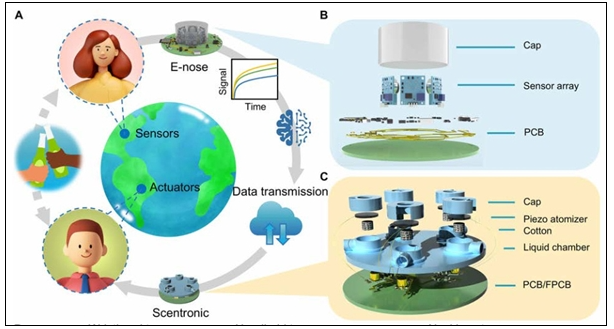
This set of equipment can transmit odor data in real time, and can also save odor samples in the cloud and retrieve them at any time. In the future, it can be used for remote companionship, online food live broadcast, metaverse sensory experience and other scenarios.
The researchers also said that this technology is still in the prototype experimental stage, and its limitations are very obvious: there are very few types of odors that can be reproduced, and the accuracy of restoring complex mixed odors is limited; wearable devices need to be close to the face to effectively smell fragrance, and there is still a long way to go before commercial use.
It should be pointed out that it cannot directly generate any smell out of thin air. Its essence is to digitally sample first, then atomize and release the pre-configured fragrance source, thereby making up for the shortcomings in sensory transmission other than audio-visual.
Comments