
Abstract:
Recently, a Reddit netizen posted a story about an outrageous installation accident. A pre-installed machine equipped with an Intel Core i7-12700K processor had been running for a full three years without any thermal grease.
According to the author of the original post, this host is an office machine used by his colleagues in the studio. It has experienced problems such as blue screens and slow operation. For this reason, the colleagues even changed the memory stick, but it still had no effect.
It was not until the author intervened to check that he discovered that there was nothing between the CPU top cover and the integrated water-cooling radiator, and there was no silicone grease.
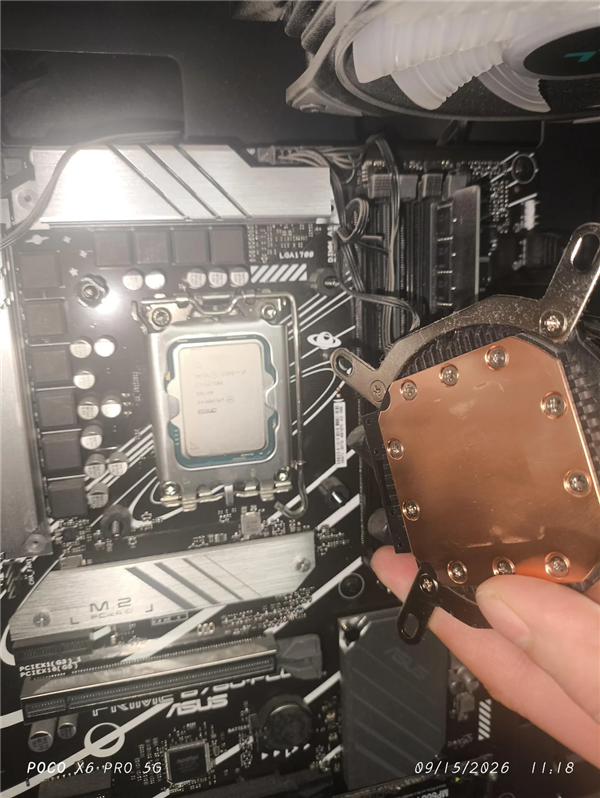
Then the author used OCCT to perform a stress test on the processor, and the CPU temperature rushed directly to 100°C. Considering that the computer had blue screens many times before and was obviously running slowly, this means that the i7-12700K has probably been working at high temperatures for a long time.
More importantly, the AIO water cooling used by this host still uses a front air intake solution, which further limits its heat dissipation performance.
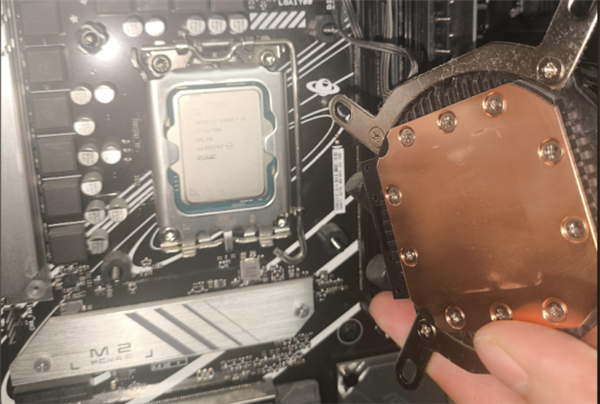
But from the perspective of physical properties, the role of thermal grease is to fill the unevenness on the microscopic level of the metal plane, thereby reducing thermal resistance. The reason why the i7-12700K has been able to survive in such an extreme environment for 3 years without burning out is largely due to its matching dual-fan AIO integrated water-cooling radiator.
Even without silicone grease, the direct contact between the pure copper cold head base and the CPU top cover still retains weak heat transfer capabilities. Together with the extremely sensitive temperature control protection mechanism of modern CPUs, the processor can barely maintain operation during the continuous frequency reduction process.
At present, the processor has been re-applied with silicone grease and returned to normal temperature, but it is not yet certain whether the three-year high temperature operation of nearly 100 degrees Celsius will cause permanent damage to the transistor life.
Comments