
Abstract:
Researchers have developed an artificial intelligence system called ChromAgeNet, which can identify aging characteristics hidden in the DNA structure from three-dimensional cell images obtained by ordinary microscopes, providing a new tool for the study of blood stem cell aging and the future search for ways to delay aging.
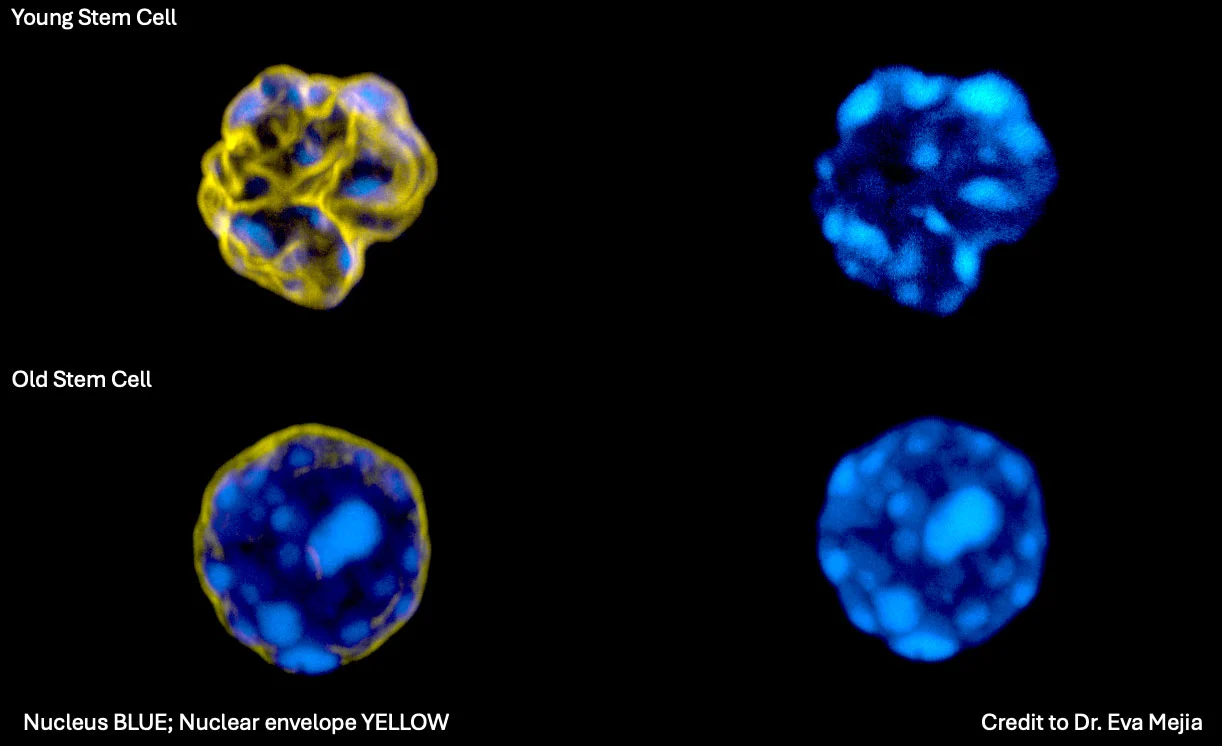
As age increases, the body's ability to produce blood cells will gradually decrease. This change is closely related to the decline in the function of the hematopoietic system. Hematopoietic stem cells are responsible for producing various blood components such as red blood cells, white blood cells, and platelets, but the internal changes that occur in these cells during aging are often so subtle that they are difficult to detect directly even with microscope observation.
To solve this problem, a research team from Spain's Belvite Biomedical Research Institute, Barcelona Supercomputing Center and Barcelona Global Health Institute jointly developed ChromAgeNet. The system analyzes three-dimensional images of cell nuclei to study the spatial organization of DNA inside the nucleus to find hidden features related to aging.
In the study published in the journal "Aging Cell", scientists used mouse hematopoietic stem cells for verification. The results show that ChromAgeNet can distinguish young cells from senescent cells with an accuracy of about 77%, which is better than traditional machine learning models that previously relied on artificially set features.
The research team pointed out that inside the nucleus, DNA does not exist in a simple linear form, but together with proteins form a complex structure called chromatin. The way chromatin is arranged affects which genes are activated, which in turn determines the identity and function of the cell. As we age, this three-dimensional structure gradually changes, but these changes are often difficult to detect with the naked eye.
In order to train the artificial intelligence model, the researchers first used the common fluorescent dye DAPI to label DNA, and then obtained three-dimensional microscopic images of the cell nucleus. The neural network then learns the subtle differences between young and old cells from a large number of samples and builds a judgment model.
Further analysis found that ChromAgeNet does not focus on traditional indicators such as cell size or shape, but on details such as the complexity of the organization of chromatin in space, the distribution of heterochromatin near the edge of the cell nucleus, and some high-density chromatin condensation areas. These structural features, which were difficult to quantify in the past, may contain important information closely related to cell age.
The researchers also conducted proof-of-concept experiments. They treated aging hematopoietic stem cells with different types of epigenetic drugs and then used ChromAgeNet to analyze whether the drugs changed the DNA organization pattern and made it more similar to the structural characteristics of young cells.
The results show that the tool can indeed detect structural changes that occur after drug treatment and determine whether some cells have transformed into "younger characteristics." However, the research team emphasized that this does not mean that these drugs have truly restored the cells to a younger state, nor can they prove that the cell functions have been restored. The current results only illustrate the ability of AI to identify age-related structural changes and their responses to interventions.
The researchers said that this technology can be used in combination with other biological age assessment tools such as epigenetic clocks in the future to provide more comprehensive information for studying aging mechanisms. Due to the low cost and wide application of DAPI staining, ChromAgeNet is expected to be used in high-throughput screening experiments in the future to quickly evaluate the effects of different drugs and interventions from massive amounts of cells.
The team also disclosed the ChromAgeNet model and related three-dimensional cell image data, hoping that other research institutions can further improve cell age assessment technology based on these results. Researchers believe that there is a wealth of aging information hidden in the three-dimensional structure of DNA, and artificial intelligence is helping scientists read these signals in an unprecedented way, opening up new research directions for understanding the aging process and developing potential anti-aging treatments.
Comments