
Abstract:
The U.S. National Transportation Safety Board (NTSB) is investigating the Amazon cargo flight accident in Miami, focusing on verifying the plane's flight speed, weather conditions, and whether key safety protection facilities were missing at the airport. Investigators are looking into multiple factors that led to the Miami cargo plane crash, including the plane's speed, weather factors and whether the tragedy could have been avoided if certain types of airport security had been in place at the time.
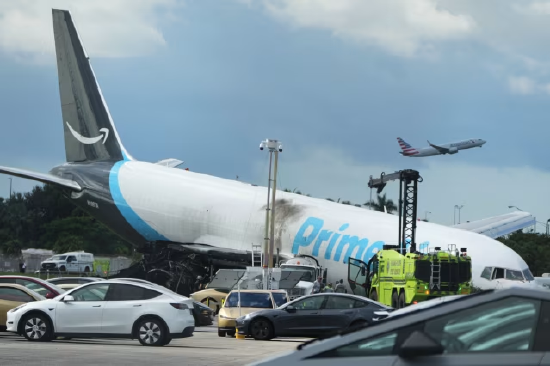
The chairman of the U.S. National Transportation Safety Board said that the Boeing airliner overshot the runway 1,300 feet and hit a van carrying seven people
At a press conference on Monday, National Transportation Safety Board Chairman Jennifer Homendy said that the above are a number of key elements that the agency needs to evaluate. The incident, which occurred on Sunday, killed five people on the ground and injured five others.
Homendi said the Boeing 767 cargo plane, operated by 21Air Cargo Airlines, eventually skidded about 1,300 feet off the end of the paved runway. The plane struck a Ford Econoline van on the airport grounds, which was carrying seven cleaning service workers, and a Toyota SUV on a road outside the airport.
Homendi personally surveyed the damaged path of the accident. She saw that the grass outside the runway was covered with tire friction marks, and navigation equipment, airbags, and fence fragments were scattered on the ground.
"There is only one word to describe the scene: devastated, completely destructive, and horrific to look at." Homendi said.
The safety committee has dispatched a 32-person investigation team to carry out work, and will also verify many other factors: the working condition of the aircraft's mechanical systems, the experience and training level of the crew, and the influence of air traffic control in the incident.
The investigation team needs to compare publicly available flight data with data read from the aircraft's black box. The team is equipped with meteorological experts who will study and judge the meteorological conditions where the incident occurred and assess the impact of thunderstorms and strong winds.
Government and industry officials following the accident investigation revealed that information from the Amazon cargo flight showed that the plane may have landed too fast when approaching Miami Airport.
Officials said that the length of the runway left for the aircraft to slow down was no longer sufficient, and the investigation will most likely focus on why the two pilots did not perform a
go-around
This standard operation is to abandon the landing and try again.When asked about the go-around, Homendi responded: "We need to question the crew."
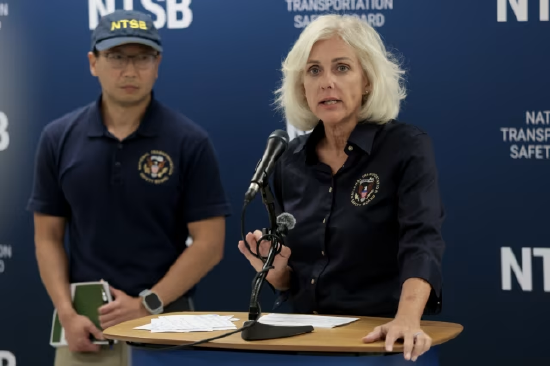
NTSB Chairman Jennifer Homendy described the accident scene as "devastated."
Amazon stated that it is working closely with local authorities and will fully cooperate with various investigations. 21Air said it was deeply saddened by the accident and expressed its condolences to the families, relatives and friends of the victims.
Homendy said that the aircraft's black box has been recovered and will be sent to the NTSB headquarters in Washington, DC for data analysis. The agency will hold another news conference on Tuesday to release more information about the investigation.
Miami Airport Runway 30 is not equipped to protect against
runway overruns
Safety protection equipment for accidents——Especialty material arresting system (EMAS)
. The system is laid at the end of the runway and is made of collapsible energy-absorbing materials. It is used to stop aircraft that have overrun the runway. China Civil Aviation. . .Homendy said the runway was not equipped with the system and would be included in the investigation.
The U.S. Federal Aviation Administration (FAA) and airport managers stated that since a safety buffer area had been set up around the runway, it was determined that there was no need to install an EMAS system at that time.
It is currently unclear whether this tragedy could have been avoided if the system had been installed. According to the FAA, this crushing material arresting device can stop aircraft traveling at up to 80 miles per hour.
Public flight data from the aviation data platform Flightradar24 showed that the Amazon Air cargo plane reached a speed of 112 knots, or approximately 129 miles per hour, when it left the runway usable area.
A Miami Airport spokesperson said that the airport undergoes annual FAA safety inspections and that various indicators continue to meet federal regulatory requirements. The airport will carefully evaluate all recommendations from the FAA and NTSB investigations.
Comments