
Abstract:
A red dwarf that should have been swallowed by an expanding star actually formed a rare three-star system with two white dwarfs that had exhausted their fuel. An international team of astronomers discovered this strange structure just 28 light-years from Earth and named it "Welopōʻai." The research team stated that the existence of this system still lacks a convincing explanation for its formation, and the relevant results have been published in Astronomy and Astrophysics.

This discovery originally originated from an observation to search for exoplanets. Researchers at the Université de Montréal's Trotier Institute for Exoplanet Research (IREx) originally hoped to find a planet orbiting a faint red dwarf star. The planets themselves are often too faint to be seen directly, but their gravity causes subtle "wobbles" in their parent stars that allow astronomers to detect them indirectly.
However, the research team used an infrared polarization spectrometer called SPIRou on the Canada-France-Hawaii Telescope on Mauna Kea, Hawaii, to detect a change in the speed of the red dwarf star of nearly 16 kilometers per second. After several years of follow-up observations, they confirmed that the object pulling the red dwarf star is more than half the mass of the sun.
Such a high mass, but accompanied by extremely low brightness, led researchers to realize that this "invisible partner" was probably not a planet, but the remnants of a dead star. Study co-author Charles-Antoine Parlan, an undergraduate student at Université Laval, said the most likely explanation is a white dwarf star, but neutron stars and even black holes cannot be completely ruled out.
A white dwarf is an extremely dense core left behind after a star has exhausted its fuel. Most stars, including the Sun, eventually end their lives this way. The research team then used the Gemini North Telescope, also located on Mauna Kea, and its "Alopeke" high-resolution imaging instrument to directly observe the white dwarf orbiting the red dwarf star for the first time.
Even more surprising is that astronomers have long known that there is another white dwarf in the system, located further away and orbiting the red dwarf with its newly discovered companion. In other words, Welopōʻai is a three-star system consisting of one red dwarf star and two white dwarf stars. The research team pointed out that no other similar structures have been found within 100 light-years of the Earth.
The reason why this system confuses researchers is that it seems "should not exist." Before becoming a white dwarf, the mass of a red dwarf's close companion is about 1.4 times that of the sun. As it evolved, it expanded into a giant star hundreds of times its original size. According to current understanding, the red dwarf was very close to the giant star at the time and may have been strongly affected by its violent expansion.
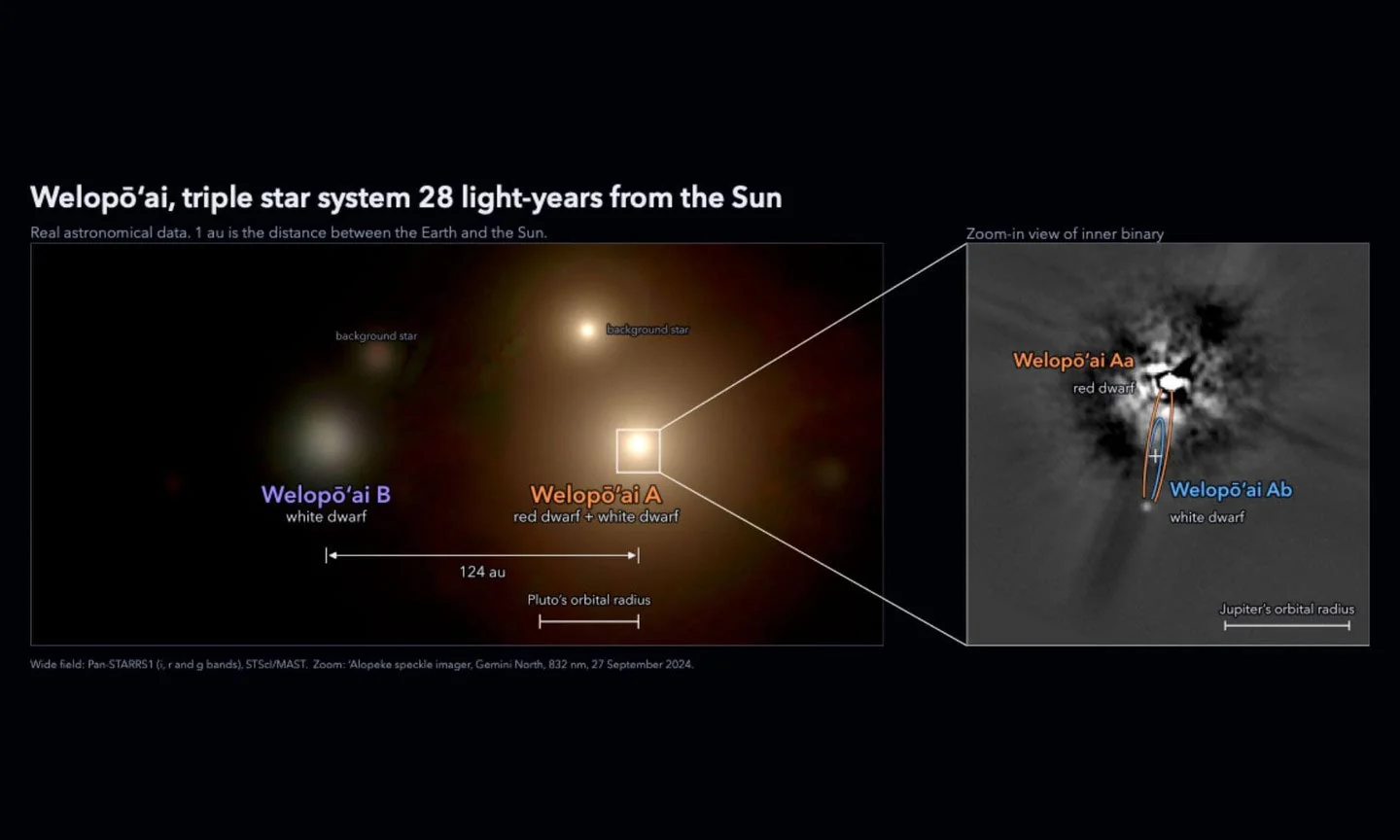
In similar binary star systems, the expanding giant star often swallows the companion star, and the two stars may even merge. But the red dwarf in Welopōʻai appears to have survived and is maintaining a stable orbit around the stellar remnant. Even more unusually, the orbit is much wider than astronomers expected based on the two stars' history of close proximity.
Patrick Dufour, an expert on white dwarfs at the University of Montreal and co-author of the paper, said: "This system should not exist. We do not yet have a clear theory to explain how it formed, which is what drives our next observation." The research team hopes to find out whether the gravitational effect of the three stars on each other can explain the abnormal orbit of the inner binary star.
The research team also accurately measured the mass of the inner white dwarf with an uncertainty of less than 1%. Such high measurement accuracy is rare for white dwarfs. The data will help scientists test theoretical predictions about stellar evolution and how matter behaves in extremely dense states.
The name Welopōʻai was determined by the A Hua He Inoa (Avoking a Name) project at the Imiloa Astronomy Center in Hawaii. The name combines "welo," meaning a hereditary or family trait, and "pōʻai," meaning an orbit or circular path, with the overall meaning being "the path of a family trait."
Etienne Atigo, the IREx researcher who led the study, said that such discoveries remind people that even in the cosmic regions near the solar system, there may still be surprising surprises hidden. He said: "Even if we are originally looking for planets, the universe often brings us something completely unexpected."
Comments