
Abstract:
At the edge of the Andromeda Galaxy, a cosmic "engulfment" event that lasted for several years was completely recorded by astronomers. The two stars orbited each other for thousands of years, until the smaller one brushed against the companion's expanding outer layers and was completely engulfed in just seven orbital periods, about seven years later. The merged celestial body was nicknamed "Bao" by the research team, and related research has been published in the journal Nature.
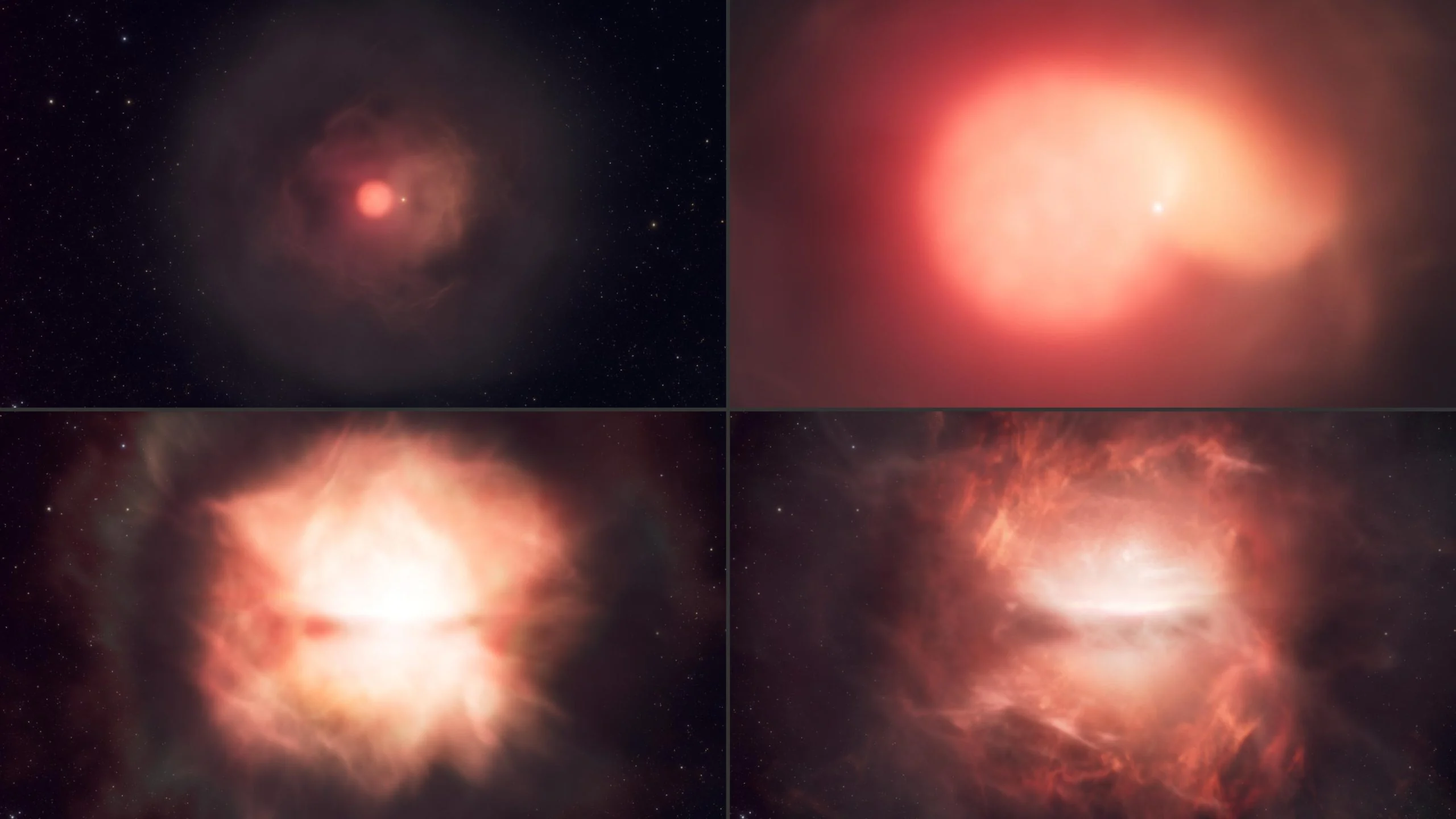
This smaller star has a mass of about 0.7 times that of the Sun, and is slightly smaller and less luminous than the Sun. The main star it orbits is a supergiant star with a mass of about 7 times that of the sun, a radius of 350 times that of the sun, and a brightness that is 18,000 times that of the sun. The research team calls them "small bags" and "big bags" respectively. Before merging, the packet begins to skim the outer layers of the atmospheric packet, stripping off the host star's outer layers of gas with each orbit, which then flows into the surrounding space.
As the small package penetrates into the outer layer of the large package, the two are wrapped in a common hydrogen envelope. The small package encounters resistance when traveling through the gas, and the orbital energy is continuously lost, and eventually spirals towards the core of the large package. The burst caused by the merger reaches its peak brightness in about a week. Researchers originally thought that it would take years for such a massive star to explode, but actual observations showed that its brightness reached its peak in just a week.
This outbreak occurs in 2025. A NASA-funded research team used observations from ground-based and space telescopes, combined with mid-infrared images from the James Webb Space Telescope, to reconstruct a complete picture before, during and after the merger. Webb observed the system 47 days after the peak of the explosion, the earliest follow-up observation of a stellar merger event of its kind.
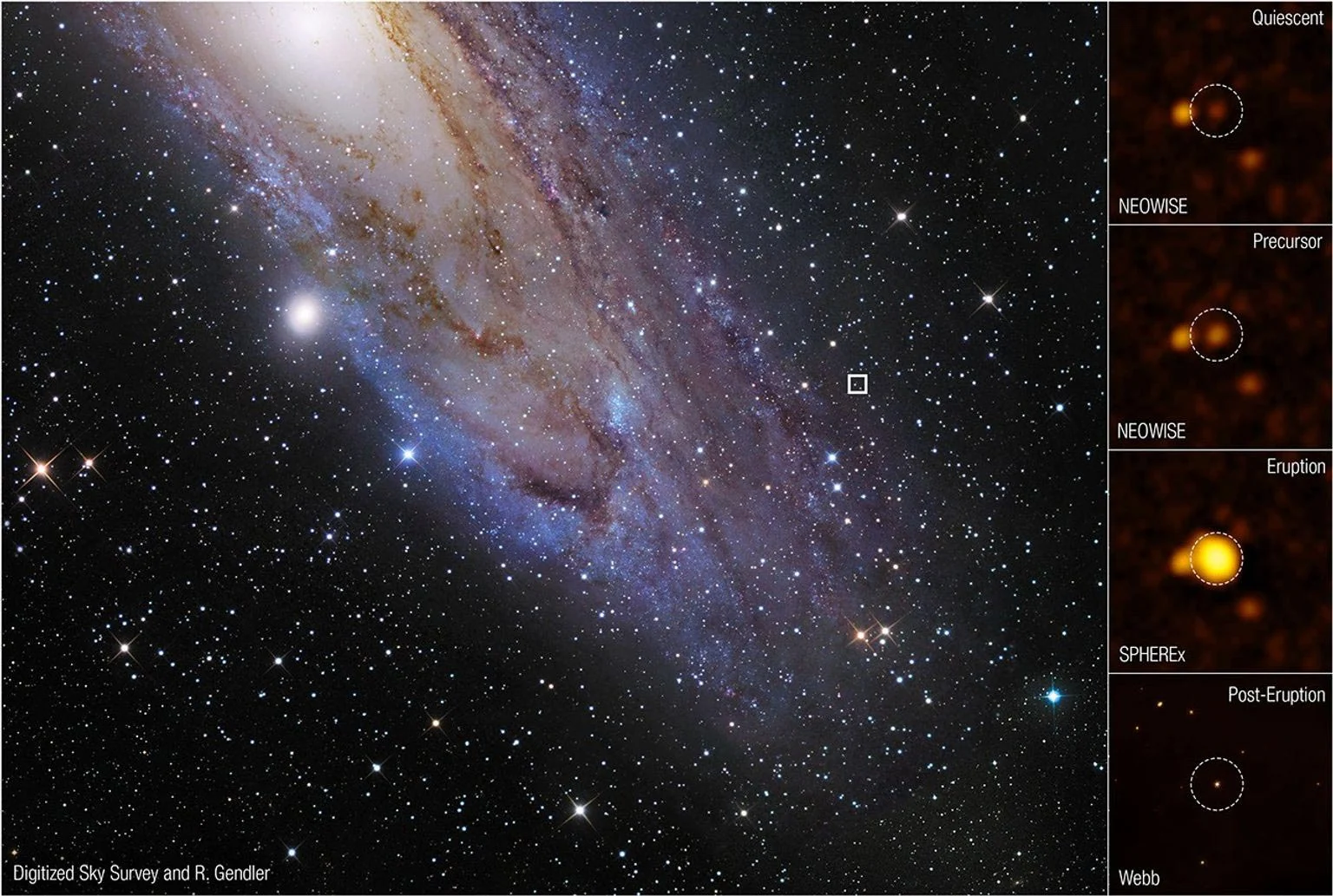
The research team first noticed this unusual variable star in 2023. At the time, data from NASA's retired NEOWISE infrared survey mission showed that its brightness had remained stable until 2018. By September 2024, the Widefield Infrared Transient Detector found that the system was brightening and ejecting dust. In July 2025, the SPHEREx infrared survey mission captured its infrared brightening while the visible light rapidly dimmed. On October 17 of the same year, the Zwicky Transient Facility detected the outburst. Subsequently, Swift Observatory and the Gemini North Telescope in Hawaii launched follow-up observations in November, and Webb observed "Bao" on December 24 through the Director's Discretionary Time Project.
Research shows that small packets are not thrown out of the common cladding, but spiral all the way into the core of the large packet. Researchers described it as "like a bomb exploding inside a living star." Webb's mid-infrared measurements also helped the team determine the amount of ejected dust and deduce how efficiently orbital energy is converted into ejected material.
Such stellar merger events are not uncommon in the universe, but are difficult to capture in real time because the timing of the explosion is difficult to predict. Some binary stars will eject enough material during the shared envelope stage for both stars to survive and form a tight orbit; such systems may produce supernovae, neutron stars or black holes in the future, or even form millisecond pulsars. When tight binaries eventually merge, they also release ripples in space-time called gravitational waves.
The official number of the "package" is AT 2025abao. Continued observations of it in the future may reveal how much mass this potentially "rejuvenated" star retains after it stabilizes. NASA's planned Nancy Grace Roman Space Telescope is also expected to detect more similar events. Researchers expect that the number of discoveries of such stellar mergers will increase significantly as a new generation of sky surveys comes into operation.
Comments