
Abstract:
With Google finally removing all traces of the Manifest V2 extension, with many plugins affected including popular extensions like uBlock Origin, AdGuard has subsequently positioned itself as a viable alternative. The ad blocker says users can still continue to use it in Chrome. However, browsers such as Firefox and Brave offer other options. Firefox has committed to continuing to support MV2 extensions, and Brave, although it is based on Chromium, has also stated that it will maintain support for MV2 extensions as long as possible.
For users who want to continue using uBlock Origin or other MV2 plug-ins and are therefore considering switching browsers, a natural question is: Which browser is the fastest and most suitable as a Chrome alternative?
Brave attempts to answer this question. The company recently announced performance tests conducted in different scenarios and compared its browser with Google Chrome, Mozilla Firefox and Microsoft Edge.
The test used an Apple Mac Mini equipped with an M2 chip, equipped with 8GB of unified memory, and running macOS 26.5.1. Brave, Chrome, Edge and Firefox were tested using the latest versions available at the time and connected to a separate 50Mbps network. Based on its search statistics, Brave selected the 50 most popular websites in the world for testing. Each experiment was repeated 10 times, and the test order of browsers was randomly adjusted to reduce the possibility that a certain browser would benefit due to the test order.
It should be noted that these results come from testing conducted by Brave itself, and should therefore be viewed from the perspective of first-party testing. Brave claims that compared to other tested browsers, its browser takes up 44% less CPU resources on average, while reducing energy consumption by 10% and memory usage by 28%. In addition, Brave receives 26% less data when loading web pages, sends 39% less data, and average web page loading speeds are 20% faster.
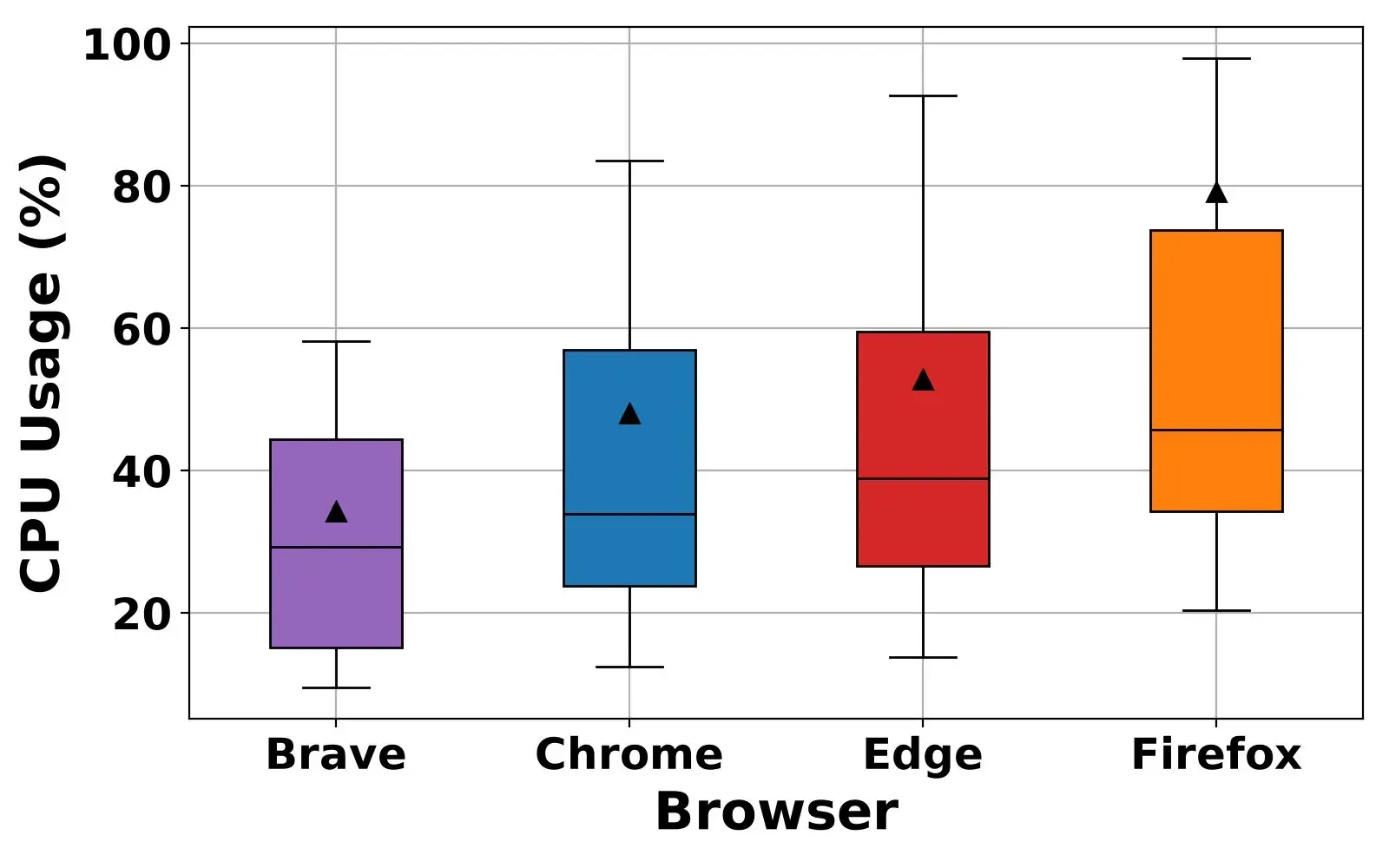
CPU usage data is particularly noteworthy. In the test, the average CPU utilization of Brave was about 33%, Chrome was about 47%, Edge was about 53%, and Firefox reached 78%. Accordingly, Brave said that Firefox's average CPU usage is about 2.4 times that of its own browser.
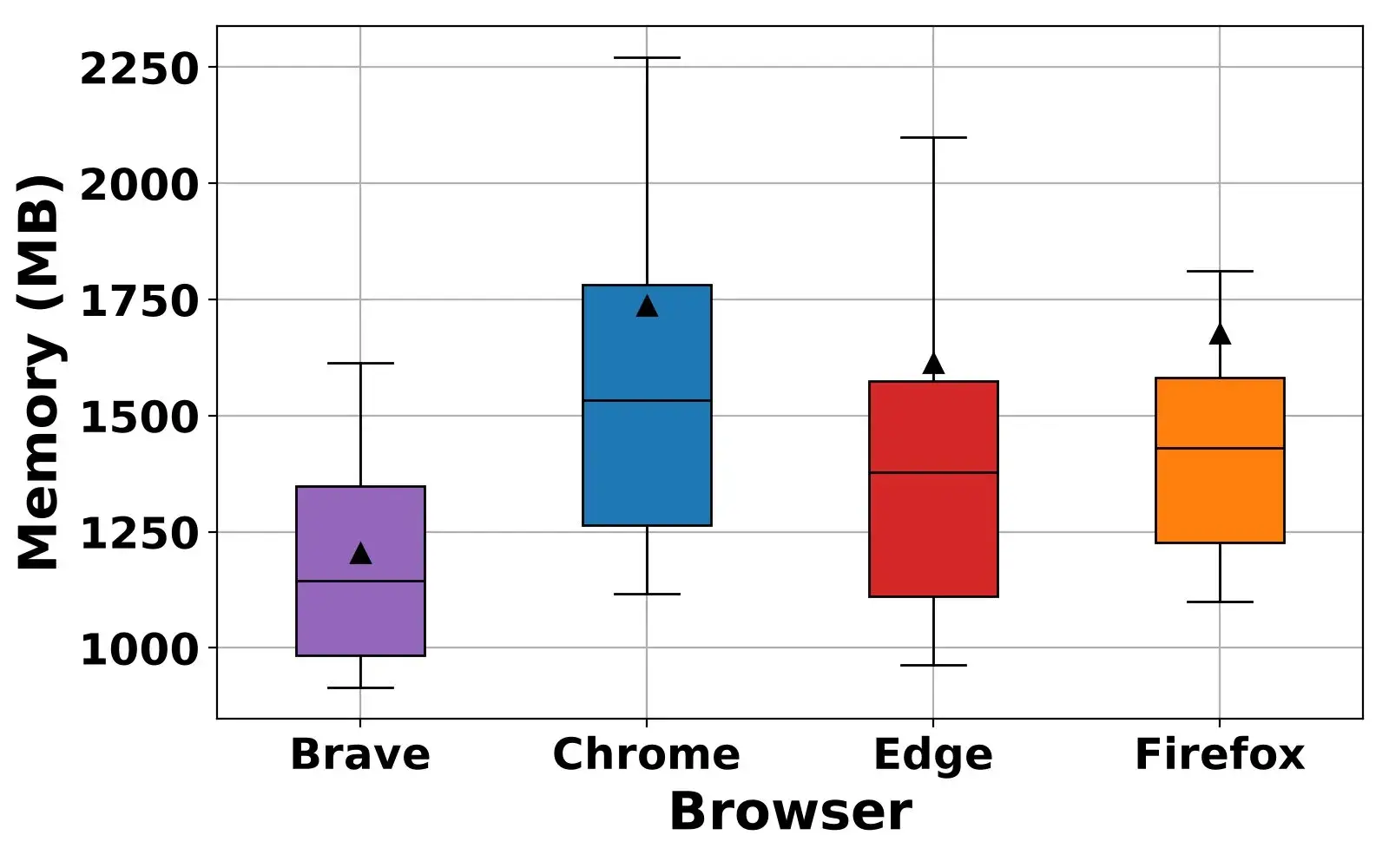
Memory usage also shows a similar trend. Brave takes up about 1200MB of memory on average each time a page is loaded, Chrome is about 1750MB, Edge is about 1620MB, and Firefox is about 1650MB. Based on this result, Brave's memory usage is about 31% lower than Chrome, about 26% lower than Edge, and about 27% lower than Firefox.
In terms of web page loading speed, Brave said that its average time is about 4.4 seconds, which is faster than Chrome's 5.1 seconds, Firefox's 5.3 seconds, and Edge's 6 seconds.
However, this data has an important limitation. When measured by maximum content draw (LCP), which is when the main visible content of a page appears, the differences between browsers are much smaller. Brave and Chrome both averaged around 2.4 seconds, and Edge and Firefox around 2.5 seconds. In other words, Brave's advantage seems to come mainly from faster completion of other related tasks in the web page loading process, not necessarily faster display of the main content of the web page.
Brave notes that its ad and tracker blocking capabilities block background trackers, analytics requests, and other delay scripts. These content often continue to load after the main page content has been displayed, and blocking them may help reduce the time it takes for the page as a whole to finish loading.
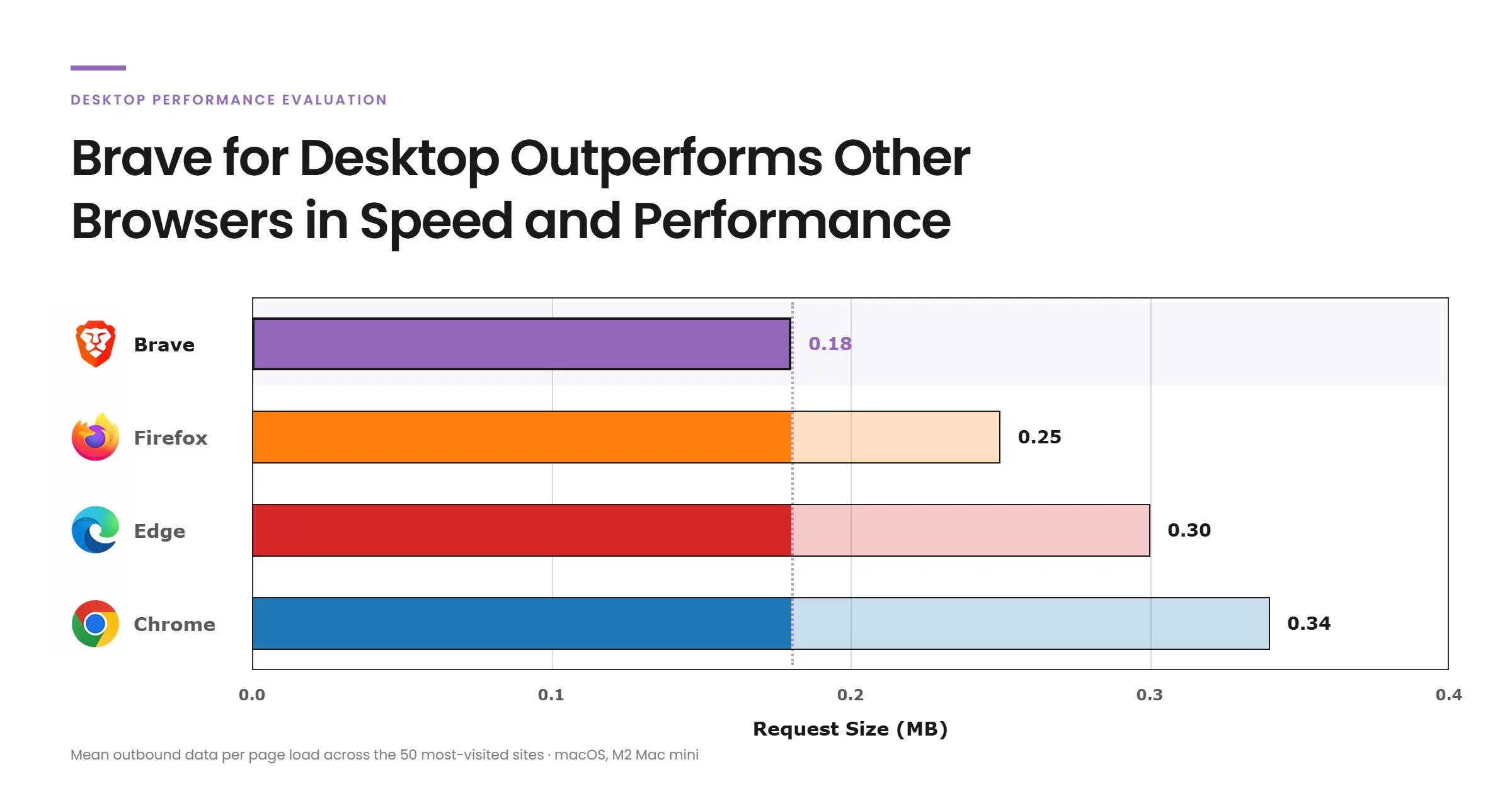
In terms of network data, Brave also claims to have obvious advantages. In the test, Brave received an average of about 4.4MB of data per page loaded, Chrome was about 4.8MB, Firefox was about 6.3MB, and Edge was about 6.8MB. As for sending data, Brave averaged just 0.18MB, compared to 0.25MB for Firefox, 0.30MB for Edge, and 0.34MB for Chrome.
Brave also runs popular browser synthetic benchmarks such as Speedometer 3.1, JetStream 2.2 and MotionMark 1.3.1. However, these results have relatively limited reference significance for the point Brave is trying to prove. Since Brave, Chrome and Edge are all developed based on Chromium, the results of the three are usually close; Firefox, which uses the Gecko engine, often lags behind.
It’s worth noting that Brave scored slightly lower than Chrome and Edge in the MotionMark test. Brave attributes this gap to the overhead of additional privacy protection features under graphics-intensive workloads.
Users can view the company’s full test report on Brave’s official website:
https://brave.com/blog/brave-outperforms-other-browsers/

Comments