
Abstract:
A new study finds that Antarctic sea ice has continued to decrease in recent years, which is triggering significant changes in the deep structure of the southern hemisphere ocean. Observational data show that an important, widespread layer of ocean water is becoming saltier, denser and sinking. This change could lead to more heat entering the deep ocean, with impacts even greater than current climate models predict.
Every Antarctic summer, large amounts of sea ice melt and release fresh water into the surrounding ocean. This seasonal input of fresh water maintains a special seawater layer called "Antarctic midwater" for a long time. This low-salinity layer of water is widely distributed in the Southern Hemisphere's oceans and plays a key role in storing carbon, transporting oxygen and driving global ocean currents, and helps the Earth redistribute heat, fresh water and carbon elements.
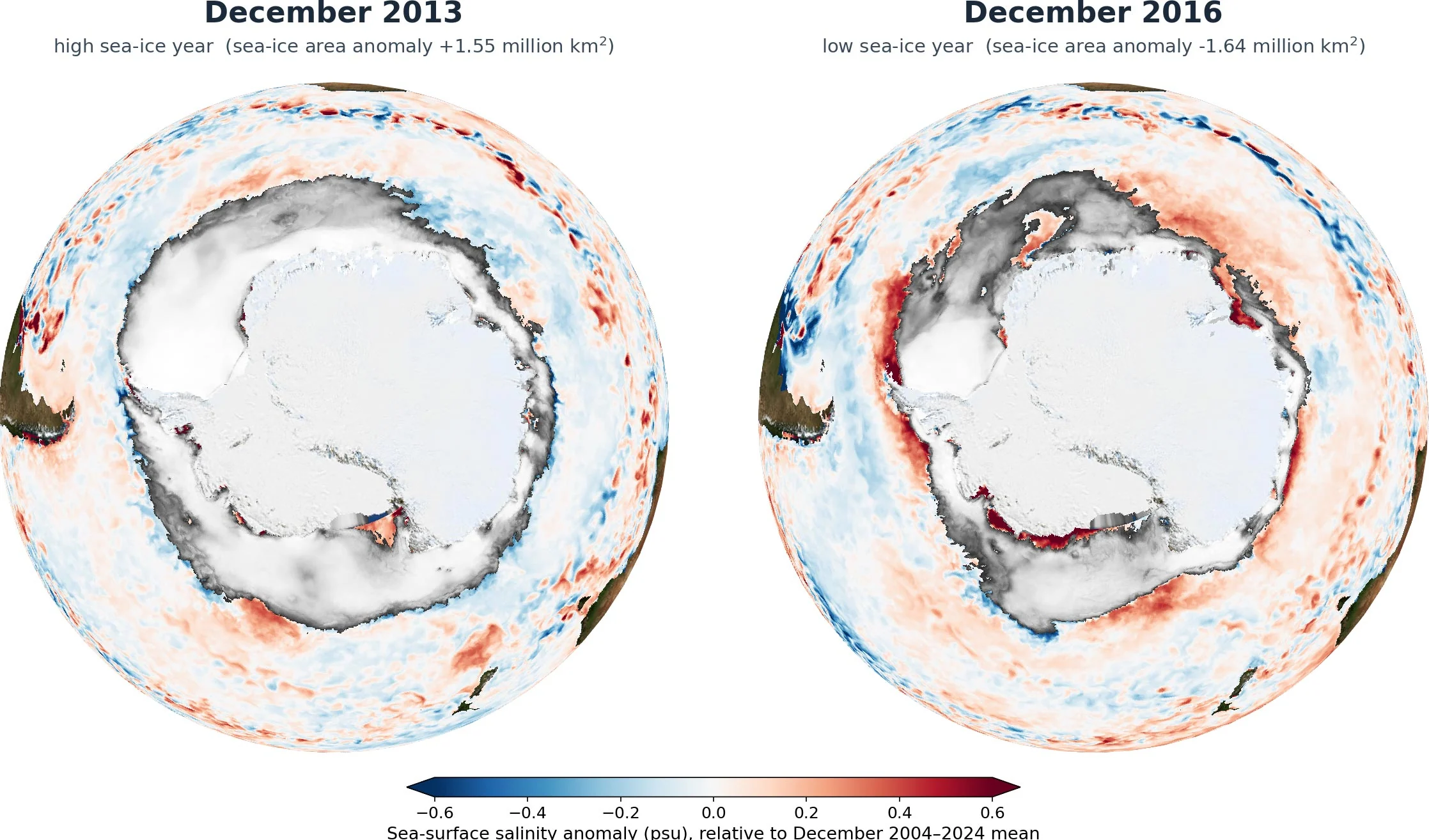
The researchers pointed out that between 1995 and 2015, freshwater produced by melting summer sea ice continued to maintain the stability of this ocean system. However, from 2016 to 2024, as Antarctic sea ice extent fell to historical lows, the supply of fresh water entering the ocean decreased significantly, causing Antarctic mid-level water to rapidly become saltier and heavier, and sink to deeper waters. The change abruptly reversed salinity and density trends over the past several decades.

Relevant results have been published in the journal Nature Climate Change. The international research team used data from the global Argo ocean observation program to conduct the analysis. The plan continuously monitors the upper ocean environment through approximately 4,000 autonomous drifting detection buoys, and conducts systematic research on ocean changes based on satellite observations and atmospheric data.
Bishakhdatta Gayan, one of the leaders of the study and an associate professor at the University of Melbourne and the Indian Institute of Science, said that the Antarctic region can be called the "freshwater engine" of the global ocean, and its changes can affect ocean circulation thousands of kilometers away. Before 2016, melting Antarctic summer sea ice produced approximately three times the annual flow of the Amazon River. Since 2016, Antarctic sea ice has remained at record lows, resulting in a sudden weakening of this critical seasonal freshwater input, with the scale of meltwater declining to approximately twice the annual flow of the Amazon River.
Co-author Professor Alberto Navera Garabato of the University of Southampton, UK, said this change is yet another proof that climate change is affecting almost all areas of the Earth's surface. As the saltier, denser Antarctic mid-level water spreads northward, it will cross the Atlantic, Indian and Pacific oceans. Because this water layer is an important component of the global ocean overturning circulation, if the current trend continues for years or even decades, it may affect the Atlantic meridional overturning circulation in the future, and this deep-ocean current system has been considered to be closely related to climate stability in the North Atlantic region.
The researchers further pointed out that this change may also ultimately affect atmospheric circulation, weather patterns and storm tracks in the Southern Hemisphere. Although the most direct impact occurs in the waters around Antarctica, its subsequent effects may gradually spread to the global scale.
In addition to ocean current systems, the research team is also concerned about possible changes in the ocean's ability to absorb heat. The ocean is currently regarded as an important "climate buffer" for the earth, able to absorb and store most of the extra heat and large amounts of carbon dioxide generated by human activities, thereby slowing down the process of global warming.
Kaushik Mishra, the first author of the paper and a doctoral candidate at the Indian Institute of Science, said that this sudden reversal revealed a key feedback mechanism that may have been missing in previous models. At this stage, the ocean absorbs more than 90% of the additional heat released into the environment by human activities, most of which is stored in the upper ocean. If the Antarctic midwater layer weakens further, excess heat could be transported to deeper waters. This means that existing climate models may be underestimating the extent of deep ocean warming, affecting assessments of regional sea level rise and future ocean and land temperature changes.
The researchers also pointed out that if the changed Antarctic mid-level water affects the seawater sinking process, the ocean's ability to store carbon may also be affected, but there is still great uncertainty about the specific impact scale and occurrence time.
Gayan believes that this change may mean that the Atlantic ocean system and the Antarctic mid-level water circulation are approaching an important critical point. Once this threshold is crossed, the Southern Hemisphere climate is likely to experience more significant and longer-lasting changes.
It is worth noting that researchers said that the last major shift in a similar direction in the Antarctic midwater occurred during the last interglacial period about 130,000 years ago. The Antarctic ice sheet was much smaller than it is today, and that transformation took thousands of years to complete.
In contrast, the changes observed this time occurred rapidly in less than two decades. The research team warned that such a rapid reorganization of the ocean system is extremely rare in modern observational records, indicating that the reduction of Antarctic sea ice may be pushing the global ocean and climate systems into a new stage.
Comments