
Abstract:
Scientists from the University of Tübingen in Germany published a paper in the latest issue of "Science" magazine saying that a new study they conducted showed that when performing visual selection tasks, the decision-making speed of crows is about twice that of primates such as humans and monkeys. In the experiment, it only took two small-billed crows an average of 235 milliseconds to identify the movement direction of the dot matrix on the screen and make a choice, while maintaining a high accuracy.
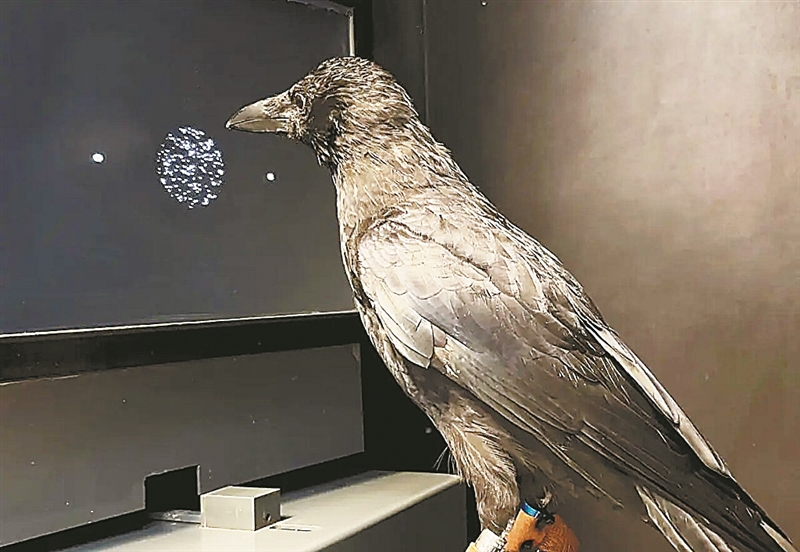
In the experiment, the crow needs to judge the overall movement direction of the white dot on the black screen and make a choice by pecking the target circle on the left or right side of the screen to obtain a reward. Image source: University of Tübingen, Germany
In the experiment, the crow had to judge whether the moving point on the touch screen was moving to the left or right, and indicate its choice by pecking the target on the left or right side of the screen. The results showed that even when the motion signal was difficult to distinguish, the crow's performance was still significantly better than random guessing; when the signal was clear, its accuracy was close to 100%.
To explore its mechanism, the team recorded neuron activity in the caudal neostriatum, a key area in the crow's brain that is equivalent to the primate prefrontal cortex. About 70 milliseconds after the visual stimulus appears, the neuron signals encoding different movement directions in the crow's brain begin to differentiate. This change occurs long before the crow actually responds. As the decision is gradually formed, the relevant neural activity gradually increases until the decision threshold is reached, and the crow then makes a choice. Neuronal activity reflects both the intensity of visual information and the final direction chosen.
These findings indicate that although the avian brain does not have a hierarchical neocortical structure, its neuronal dynamics are still highly consistent with decision-making models in humans and non-human primates. The different ways their brains are organized appear to follow similar basic principles of decision-making, and crows perform this task about twice as fast as primates.
The team believes that this high-speed decision-making ability may be related to the evolutionary need for fast visual processing in birds during flight, foraging and avoiding predators. Next, they will continue to study the neural mechanisms that allow crows to gain this timing advantage.
Comments