
Abstract:
Apple's MacBook's mute button is supposed to silence the device, but a developer has found a way to make a muted MacBook "sound" again. This sound does not come from a traditional speaker, but directly from the touch panel: by driving the tactile motor in the touch panel at high speed to simulate press feedback, the subtle vibrations are converted into mechanical speech.
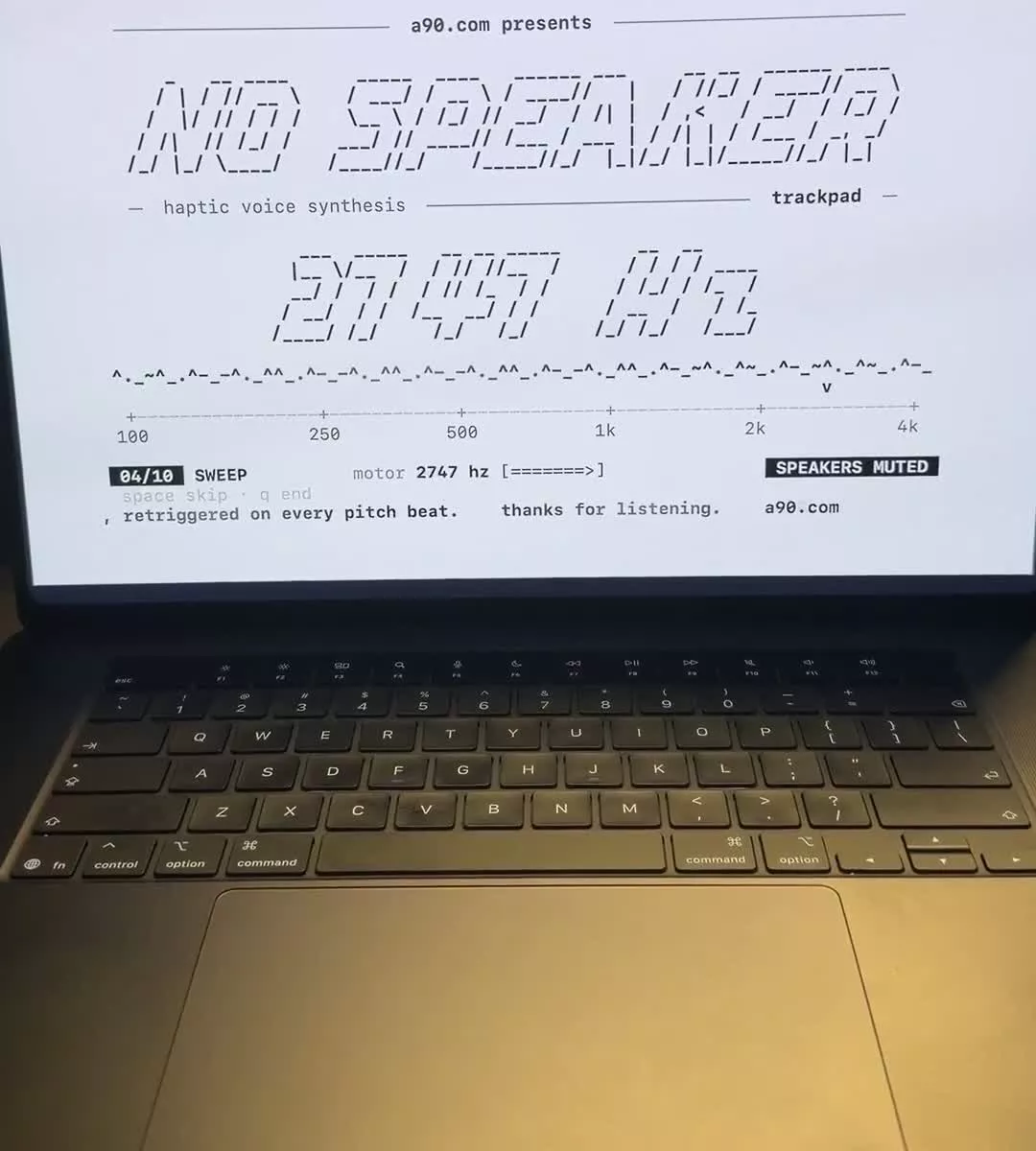
Developer Cody Collier recently released a demonstration video on the X platform. In the video, his MacBook reads text in a low, buzzing robotic voice, interspersed with electronic sound effects similar to chip music. This method of play will be familiar to anyone who has ever seen a floppy drive "play" an entire song, except this time, the sound-generating device is hidden in the trackpad under the user's palm.
To achieve this effect, Collier had to bypass Apple's regular interfaces for developers. Apple's public haptic feedback API only allows applications to trigger three fixed tactile modes, which is far from enough to accurately control audio output. Therefore, he developed an open source tool called No Speaker, which directly calls an undisclosed and undocumented MultitouchSupport framework in macOS, which can drive the trackpad motor at a frequency of up to 4,000 times per second.
Collier also tested the range of pitches the trackpad could emit and found that it could cover multiple semitones, from 98 Hz to nearly 4,000 Hz. Surprisingly, the touch panel glass surface can produce quite noticeable volume in most frequency bands, especially around 1000 Hz, where the sound is clearest.
Making the trackpad actually "speak" is more complicated. The tool first calls the built-in speech function of macOS to read the text into the memory; then it extracts the two strongest formants in the speech every 10 milliseconds, which are the resonance characteristics that determine the shape of the vowels. It also obtains the pitch and loudness information, and then the motor plays it out in pairs of tones. Consonants with hissing sounds like "s" and "f" are converted into rapid, high-frequency vibration pulses.
No Speaker is available for free download on GitHub. The tool requires a Force Touch trackpad, so in theory MacBooks from 2015 and later, as well as Magic Trackpad 2 or newer, should be compatible. However, Collier has only tested it on the MacBook Pro equipped with the M5 Max chip. He also recommends that users place the notebook on a desktop for use, as the sound will be significantly reduced when placed on the lap.
Collier said the tool does not push the haptic motors beyond their normal maximum strength, so there is no additional stress on the hardware. However, since MultitouchSupport is an undisclosed interface, any system updates to macOS may invalidate this function.
Interestingly, Microsoft seems to have already considered a similar direction. As previously reported, Microsoft applied for a touch panel patent in 2023, envisioning using the touch panel glass itself as a speaker diaphragm. The design plans to generate click feedback at frequencies below 400 Hz and play audio upward from that frequency, up to 10,000 Hz, much higher than No Speaker
Comments