
Abstract:
A new study of ancient human fossils reveals an important stage in human evolution that has long been overlooked. Researchers found that the Australopithecus, which lived about 2 million to 4 million years ago, did not abandon the arboreal life immediately after human ancestors began to walk upright. Instead, they retained both tree climbing and ground walking for a long period of time.
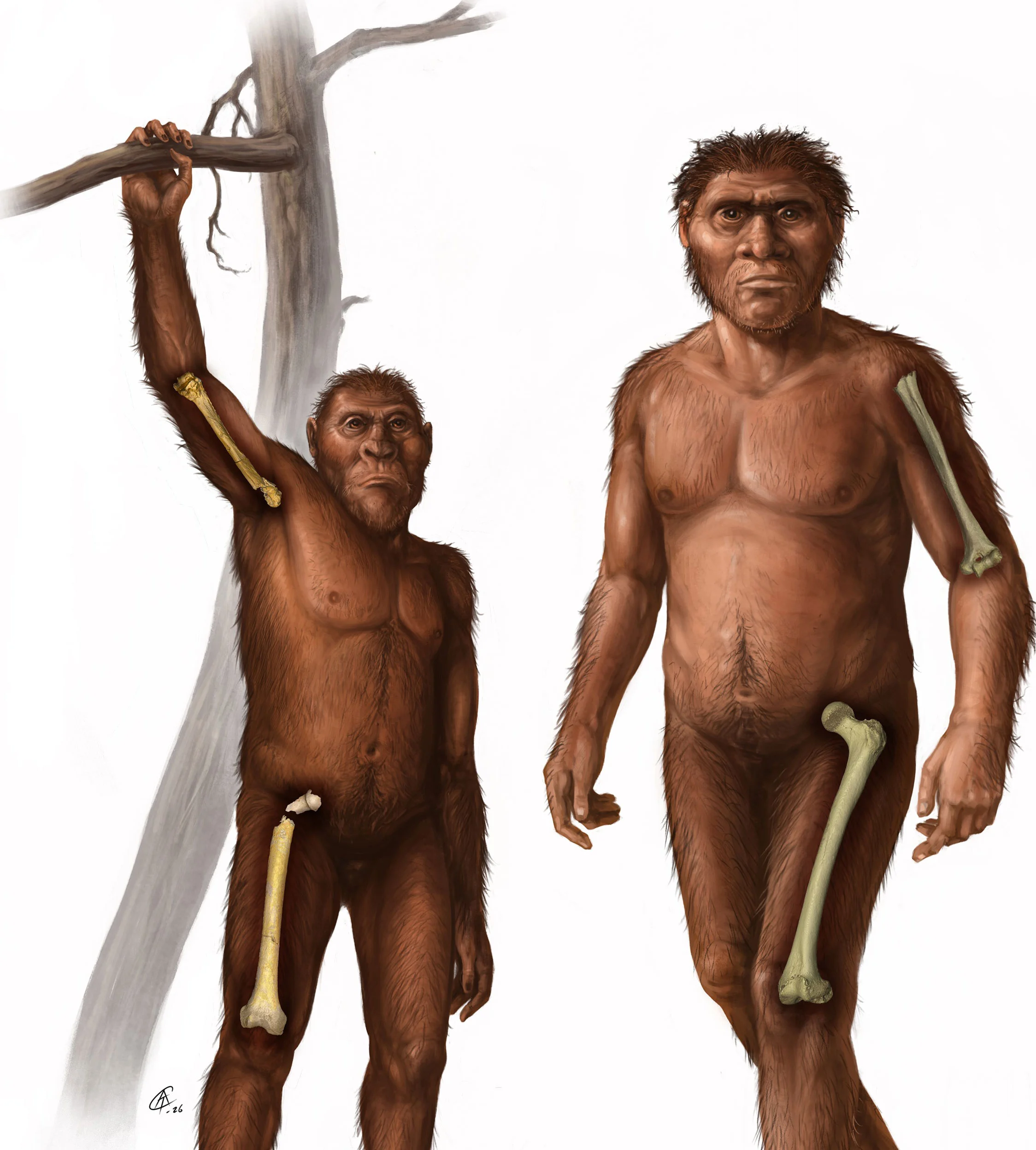
This research was completed by an international team led by the Keck School of Medicine of the University of Southern California, and the research results were published in Science Advances. The researchers analyzed the fossil remains of seven ancient human individuals from Australopithecus and its descendants, early members of the genus Homo, ranging in age from about 1.5 million to 3.7 million years ago.
Bipedalism has long been considered one of the most important features that distinguish humans from other great apes. However, the scientific community has been trying to answer a key question: When did human ancestors gradually transition from balancing activities in trees and on the ground to living almost entirely on the ground?
In order to find the answer, the research team did not simply study the appearance of the bones, but turned their attention to the strength of the bones themselves.
Researchers point out that bones continuously adjust their structure in response to the mechanical stress an individual endures over time, and therefore can record the daily activities of an organism. Animals that often climb trees tend to have stronger arm bones, while humans who walk upright on the ground tend to have stronger thigh bones.
To this end, the research team used CT scanning technology to conduct a detailed analysis of the internal structure of the fossil. They measured the thickness and internal tissue structure of the upper arm bones, femurs and tibias, and assessed the bones' ability to resist bending and twisting to reconstruct the movement habits of these ancient human ancestors.
The results show that early Homo, who lived about 1.8 million to 2.3 million years ago, already showed characteristics close to modern humans. Their thigh bones were significantly stronger than their arm bones, indicating that they mainly relied on the ground for walking and had greatly reduced their activities in the trees.
However, earlier Australopithecus showed a completely different pattern.
Researchers found that the arm bones of Australopithecus individuals, including the famous "Little Foot" fossil, were significantly stronger, indicating that they still frequently used their upper limbs for climbing activities. But at the same time, the force characteristics of its leg bones are very close to those of modern humans.
This discovery means that Australopithecus may have developed a unique movement pattern that no longer exists in the modern world.
They not only retain the strong ape-like upper limbs, which can move between trees, but also have the use of lower limbs close to modern humans, and can effectively walk on two feet. In other words, the emergence of upright walking does not mean the immediate end of arboreal life. The two behaviors have coexisted for a long time.
Kristian J. Carlson, leader of the research team and professor at Keck School of Medicine, said that the body combination of Australopithecus shows a very special movement strategy. Its characteristics are neither like modern humans nor any existing apes, so it is difficult to find direct modern reference objects.
Research further shows that a key turning point in human evolution may have occurred about 2 million years ago. When Australopithecus gradually evolved into the early genus Homo, its dependence on life on the ground increased significantly, while climbing behavior began to decrease significantly.
At the same time, this change in behavior coincided with other important evolutionary traits. Researchers pointed out that during this period, the brain size of human ancestors began to increase, their body proportions changed, and their ability to adapt to the terrestrial environment continued to increase.
The research team believes that this study provides new evidence for understanding the origin of human bipedal walking. In the past, people often regarded "walking" and "leaving trees" as the same process, but fossils show that this is not the case. At least millions of years ago, human ancestors lived for a long time between two worlds, both as climbers in the trees and as walkers on the ground.
The researchers said that this discovery not only gives people a new understanding of Australopithecus, but also further illustrates that human evolution is not a simple linear process, but has gone through a complex and long transitional stage. Before becoming a "terrestrial creature" in the true sense, human ancestors had a unique lifestyle that combined two ways of survival.
Comments