
Abstract:
According to a report in Nature magazine on November 2, ultra-fine neural probes called Neuropixels are changing the way scientists study the brain. This device, which is thinner than a human hair, can record the electrical activity of hundreds of neurons simultaneously, allowing researchers to observe the information processing process inside the brain with unprecedented precision. At present, this technology has gradually entered human brain research from animal experiments.
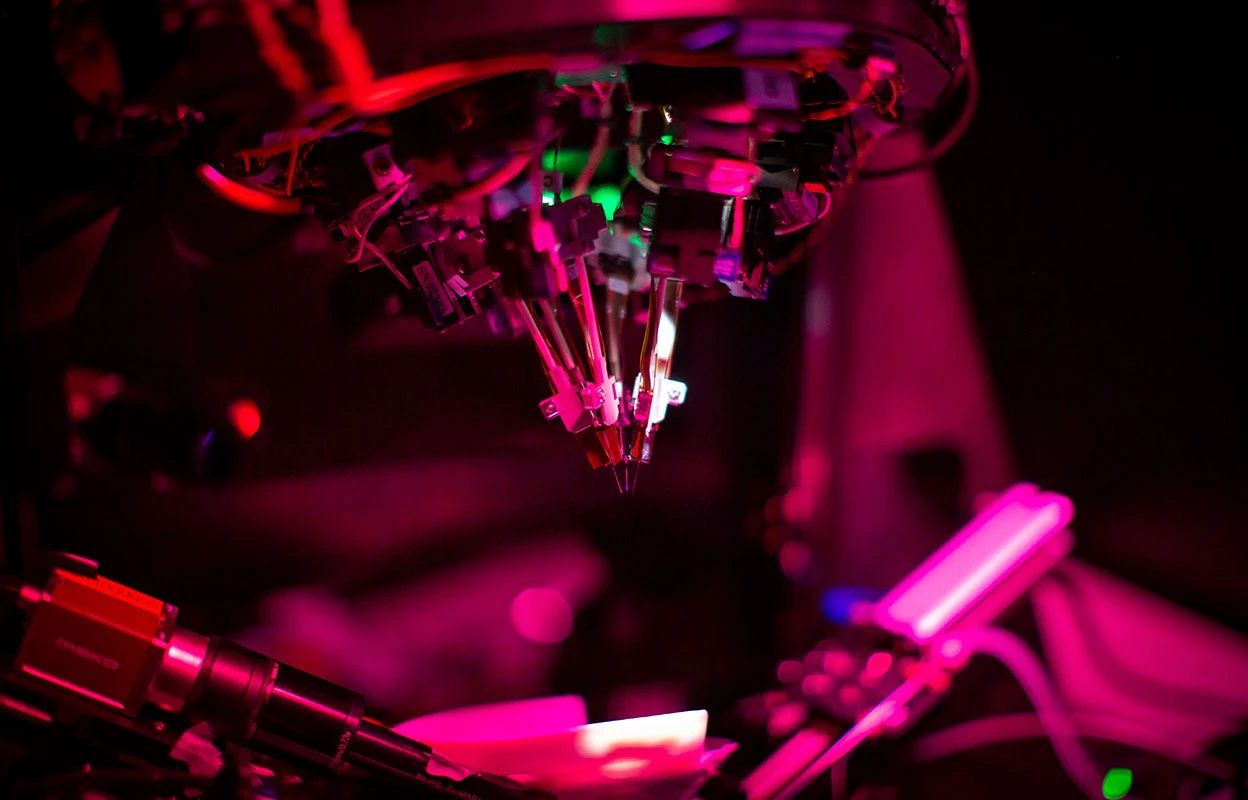
In an operating room at a London hospital, scientists are trying to "listen" directly to the human brain.
A female patient underwent shunt surgery for normal pressure hydrocephalus at the National Hospital of Neurology and Neurosurgery in London, UK. During the operation, she agreed to participate in a special experiment: the doctor briefly inserted a Neuropixels probe, about 1 centimeter in length and thinner than a hair, into the brain to record the electrical signals of neurons in real time.
The researchers then played a series of words to the patients, including "blind spot," "parking spot," and "piggy bank," to see how the brain processed the transitions between different words and how the frequency and familiarity of the words affected neural activity.
As the sound rang in the operating room, the nerve signal waveform on the monitoring screen changed significantly. This means that researchers have been able to capture the human brain's real-time response to external language stimulation through probes.
In the past, although scientists were able to use electroencephalography or implanted electrodes to monitor human brain activity, they often could only obtain signals produced by a large number of neurons, making it difficult to distinguish what individual neurons were doing.
Pierre Bourdillon, a neurosurgeon at the Rothschild Foundation Hospital in Paris, France, used a vivid metaphor to explain the breakthrough of this technology.
Traditional EEG monitoring is like placing a microphone at a busy intersection and trying to distinguish each person's conversation from the jumble of sounds. Neuropixels is closer to installing microphones on each person's collar to hear the voices of different individuals.
“We’re just starting to get to the point where we can have individual microphones for everyone,” he said.
The key breakthrough of this technology is that it allows scientists to observe the activity of large numbers of individual neurons simultaneously.
Neuropixels was first launched in 2017 and was developed in cooperation with institutions such as the Howard Hughes Medical Institute Janelia Research Park in the United States and the Belgian Microelectronics Research Center (Imec).
The first-generation Neuropixels probe has 960 recording sites, 384 of which can read signals simultaneously. Its silicon probe body is as thin as a hair and is connected to a chip about the size of a Nano SIM card, which is responsible for reading, amplifying and digitizing neural signals.
In early animal experiments, scientists implanted two probes into the brains of mice and successfully recorded approximately 700 neurons distributed in 5 brain regions at the same time.
Neuropixels 2.0, launched in 2021, further improves the recording capabilities, with 5120 recording sites, 1536 of which can be read simultaneously, and the device has become lighter.
Using a new generation of technology, scientists have been able to record tens of thousands of neurons simultaneously in mouse brains, and in some experiments, track them for months.
This means that researchers can no longer only observe the activity of a local area of the brain, but can instead study how different brain areas work together.
In 2025, an international collaborative research achieved larger-scale results.
Twelve laboratories from the United States and Europe jointly conducted research, using Neuropixels technology to record the activities of more than 620,000 neurons in 279 brain regions in 139 mice, and draw a map of whole-brain neural activity involving functions such as vision, movement, and decision-making.
Research has found that
neural signals related to sensation, cognition and movement may be more widely distributed in the brain than previously thought.
This provides an important basis for scientists to re-understand the brain's information processing mechanism.Today, Neuropixels has been used by about 1,700 laboratories around the world, and the research subjects cover more than 20 animals, including mice, zebra finches, bearded dragon lizards, and even octopuses.
In primate research, the technology has also brought about significant changes.
Tirin Moore, a neuroscientist at Stanford University, said that before the advent of Neuropixels, researchers could usually only record the activity of about 20 primate neurons a day, even if their experiments went well. Today, they are able to routinely record from at least 100 neurons.
Moore believes that without such tools, primate neuroscience research will remain severely limited.
Currently, the Stanford University research team plans to use Neuropixels to draw high-resolution neural activity maps of the macaque visual system to further understand how the brain processes visual information.
It is worth noting that
Neuropixels are not exactly the same as implantable devices for brain-computer interface applications.
Its current main use is in basic neuroscience research, helping scientists understand processes such as sensation, movement, cognition and decision-making by recording neuron activity. Although related research may provide a basis for future brain-computer interface technology and neurological disease research, this does not mean that Neuropixels has mature clinical treatment capabilities.
"Nature" pointed out that Neuropixels are pushing neuroscience into a new stage: scientists can not only observe whether different areas of the brain are active, but also further study how individual neurons participate in complex information processing.
From mice to primates to human operating rooms, this hair-thin probe is helping scientists explore the working mechanism of the human brain with higher precision.
Comments