
Abstract:
The 2026 Nobel Prize in Physiology or Medicine is awarded to Karl Deisseroth, Peter Hegemann and Georg Nagel for their "
discoveries in light-controlled ion channels and optogenetics
".
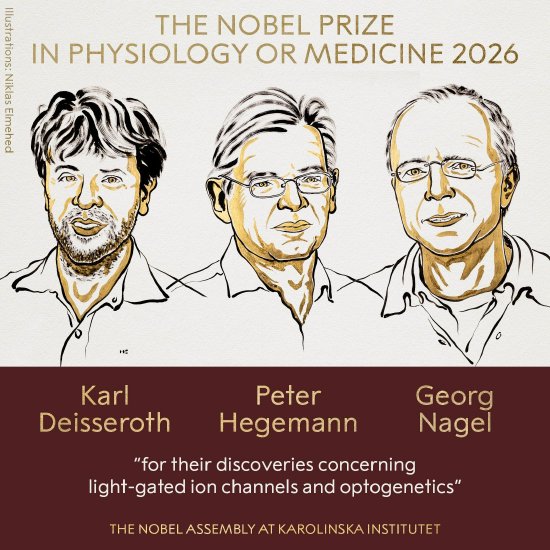
The work of the three people jointly laid the foundation for optogenetics, a core technology of modern neuroscience. It allows researchers to use light to precisely control specific nerve cells in the brains of living animals, allowing them to directly observe how these neurons influence memory, mood, behavior and body function.
This technology solves a long-standing core puzzle in neuroscience. In the past, although researchers were able to observe whether a certain brain area was active when a specific behavior occurred, it was difficult to further prove whether this activity was the direct cause of the behavior. Optogenetics changes this: researchers can actively turn on or off specific nerve cells and then observe whether the animal's behavior changes accordingly, moving from correlational research to causal verification.
The entire breakthrough originally came from a single-celled green algae. Peter Hegemann has long studied why Chlamydomonas is able to swim towards light sources. In the early 2000s, he and Georg Nagel discovered a special protein located on the cell membrane of algae-channelrhodopsin. This protein has a key property: When illuminated by blue light, ion channels in the protein open, allowing charged ions to flow into the cell and generate electrical signals. More importantly, the two discovered that even if the protein is put into other cells, these cells that were not originally light-sensitive can become light-responsive.
This step provides the core "switch" of optogenetics.
The person who really brought this molecular tool into neuroscience was Karl Deisseroth. Deisseroth introduced the gene encoding channelrhodopsin into rat nerve cells. In 2005, he showed that he could trigger neural signals simply by shining blue light on these cells. Two years later, this method was further implemented in the brains of living mice. Researchers will now be able to use light to directly control specific neurons in living animals and observe how the corresponding behavior changes.
This method of controlling neural signals with light came to be known as "optogenetics." It has quickly become one of the most important experimental tools in neuroscience. Using optogenetics, researchers have been able to identify neural circuits that control specific memories, emotions, and behaviors and further study how these circuits relate to neurological and psychiatric disorders.
The Nobel Committee believes that
this technology allows researchers to map brain function in ways previously unimaginable
.The significance of optogenetics is not limited to basic research. In clinical medicine, researchers have tried to use similar principles to restore visual function in some visually impaired patients. Related research hopes to bypass the damaged natural photoreceptor system by giving retinal cells new light-sensitive abilities.
Therefore, the three winners actually completed a complete technological chain:
Hegemann and Nagel discovered ion channels that can be directly opened by light, while Deisseroth transformed this molecular mechanism naturally present in algae into a tool for controlling nerve cells.
From initially studying why algae swim toward light, to later being able to use light to control neurons in living brains, this work ultimately spawned a whole new field of research.The Nobel Committee believes that optogenetics has fundamentally changed the way humans study the brain and established a new experimental basis for understanding the neural mechanisms behind memory, emotion and behavior.
Karl Deisseroth was born in 1971 and currently works at the Howard Hughes Medical Institute and Stanford University; Peter Hegemann was born in 1954 and is currently the Hertie Senior Professor of Neuroscience at Humboldt University in Berlin; Georg Nagel was born in 1953 and is currently a professor of molecular plant physiology at the University of Würzburg.
Comments