
Abstract:
On November 3, according to the latest analysis from market research firm Counterpoint Research, Volkswagen is implementing a global technology strategy adjustment: on the one hand, it is cooperating with NXP (NXP) to promote a globally unified electronic and electrical architecture, and on the other hand, it is establishing a local technology system with greater autonomy in China. This means that Volkswagen is adopting a technology "dual-track system" to respond to the different needs between large-scale operations in the global market and rapid iteration in the Chinese market.
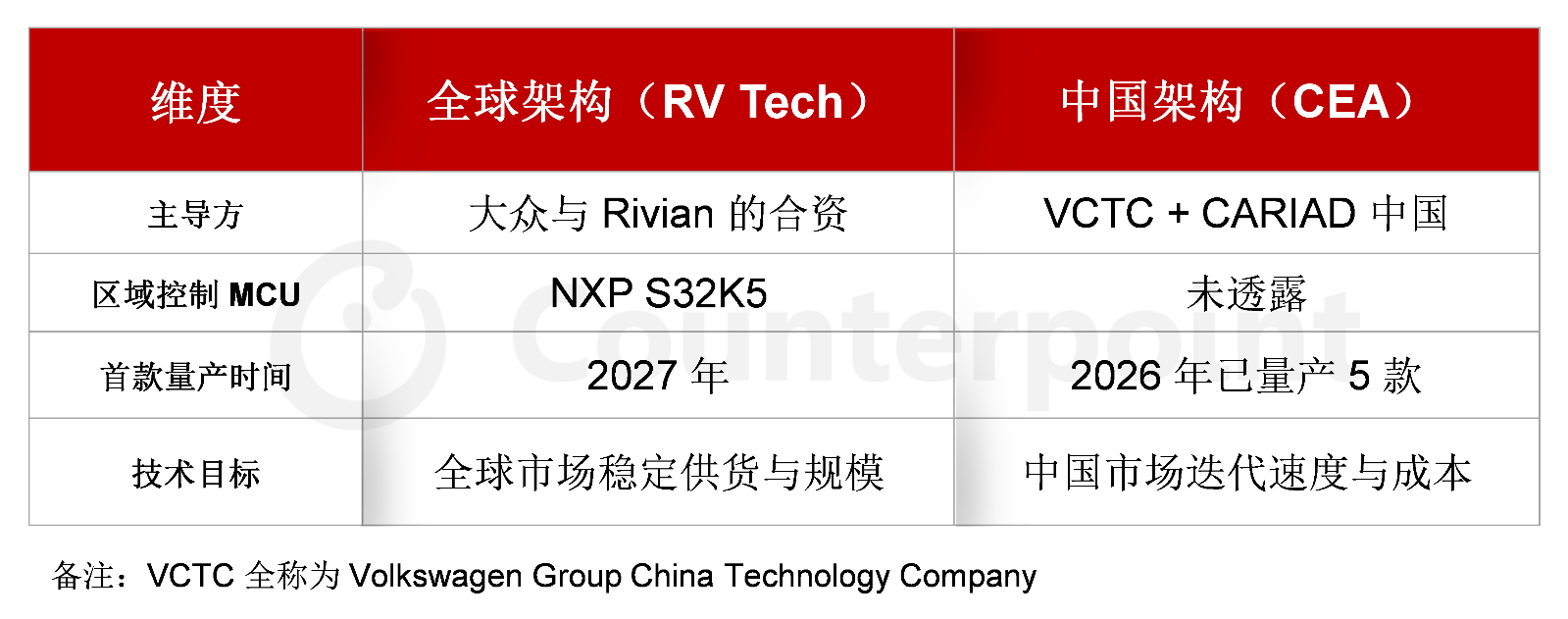
On October 26, Volkswagen and NXP reached a strategic cooperation and plan to use S32K5 series microcontrollers as regional control modules, covering multiple brands and models of the group. The first model equipped with related technologies is planned to be launched in 2027.
Just two days later, Volkswagen held its first Tech Day in China and released a local technology system called VEGA, covering the three major areas of vehicle platform, electronic and electrical architecture, and advanced driver assistance systems (ADAS).
Counterpoint Research believes that these two decisions may seem contradictory, but actually reflect Volkswagen's redistribution of dominance in global technology research and development:
The global architecture pursues scale and stability, while the Chinese architecture prioritizes development speed and market adaptability.
This strategy also means higher operating costs. The parallel operation of two technical systems will increase investment in verification testing, supply chain management and software maintenance. There is still uncertainty about whether the two architectures will be gradually integrated in the future and which architecture will dominate.
Volkswagen China’s R&D efficiency has been greatly improved, with software testing shortened from three days to two to three hours.
At this Tech Day, Volkswagen focused on demonstrating the progress of China's local R&D system. Among them, the AI tool chain C-Brain developed based on China Electronics and Electrical Architecture CEA has become an important means to improve R&D efficiency.
Data disclosed by Volkswagen show that with the help of C-Brain, the software functional testing cycle has been shortened from the original
3 days to 2 to 3 hours
, software problem diagnosis time is reduced from2 weeks to 20 minutes
.Counterpoint Research pointed out that although these figures cannot directly represent the improvement in overall R&D efficiency, they reflect that Volkswagen is changing its past model of relying on a unified global R&D process.
In the opinion of the agency, the significance of VEGA lies not only in the launch of a technical system, but also in the fact that Volkswagen has begun to hand over more research and development decisions on vehicle platforms, electronic and electrical architecture, and intelligent driving systems to Chinese teams to shorten technology development and product iteration cycles.
In terms of electronic and electrical architecture, CEA is an important part of Volkswagen China's technology system, but it is not completely independently developed.
In April 2024, Volkswagen and Xpeng Motors signed a strategic cooperation framework agreement on electronic and electrical architecture, clearly establishing joint development based on Xpeng's latest generation EEA 3.0 electronic and electrical architecture. Volkswagen emphasized that CEA was jointly developed by Volkswagen (China) Technology Co., Ltd. (VCTC), CARIAD China and Xpeng Motors.
Counterpoint Research believes that CEA integrates Xpeng's electronic and electrical architecture technology, Volkswagen's functional safety and verification system, and the localized engineering development is completed by Volkswagen's China R&D team.
It is worth noting that as Xpeng’s electronic and electrical architecture evolves to EEA 4.0 in 2026, Volkswagen CEA 1.0 also faces the problem of how to continue to upgrade and narrow the generational differences in technology.
However, the agency believes that
a more important change for Volkswagen than which generation of technology is adopted is the delegation of some architectural definition rights and technology selection rights to the Chinese team.
This means that the Chinese R&D department is not only responsible for localization adaptation, but also can participate more deeply in the formulation of the underlying technical route.In the field of intelligent driving chips, Volkswagen has also adopted a multi-route parallel strategy.
Counterpoint Research pointed out that Volkswagen has laid out three ADAS chip technology routes in China, including promoting self-developed chips through the joint venture CoreCheng established with Horizon.
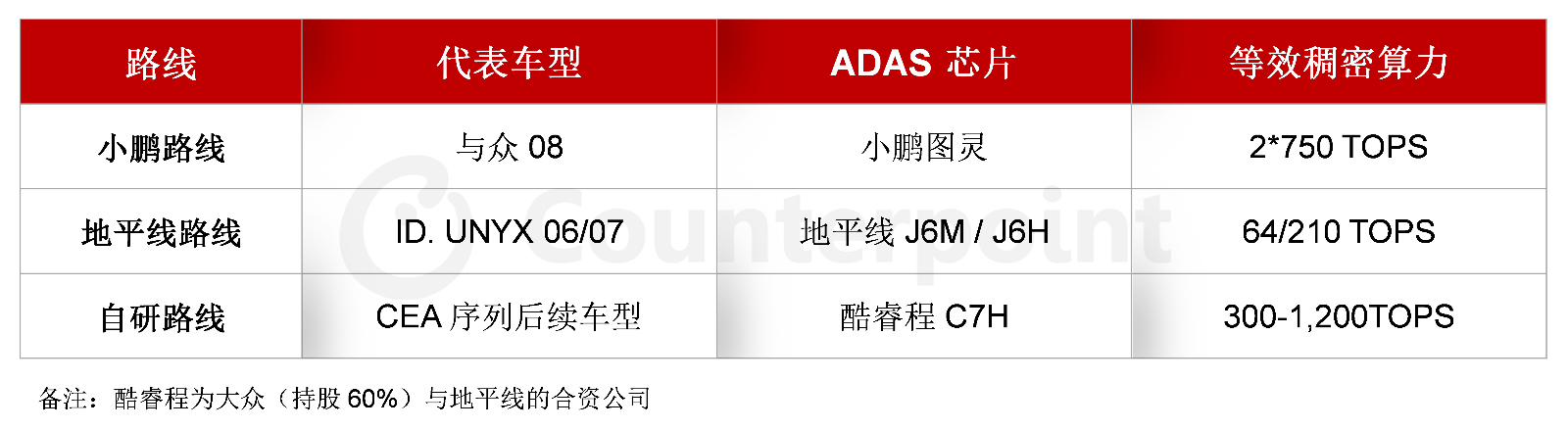
According to the information disclosed by the agency, CoreCheng is developing the C7H system-on-chip (SoC) code-named Nash Architecture, and plans to
mass production in 2028
.Counterpoint Research specifically pointed out that C7H is not a chip product licensed directly from Horizon IP. Horizon mainly plays the roles of joint venture shareholder, AI basic model technology provider and chip supply chain partner.
For Volkswagen, one of the important goals of self-developed chips is to reduce dependence on external suppliers and reduce the cost of high value-added technology through internal development.
Counterpoint Research believes that this reflects the changes taking place in the automotive industry: car companies are no longer satisfied with purchasing standardized chips provided by suppliers, but hope to have more chip definition rights to meet the performance, cost and product differentiation needs of their own intelligent driving systems.
In addition to the technical architecture and chips, Volkswagen also announced its technical plan for higher-level autonomous driving.
At Tech Day, Volkswagen stated that it plans to
have L3 autonomous driving technology ready by 2027
.However, Counterpoint Research reminds that technology readiness does not mean that relevant functions will be officially commercialized for Chinese consumers in 2027.
The agency pointed out that technical preparation, road test approval and market access for individual users belong to different stages. Combined with China's autonomous driving-related regulations and market access process, it predicts that China's L3 autonomous driving for individual users may be commercialized as early as 2029.
In addition, Volkswagen also plans to apply the technology system developed in China to more overseas markets, including promoting the CMP platform integrating CEA architecture to South America, Africa, Southeast Asia and other regions.
Counterpoint Research believes that this layout is mainly to use the advantages of China's R&D system in cost control and development efficiency to meet the product needs of emerging markets.
However, the supplier of the regional control microcontroller used in Volkswagen's CEA architecture has not yet been made public. Whether China's local chips will be used in the future will also affect the extent to which China's automotive electronics supply chain participates in Volkswagen's global product system.
Counterpoint Research concluded that the core of Volkswagen's technology strategy adjustment is not only to establish a local R&D system in China, but also to redistribute technology decision-making power within the group.
In the past, Volkswagen mainly relied on its German headquarters to lead global technology development, and the Chinese team was responsible for local adaptation; now, the Chinese team is gaining more choices in underlying architecture, chips and intelligent driving technology.
But whether this adjustment can be successful remains to be seen. The long-term parallelization of two sets of technology systems will bring additional costs. Whether the technology developed by the Chinese team can form a scale advantage, and whether it will reversely affect Volkswagen's global technology route in the future, will become questions that Volkswagen needs to answer in the next stage.
Comments